
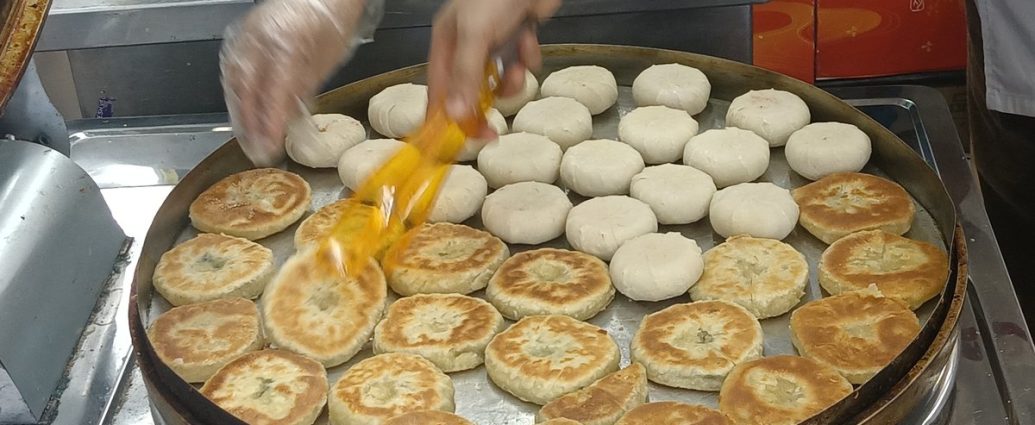
Scallion Pancake (葱油饼) is the king of Chinese street food — a crispy, flaky, layered flatbread studded with fresh scallions and pan-fried to golden perfection. With its shatteringly crisp exterior and soft, chewy interior, it is the perfect accompaniment to any meal or a satisfying snack on its own, especially dipped in black vinegar and chili oil.
The genius of 葱油饼 is lamination without butter. Where French pastry builds layers by folding butter into dough, the Chinese version uses a simple trick: hot-water dough rolled thin, brushed with scallion oil, coiled into a spiral, and rolled flat again. That coil is what creates the layers — each turn of the spiral becomes a separate sheet, and when the pancake hits the pan, the moisture between them turns to steam and pushes them apart. It is one of the great cheap inventions of Chinese cooking, sold from street carts and breakfast stalls across the country for a few yuan.
This recipe comes from a street vendor in Shanghai whose scallion pancakes draw queues around the block. His secret: a “roughed” dough that creates hundreds of thin layers, each one trapping steam that makes the pancake puff and flake.
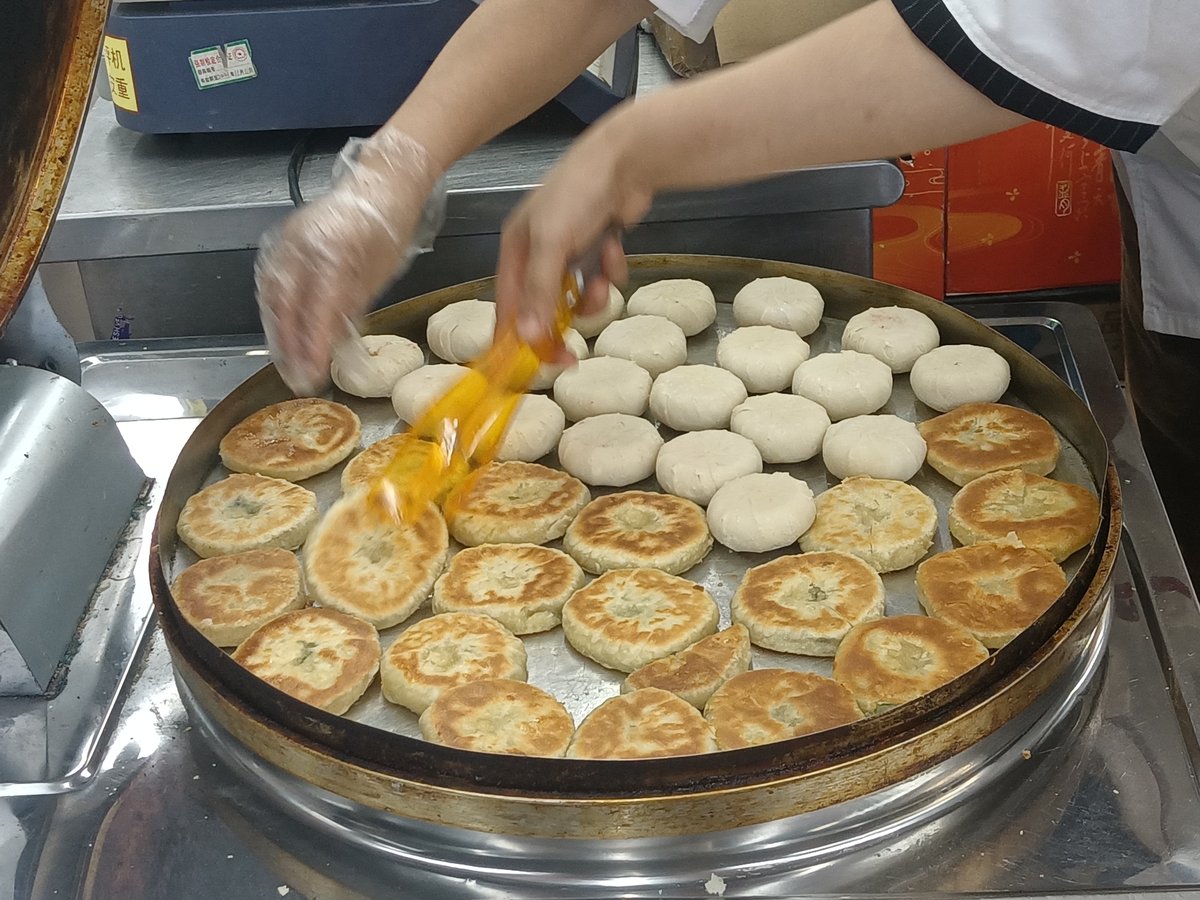
Hot Water Dough and the Coil
Two techniques make this pancake what it is. Hot water dough: pouring boiling water over the flour partially gelatinizes the starch, which softens the gluten and produces a dough that is tender and slightly chewy rather than elastic and bready. It also means no yeast and no rising — the dough is ready in fifteen minutes. The coil: after rolling the dough into a thin sheet, brushing it with scallion oil, and scattering scallions, the sheet is rolled into a long rope and then coiled into a snail shape. Flattening that coil produces dozens of alternating layers of dough and oil. That is the entire secret of flakiness, and it costs nothing.
Getting the Crisp
- Scallion oil, not raw scallions alone — heat oil with scallion whites until fragrant, then use that oil to brush the dough; it distributes the flavor into every layer
- Roll thin, then coil tight — thin sheets mean more layers; a tight coil keeps them from merging
- Rest the coiled dough 15 minutes before the final flattening so the gluten relaxes and it does not spring back
- Pan-fry in a generous amount of oil — shallow-frying, not dry-frying, is what gives the shattering crust
- Press with a spatula as it cooks — this compresses the layers and increases contact with the hot pan
Ingredients and Where to Find Them
- All-purpose flour — all-purpose flour, plus boiling water for the dough
- Sesame oil — toasted sesame oil, brushed over the dough with the scallion oil
- Chinkiang black vinegar — Chinkiang vinegar for the classic dipping sauce
Also needed: scallions (a generous bunch), salt, white pepper, and a neutral oil for frying. That is the whole list — this is a dish of technique, not ingredients.
How to Make It
- Mix 300g (2.5 cups) flour with 1/2 teaspoon salt; pour in 200ml boiling water and stir with chopsticks, then knead 5 minutes into a smooth dough; rest 30 minutes covered
- Make scallion oil: heat 4 tablespoons oil with the whites of 6 scallions until fragrant; cool and strain, reserving the oil
- Divide the dough into 4 pieces; roll each into a thin rectangle, about 2mm thick
- Brush generously with scallion oil, sprinkle with salt, white pepper, and a handful of chopped scallion greens
- Roll the sheet into a long rope, then coil it into a spiral; tuck the end underneath
- Rest 15 minutes, then flatten each coil with your palm and roll gently into a 15cm round
- Shallow-fry in 1cm of oil over medium heat for 3 minutes per side, pressing with a spatula, until deep golden and crisp; drain and cut into wedges
Variations
- With egg — crack an egg over the pancake in the pan and spread it before flipping; a popular street version (蛋饼)
- With five-spice — add 1/4 teaspoon five-spice powder to the oil for a warmer, more aromatic pancake
- With lard — traditional vendors use lard instead of oil for the brush; it produces an even flakier result
- Freezer version — flatten the coils, freeze between parchment sheets, and pan-fry from frozen, adding 2 minutes per side
Frequently Asked Questions
Why did my scallion pancakes turn out hard instead of flaky?
Usually the dough was overworked or the coil was too loose. Knead just until smooth, rest the dough thoroughly, and roll the sheet thin before coiling it tightly — the layers come from the coil, not from kneading. Also make sure the pan is hot enough and there is enough oil for shallow-frying.
Can I make them ahead?
Yes. Flatten the coiled pancakes, stack them with parchment between, and refrigerate up to 3 days or freeze up to 2 months. Cook straight from frozen, adding a couple of minutes per side.
What dipping sauce goes with scallion pancakes?
The classic combo is 2 parts Chinkiang black vinegar to 1 part soy sauce, with a drizzle of chili oil and a pinch of sugar. Some also add grated ginger or minced garlic.
Why use boiling water instead of cold water?
Hot water partially cooks the flour, gelatinizing the starch and softening the gluten. The result is a dough that is tender and slightly chewy rather than elastic — the texture you want for a flatbread that will be rolled thin and layered. Cold-water dough would spring back and turn tough.
More Chinese Snacks & Street Food
Love crisp, hand-held Chinese food? Try my Potstickers 锅贴, the crispy Ham Sui Gok 咸水角, or the classic Spring Rolls 春卷.
As an Amazon Associate, I earn from qualifying purchases. These are affiliate links at no extra cost to you.
1 Comment