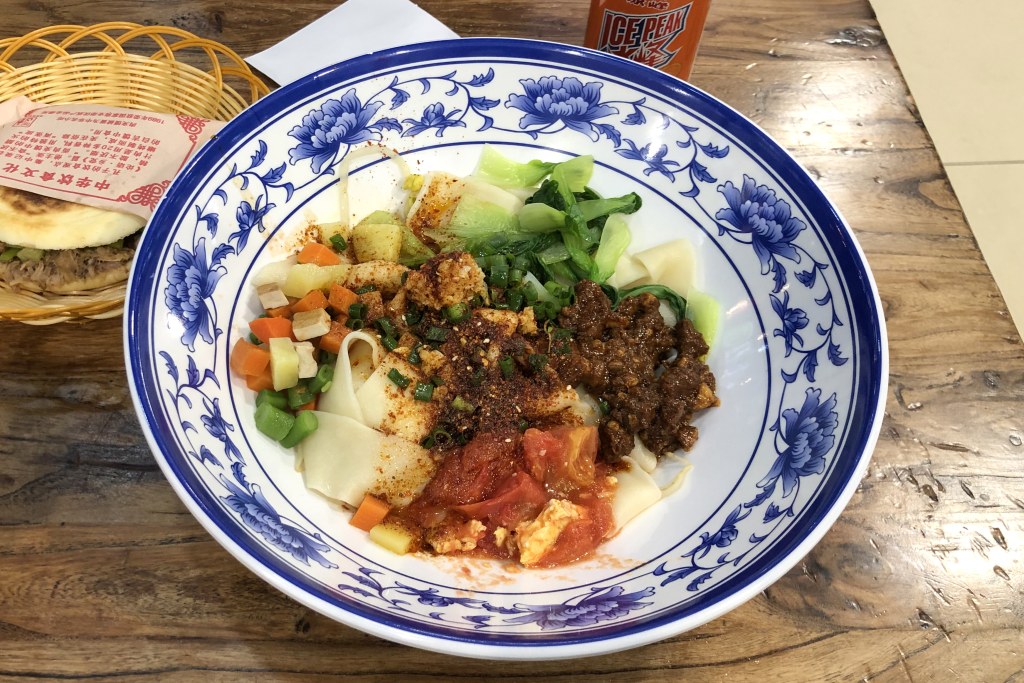
biangbiang面 is the noodle dish with the name nobody can write. Each noodle is a single belt of dough — as wide as three fingers, as long as your arm — slapped against the counter until it stretches, then dropped into boiling water and dressed with chili, garlic and a pour of smoking oil. One noodle fills a bowl.
It comes from Shaanxi, and it is the most theatrical thing in Chinese street food: the slapping is not a gimmick, it is how the noodle is made, and it is where the name comes from.
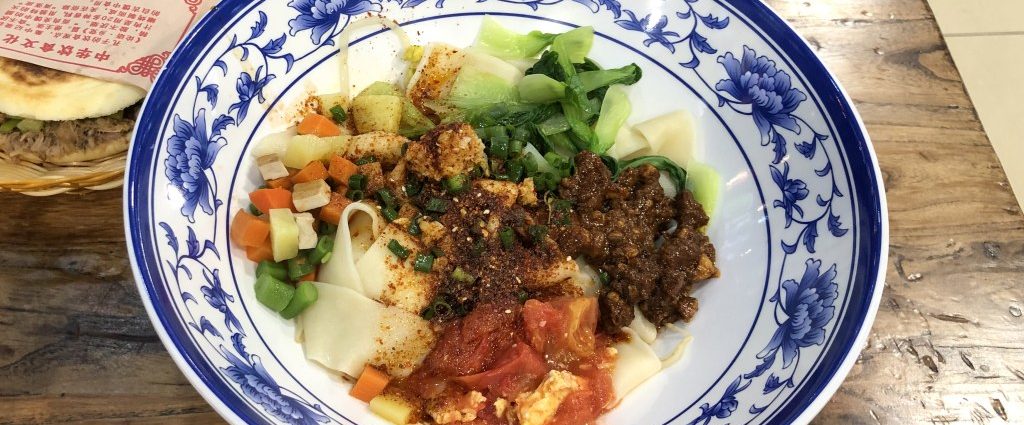
biangbiang面 are very wide, thick hand-pulled belt noodles from Shaanxi province, made by slapping and stretching a rested dough against the counter. They are usually served 油泼 — topped with coarse chili flakes, minced garlic and scallion, then hit with smoking-hot oil that blooms the chili — and finished with black vinegar and soy. The name is onomatopoeia for the slapping sound. It is not the same as 油泼面: 油泼 describes the dressing, biangbiang describes the noodle.
The Name Is a Sound, Not a Word
“Biang biang” does not mean anything. It is the noise the dough makes when a cook lifts a strip of it and slaps it down on the work surface — biang, biang — over and over, stretching it a little further each time. The dish is named after its own preparation.
That is unusual enough, but it is nothing compared to what happens when you try to write it down.
The Character Nobody Can Type
The character for biáng is, by most counts, 58 strokes — the most complex Chinese character in common use anywhere. It is not a character you learn; it is a character you memorise as a rhyme. One common version of the mnemonic walks you through the components in order, and the character is built from parts that each mean something: 穴 (cave), 月 (moon), 馬 (horse), 心 (heart), 言 (speech), 刂 (knife), 辶 (to walk).
The practical consequence is that for most of its history the character could not be typed at all. It was added to the Unicode standard only in 2020, which means that until very recently the only way to write the name of the dish on a phone was to write it in pinyin — biangbiang面 — exactly as this page does. In Shaanxi you will still see it painted by hand on shop signs, and nowhere else.
Noodles Like a Belt
Shaanxi has a well-known list of local oddities — 陕西八大怪, the “eight wonders of Shaanxi” — and two of them describe this dish directly. The first is 面条像裤带: noodles like a belt strap. The second is 辣子是道菜: chili is a dish, not a seasoning. biangbiang面 is both at once.
The width is not decoration. A wide noodle has more surface for the chili and oil to cling to, and a thicker one keeps its chew after boiling. There is also a practical reason: a soft, heavily rested dough can be stretched very wide without tearing, so the cook gets a dramatic noodle out of nothing but flour, water and time.
Ingredients and Where to Find Them
- Plain flour — 400g of all-purpose flour; bread flour is too strong for this dough
- Coarse chili flakes — 辣椒面, the coarse kind, not fine cayenne
- Black vinegar — Chinkiang black vinegar, for the finish
Also needed: salt, water, neutral oil, garlic, scallions, light soy sauce, a pinch of ground Sichuan pepper, and a handful of greens — bok choy or bean sprouts — to blanch alongside the noodles.
Prep: A Soft Dough and a Long Rest
Everything about this dish depends on the dough being soft and rested. A stiff dough will tear the moment you try to slap it.
- Mix 400g of flour with 1 teaspoon of salt. Add about 210ml of water — a little at a time — and knead for 10 minutes into a soft, slightly tacky dough
- Cover and rest 30 minutes, then knead briefly again until smooth
- Divide into 8 pieces. Roll each into a short log, coat generously with oil, and lay them on an oiled tray without touching
- Cover and rest at least 1 hour, ideally 2. This is the step people skip, and it is the reason their noodles break. The gluten needs time to relax
Cook: Slapping and Pulling
- Bring a large pot of water to a rolling boil and salt it
- Take one oiled log and flatten it with your palm into a rough oval
- Press a groove down the centre with a chopstick or the side of your thumb — this becomes the tear line
- Hold both ends and lift. Slap the strip down on the counter, then pull gently as it lands. Repeat: slap, stretch, slap, stretch
- Keep going until the noodle is as wide as three fingers and roughly a metre long. The slapping is what stretches it evenly
- Tear along the centre groove to make two noodles, or leave it whole for one dramatic belt
- Drop into the boiling water and cook 2–3 minutes. It is done when it floats and the thickest part is opaque but still chewy
- Blanch the greens in the same water for 30 seconds and lift everything into a bowl
The Oil Splash
This is the part that makes the dish, and it takes ten seconds.
- On top of the hot noodles put 2 tablespoons of coarse chili flakes, 1 minced garlic clove, a sliced scallion, a pinch of ground Sichuan pepper and a little salt
- Add 1 tablespoon of light soy sauce and 1 tablespoon of black vinegar around the edge of the bowl
- Heat 3 tablespoons of neutral oil in a small pan until it is just smoking — a wisp of smoke, not a haze
- Pour it directly over the chili and garlic. It should hiss violently and smell toasted within a second
- Toss immediately, before the chili settles, and eat at once
Troubleshooting: Why Your Noodles Tear
- The dough snaps when you slap it — it was not rested long enough, or it is too stiff. Rest it longer and add water until it is soft and slightly tacky
- The noodles are rubbery and tough — too little water in the dough, or they were undercooked. This dough wants to be soft, and the noodles want a full 3 minutes
- They stick together in the pot — not enough oil when resting, or too many in the water at once. Cook two at a time
- The chili tastes raw instead of toasted — the oil was not hot enough to bloom it. It needs to be at the first wisp of smoke
- The chili tastes burnt and bitter — the oil went past smoking. Take it off the heat the moment it smokes, and pour straight away
How to Serve It
One bowl per person, one or two noodles each, eaten immediately — the noodles lose their chew as they sit. Serve it as a street-food meal in its own right, or alongside the other Shaanxi classics: Rou Jia Mo 肉夹馍, the braised pork “burger” that is the province’s other great export, and Liang Pi 凉皮, the cold noodle that shares its chili-and-vinegar logic.
Frequently Asked Questions
What does “biang biang” mean?
Nothing — it is onomatopoeia. It imitates the sound of the dough being slapped against the counter while it is stretched. The dish is named after the noise it makes.
How many strokes is the biang character?
Usually counted at 58, which makes it the most complex Chinese character in common use. It was only added to the Unicode standard in 2020, so most people write the name in pinyin instead.
Is biangbiang the same as 油泼面?
Not quite. 油泼面 (“oil-splashed noodles”) describes the dressing — chili and aromatics hit with hot oil. biangbiang describes the noodle itself: the wide, hand-slapped belt. Most biangbiang面 is served 油泼, which is why the two get confused.
Can I make it without slapping the dough?
You can roll it out with a rolling pin, and it will taste fine — but you will not get the same texture, because slapping stretches the gluten unevenly in a way rolling does not. The slap is the recipe.
More Street Food Favorites
If you like noodles with real chew, try Dan Dan Noodles 担担面, Chongqing Small Noodles 重庆小面 and Suan La Fen 酸辣粉 — or go back to breakfast with Youtiao 油条 and Scallion Pancakes 葱油饼.
Photo: N509FZ via Wikimedia Commons, CC BY-SA 4.0. Adapted by resizing.
As an Amazon Associate, I earn from qualifying purchases. These are affiliate links at no extra cost to you.