Scallion Oil Noodles (葱油拌面), known as Cong You Ban Mian in Chinese, is a beloved Shanghai home classic — springy wheat noodles tossed in a fragrant scallion-infused oil, with a splash of soy sauce for that perfect salty-sweet balance. Despite having only four ingredients, it is one of the most satisfying noodle dishes you will ever eat. Here is the authentic way to make it.
Scallion oil noodles is a Shanghai-style dish of cooked wheat noodles tossed with scallion-infused oil, light soy sauce, and dark soy sauce. The scallions are slowly fried until deep golden, infusing the oil with a sweet, savory aroma that coats every strand of noodle.
葱油拌面 is the taste of an ordinary Shanghai morning. It is a 本帮菜 (Shanghai local cuisine) staple — the food of neighborhood noodle shops, where a bowl costs almost nothing and arrives within minutes. Its economy is the point: scallions are cheap, oil is cheap, noodles are cheap, and the dish turns them into something that tastes far richer than it is. Shanghai home cooks often keep a jar of 葱油 (scallion oil) in the kitchen, made in a big batch and used for weeks — for noodles, for tossing with rice, for finishing vegetables. It is one of the most useful condiments in Chinese cooking, and it costs about fifteen minutes to make.
This recipe comes from a Shanghainese home cook who taught me the one rule that makes or breaks this dish: the scallions must be fried LOW and SLOW until they turn a deep amber color — nearly caramelized. Rushing this step leaves the oil flat and bitter; doing it right creates the unmistakable sweet-savory fragrance that defines this noodle bowl.
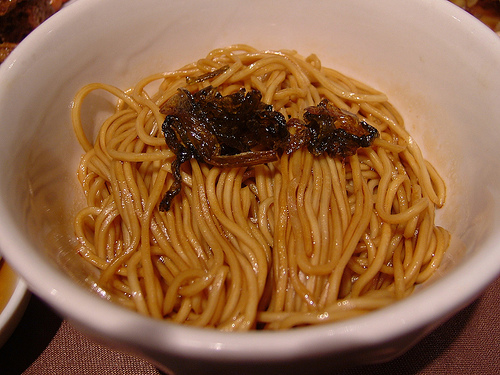
Low and Slow: The Whole Recipe in One Step
Everything about this dish depends on how the scallions are fried. Cut into lengths and dropped into oil over medium-low heat, they go through three stages. First they soften and release their water. Then, after eight to ten minutes, they begin to color, and the oil takes on their fragrance. Finally, at the ten-to-fifteen-minute mark, they turn a deep amber-brown and the oil becomes sweet, nutty, and faintly caramelized — this is the moment. Fried too fast, the scallions blacken at the edges while their interiors stay raw, and the oil turns acrid. The slow approach is not fussiness; it is the recipe.
Choosing Noodles and Seasoning
- Thin wheat noodles (细面) — Shanghai 拌面 noodles are thin and slightly alkaline, giving them a springy chew that holds the oil
- Two soy sauces, not one — light soy for salt, dark soy for the deep mahogany color; using only light soy leaves the noodles pale
- A pinch of sugar — essential; it rounds the saltiness and echoes the sweetness of the caramelized scallions
- Do not overdress — a tablespoon of oil per serving is plenty; these noodles should glisten, not swim
- Toss immediately — the noodles absorb the oil and dry out quickly; serve within a minute of tossing
Ingredients and Where to Find Them
- Thin wheat noodles — thin wheat noodles, or fresh Shanghai-style noodles
- Light soy sauce — light soy sauce and dark soy sauce, both needed
- Neutral oil — neutral oil, so the scallion flavor is not competing with olive or peanut
Also needed: a generous bunch of scallions (about 10), sugar, and salt. Dried shrimp or a spoonful of lard are traditional enrichments in some Shanghai homes.
How to Make It
- Wash and dry 10 scallions thoroughly, then cut into 5cm lengths, keeping the whites and greens separate
- Heat 200ml neutral oil in a pan over medium-low heat and add the scallion whites first
- Fry gently for 10–15 minutes, stirring occasionally, until the scallions are deep amber-brown and the oil is fragrant
- Add the scallion greens for the last 2 minutes, then remove the scallions with a slotted spoon and reserve them
- Stir 1 tablespoon light soy, 1 teaspoon dark soy, and 1 teaspoon sugar into the warm oil
- Cook 300g (10.5 oz) thin wheat noodles until just tender; drain well
- Toss the noodles with 1–2 tablespoons of the scallion oil per serving, top with the fried scallions, and eat immediately
Variations
- With dried shrimp — 开洋拌面 adds soaked dried shrimp fried with the scallions for a briny, savory version
- With lard — a teaspoon of lard mixed into the oil adds richness; traditional in old Shanghai
- With a fried egg — a runny-yolked egg on top turns it into a fuller meal
- As a condiment — make a double batch of the oil and keep it in a jar for up to a month; use it on rice, vegetables, or Scallion Pancakes 葱油饼
Frequently Asked Questions
Why did my scallion oil turn bitter?
The heat was too high, or the scallions were fried past amber. Use medium-low heat, watch for the moment the scallions turn deep golden-brown, and pull them out immediately. Burnt scallions make bitter oil, and there is no way to fix it.
How long does the scallion oil keep?
Stored in a clean jar in the refrigerator, it keeps for about a month. Bring it to room temperature before using, since the oil solidifies when cold. The fried scallions themselves are best used within a few days.
What noodles work best?
Thin, slightly alkaline wheat noodles are traditional — they have a springy chew that stands up to the oil. Fresh noodles are best; dried thin wheat noodles work well too. Avoid thick, soft noodles, which absorb too much oil.
Is this dish vegetarian?
Yes — it is naturally vegan. The deep umami comes from the caramelized scallions and soy sauce, not any animal products.
More Shanghai Home Cooking
Love Shanghai flavors? Try my Shanghai Fried Noodles 上海炒面, the crisp Scallion Pancake 葱油饼, or the borscht-inspired Lu Song Soup 罗宋汤.
As an Amazon Associate, I earn from qualifying purchases. These are affiliate links at no extra cost to you.