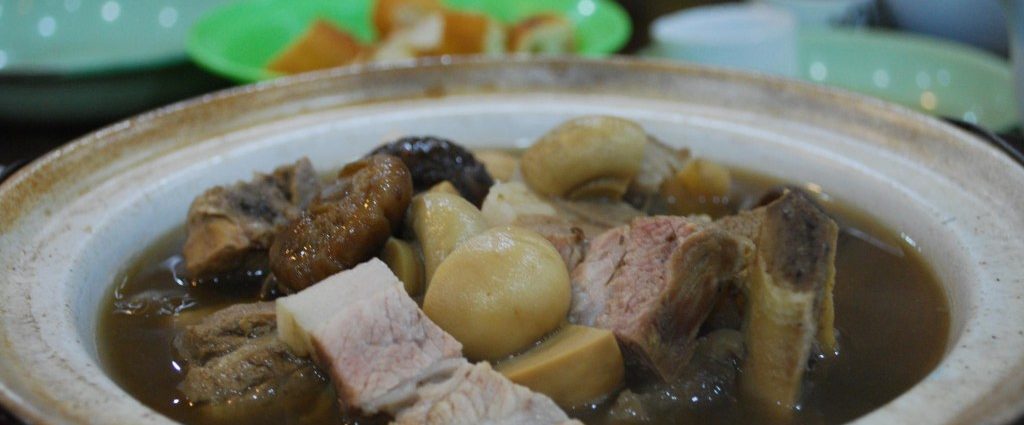
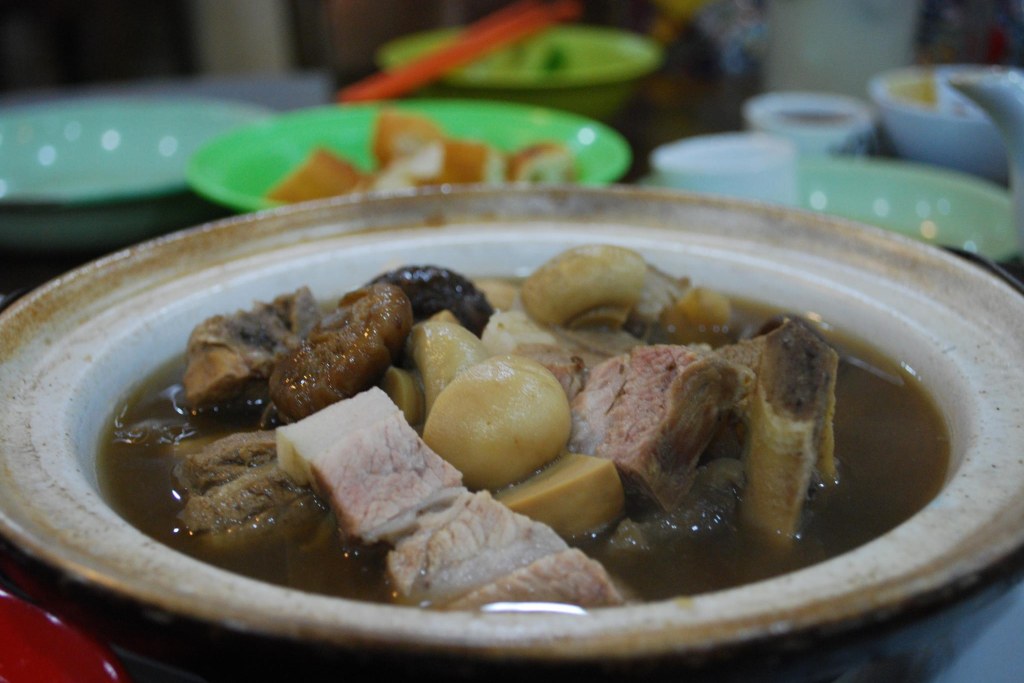
肉骨茶 — bak kut teh — is the most popular soup you have probably never heard of. Pork ribs simmered for hours in a dark, deeply savoury broth of garlic, pepper and Chinese herbs, eaten for breakfast in Malaysia and Singapore with rice, fried dough and a pot of strong tea. It is the food of the Hokkien and Teochew communities who built the ports of Southeast Asia, and it has two rival versions that people will argue about for hours.
It also has the best misleading name in Chinese cooking: it is called “meat bone tea”, and there is no tea in it.
肉骨茶 (bak kut teh) is a pork rib soup from the Hokkien and Teochew communities of Malaysia and Singapore. The name is Hokkien for “meat bone tea” — bah meat, kut bone, teh tea — and refers to the Chinese tea traditionally drunk alongside it, not to an ingredient. There are two main styles: the Hokkien (福建) version from Klang, dark and herbal with soy sauce and medicinal herbs, and the Teochew (潮州) version from Singapore, light and clear with white pepper and garlic. It is usually eaten with rice and 油条.
There Is No Tea in It
The name comes from Hokkien, the language of southern Fujian and of most Chinese migrants to Malaysia and Singapore. Bah is meat, kut is bone, teh is tea. So the dish literally translates as “meat bone tea” — and every ingredient in that phrase except the last one is in the bowl.
There are two explanations, and both are probably true. The first is that the dish is traditionally eaten with a pot of Chinese tea — 铁观音, 普洱 or 菊花 — poured continuously through the meal and considered part of it. The second is that the herbal broth was itself regarded as a medicinal decoction, a 茶 in the older sense of a brewed preparation. Either way, the tea is beside the bowl, not in it.
Two Schools: Klang and Singapore
Bak kut teh is not one dish. It is two, and they look nothing like each other.
福建派 — the Hokkien school, from Klang (巴生) in Selangor, Malaysia, is the darker and more medicinal of the two. The broth is built on dark soy sauce and a full complement of Chinese herbs — 当归, 党参, 玉竹, 川芎 — and simmers down to something close to black. It is usually cooked and served in a claypot (砂煲), and Klang remains the benchmark; locals will tell you the dish has never been done properly anywhere else.
潮州派 — the Teochew school, dominant in Singapore, goes the other way entirely: no dark soy, almost no herbs. The broth is pale, clear and driven by two things — an enormous quantity of garlic and a generous hand with white pepper. Where the Hokkien version is deep and medicinal, this one is bright, peppery and clean.
Both are correct. Which one you grew up with decides which one you think is the real thing.
The Herbs in the Dark Version
The Hokkien spice mix is a 药膳 formula — a medicinal food recipe — and the herbs are chosen for what they are believed to do, not only for flavour:
- 当归 (angelica) — the dominant note; sweet, earthy, and the reason the broth tastes medicinal
- 党参 (codonopsis) — a mild, sweet root used as a gentler stand-in for ginseng
- 玉竹 (solomon’s seal) — adds a faint sweetness and body
- 川芎 (ligusticum) — pungent and slightly bitter; use sparingly
- 桂皮, 八角, 丁香 — cinnamon, star anise and clove, for warmth
- 枸杞 and 红枣 — goji berries and red dates, for sweetness
If you are making the Teochew version, you can ignore all of it. Garlic and white pepper are the whole recipe.
Ingredients and Where to Find Them
- Pork ribs — 1kg of meaty ribs; ask for 排骨 or 龙骨 rather than a lean rack
- Bak kut teh spice packet — a prepared spice packet is how most people make it, and it is genuinely good
- Dong quai — 当归 if you are building the herbal mix yourself
- White pepper — ground white pepper; for the Teochew version this is the main seasoning, not a background note
Also needed: a whole bulb or two of garlic, dark and light soy sauce, salt, and optionally tofu puffs (豆卜), shiitake mushrooms and 咸菜 (pickled mustard greens). To serve: white rice and 油条.
Prep: Blanching the Ribs
- Cut the ribs into individual pieces and put them in a pot of cold water. Bring to a boil for 3 minutes
- Drain and rinse each piece, rubbing off the grey scum. This is what keeps the finished broth clean rather than cloudy
- Peel two whole bulbs of garlic but leave the cloves intact — smashed, not chopped, so they sweeten the broth without burning
Cook: The Broth
- Put the blanched ribs in a pot with 2 litres of water, the garlic, and either a bak kut teh spice packet or your own herb mix in a cloth bag
- Teochew version: add 2 teaspoons of ground white pepper now. Hokkien version: add 2 tablespoons of dark soy sauce plus 1 teaspoon of white pepper
- Bring to a boil, then drop to a bare simmer and cook 1.5–2 hours, until the meat pulls from the bone but has not fallen apart
- Skim the fat from the surface as it rises. If you want a cleaner broth, chill it and lift the solid fat off the top
- Season with 2 tablespoons of light soy sauce and salt. The Hokkien version should be dark and herbal; the Teochew version pale and peppery
- In the last 15 minutes, add tofu puffs or shiitake mushrooms if you are using them, so they soak up the broth
- Serve in bowls or a claypot, with rice, 油条 for dipping, and a small dish of dark soy sauce with sliced chili and raw garlic
Troubleshooting: Why Your Bak Kut Teh Tastes Weak
- The broth is thin and watery — too much water for the amount of rib, or not enough simmering. Reduce it uncovered at the end until it tastes concentrated
- It is bitter and overpowering — too much 当归 or 川芎. These are strong herbs; halve them and taste at the one-hour mark
- The ribs are tough — they were simmered too briefly, or the cut was too lean. Use meatier ribs and give them a full 2 hours at a bare simmer
- It tastes like medicine rather than food — you have made the Hokkien version too strong. Add water, more garlic, or a little sugar, or simply switch to the Teochew style
- The broth is cloudy and greasy — the ribs were not blanched, or the fat was never skimmed. Blanch properly and skim as it cooks
How to Eat It
In Malaysia and Singapore this is breakfast, and the ritual matters as much as the recipe. A bowl of ribs and broth, a plate of white rice, 油条 torn and dunked, pickled greens on the side, and a pot of tea that keeps being refilled. The dipping sauce — dark soy, sliced red chili, raw garlic — is not optional.
It is a complete meal on its own, but it also sits naturally alongside the other slow-simmered pork soups on this site: my Lotus Root and Pork Rib Soup 莲藕排骨汤 and Clear Pork Rib Soup 清炖排骨汤 take the same cut of meat in a completely different direction. For another soup built on Chinese herbs, see the Cantonese Pig Lung and Almond Soup 猪肺杏仁汤.
Frequently Asked Questions
Why is it called tea if there is no tea in it?
Because of the tea you drink with it. Bak kut teh is traditionally eaten alongside a pot of Chinese tea, and the Hokkien name — bah meat, kut bone, teh tea — describes the whole meal rather than the bowl.
What is the difference between Hokkien and Teochew bak kut teh?
The Hokkien version, from Klang in Malaysia, is dark and herbal, built on soy sauce and a medicinal herb mix. The Teochew version, dominant in Singapore, is pale and clear, seasoned mainly with white pepper and a lot of garlic. They share only the ribs.
Can I use a spice packet instead of the individual herbs?
Yes, and most people do — the packets are well made and consistent. To control the bitterness, buy the herbs separately so you can dial back the 当归 and 川芎.
Is bak kut teh healthy?
It is rich in collagen and it is a traditional 药膳 — a medicinal food — but it is also high in fat, salt and purines, so it is not something to eat daily if you have gout or high blood pressure. The Teochew version is the lighter of the two.
More Chinese Soups to Try
If you like soups that simmer for hours, try Winter Melon and Pork Rib Soup 冬瓜排骨汤, the Chaozhou classic Patriotic Soup 护国菜, the Hainanese Coconut Chicken Soup 椰子鸡汤, or the banquet centrepiece Fotiaoqiang 佛跳墙.
Photo: Alpha from Melbourne, Australia via Wikimedia Commons, CC BY-SA 2.0. Adapted by cropping and resizing.
As an Amazon Associate, I earn from qualifying purchases. These are affiliate links at no extra cost to you.