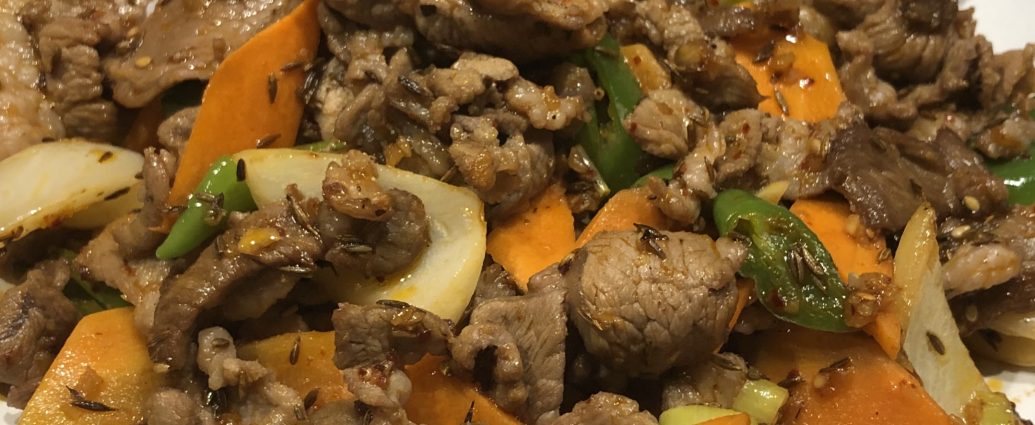
Cumin Lamb (孜然羊肉) is the definitive flavor of China’s northwest — tender slices of lamb flash-fried with cumin seeds, dried chilies, and onion until the kitchen smells like a Xinjiang night market. The pairing of lamb and cumin is ancient in the region’s Silk Road cooking, and in China it ranks among the most beloved of all stir-fries: boldly spiced, deeply savory, and unapologetically aromatic.
The dish is often called 孜然羊肉 (zīrán yángròu), “cumin lamb,” and it grew out of Xinjiang’s lamb-centered grill culture, where cumin and chili powder are the signature dusting for everything from lamb skewers to whole roasts. Stir-frying brings the same flavors indoors: quick, high-heat cooking keeps the lamb tender while the toasted cumin seeds release their warm, citrusy perfume into the oil. This recipe stays true to the style — and works beautifully with leg of lamb or boneless shoulder.
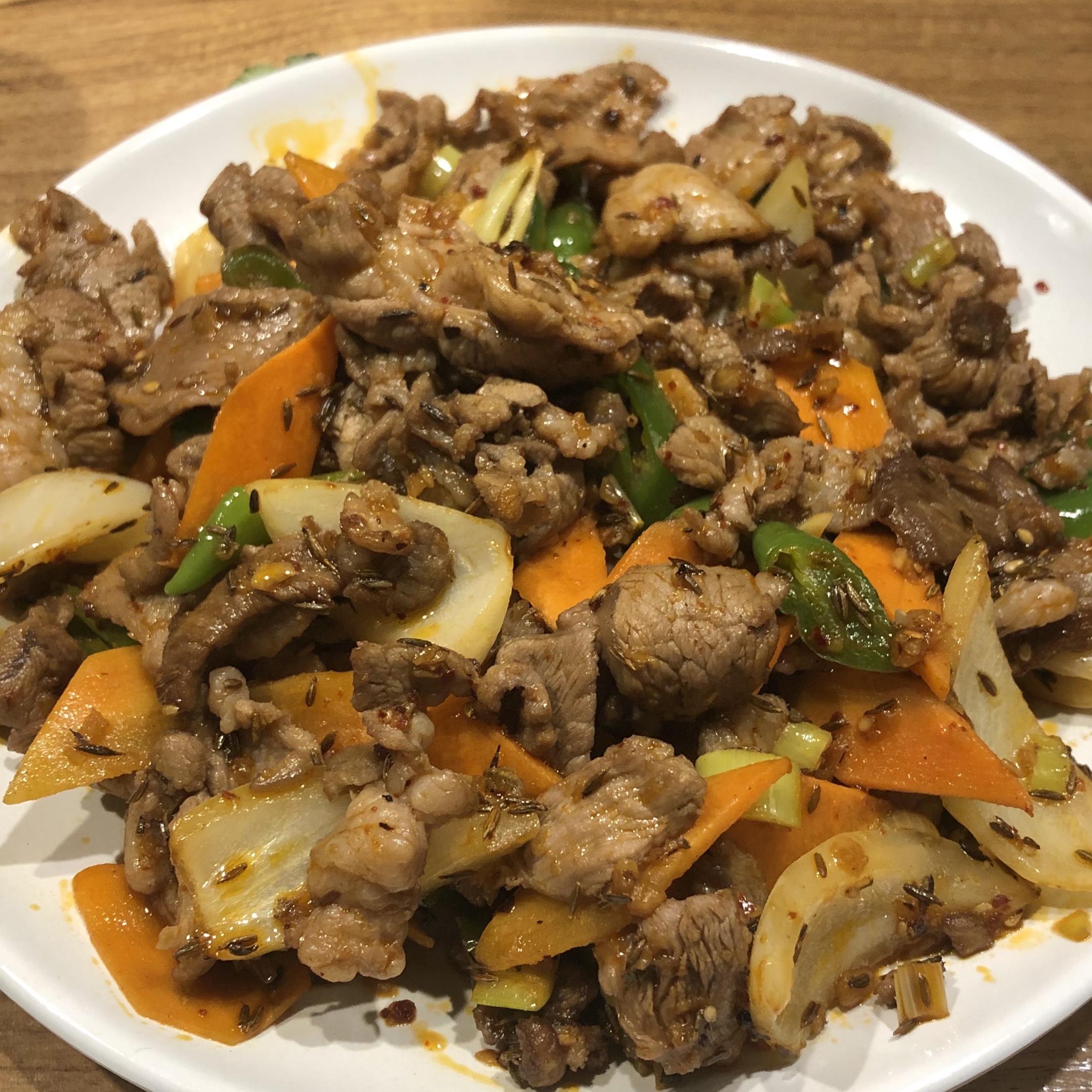
Photo via Wikimedia Commons, CC BY-SA 4.0
Cumin’s Silk Road Journey
Cumin is not native to China. It arrived from Central Asia and the Middle East along the trade routes that connected Xi’an to Samarkand and beyond, and it took root in the northwest — in Xinjiang, Gansu, and Ningxia — where it is called 孜然 (zīrán), a transliteration of a Central Asian word. That history explains why cumin is associated so strongly with lamb in Chinese cooking and barely appears at all in Cantonese or Shanghainese food: the two ingredients travelled together along the same route. In Xinjiang, cumin is used with a free hand — dusted over lamb skewers at street stalls, stirred into stir-fries, and rubbed on roasts. The combination of cumin’s warm, slightly citrusy aroma with lamb’s rich, faintly gamey flavor is one of the great pairings in world cooking.
Whole Seeds, Toasted
- Use whole cumin seeds, not ground powder — they toast in the hot oil and release a far more complex aroma
- Bloom them early — added to the hot wok before the lamb, so the oil carries their flavor through the dish
- A little ground cumin at the end — a second addition just before serving deepens the flavor and adds freshness
- Chili flakes or dried chilies for heat — Sichuan-style chili flakes are ideal; they bloom rather than burn
- Onion is essential — its sweetness balances the cumin’s earthiness and the lamb’s richness
- High heat, fast cooking — the wok should be at its hottest; the lamb should be seared, not stewed
Velveting the Lamb
Lean lamb dries out quickly under the intense heat this dish requires, so the meat is velveted first: sliced thin against the grain, then tossed with cornstarch, egg white, a splash of water, and a little soy, and left for twenty minutes. The coating forms a protective sheath that seals in moisture and keeps the slices silky even at high heat. It is the same technique used for Cantonese beef stir-fries, applied here to a northern dish. Skip it and the lamb will be tough within a minute of hitting the wok.
Ingredients and Where to Find Them
- Cumin seeds — whole cumin seeds
- Lamb — boneless leg of lamb or shoulder
- Chili flakes — chili flakes for heat
Also needed: onion, garlic, ginger, scallions, dried chilies, light soy sauce, Shaoxing wine, cornstarch, egg white, sugar, white pepper, and a little five-spice powder. Cilantro is a traditional garnish.
How to Cook It
- Slice 400g (14 oz) lamb thinly against the grain; marinate 20 minutes with 1 egg white, 2 teaspoons cornstarch, 1 tablespoon Shaoxing wine, 1 tablespoon light soy, and 1 teaspoon sugar
- Heat a wok until smoking with 3 tablespoons oil and add 2 teaspoons whole cumin seeds; sizzle 15 seconds
- Add the lamb in a single layer and sear 90 seconds without stirring, then toss until just cooked; remove
- Add 1 sliced onion and stir-fry 2 minutes until softened and lightly charred
- Add garlic, ginger, 6 snipped dried chilies, and 1 teaspoon chili flakes; stir 30 seconds
- Return the lamb, add 1 teaspoon ground cumin, 1 teaspoon light soy, and a pinch of five-spice; toss 30 seconds over maximum heat
- Scatter with scallions and cilantro and serve immediately with rice or flatbread
Variations
- With lamb skewers — the same spice mix dusted over grilled skewers; see my Lamb Skewers 羊肉串
- With beef — 孜然牛肉 uses the same approach with thinly sliced beef
- With potatoes — cubes of par-boiled potato added with the onion make it a fuller dish
- With more heat — extra chili flakes and a spoonful of chili oil at the end
Frequently Asked Questions
Why does my cumin lamb taste flat?
The cumin was not toasted. Whole seeds need to sizzle in hot oil for 15–30 seconds to release their aroma, and a second addition of ground cumin at the end adds a fresh top note. Using only pre-ground cumin gives a dull, dusty flavor.
How do I stop the lamb from being tough?
Velvet it with cornstarch and egg white, slice it thin against the grain, and cook it fast over very high heat. Lamb should be seared in 90 seconds, not simmered — the longer it stays in the wok, the tougher it gets.
What cut of lamb is best?
Boneless leg of lamb or shoulder are ideal — they have enough marbling to stay juicy under high heat. Avoid overly lean cuts like loin chops, which dry out in a quick stir-fry.
Can I use ground cumin instead of whole seeds?
You can, but the result is noticeably less aromatic. Whole seeds bloomed in oil provide the signature fragrance of the dish. If you only have ground cumin, add it late — ground spices burn quickly and turn bitter in a hot wok.
More Stir-Fry & Northwest Favorites
Love bold wok dishes? Try my Dry-Fried Shredded Beef 干煸牛肉丝, the grilled classic Lamb Skewers 羊肉串, or the northeastern Di San Xian 地三鲜.
As an Amazon Associate, I earn from qualifying purchases. These are affiliate links at no extra cost to you.