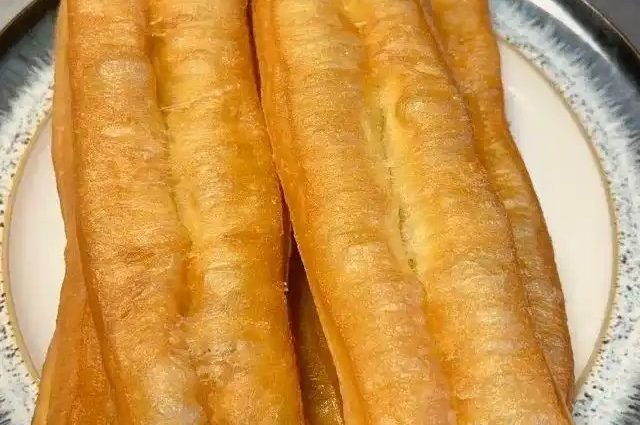
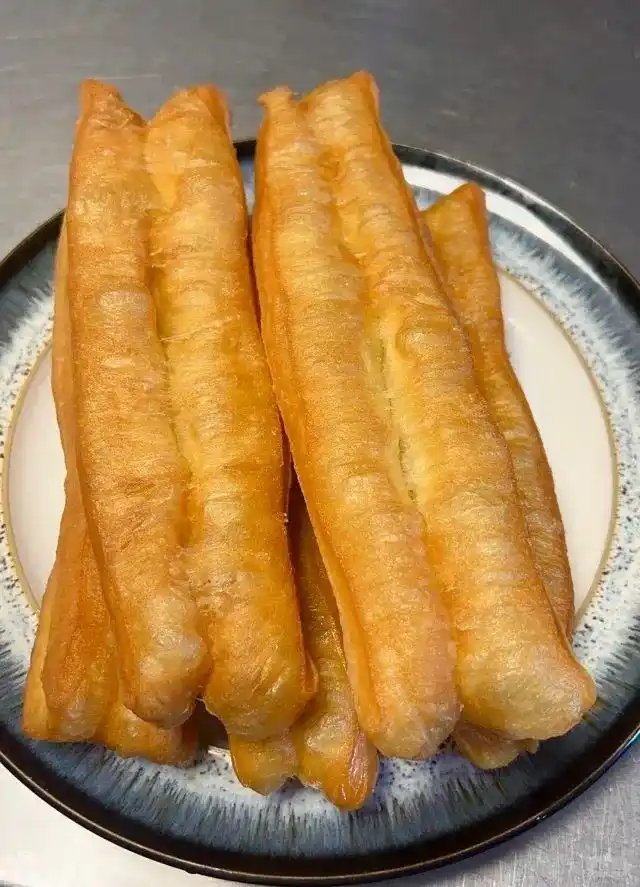
Youtiao (油条) is the smell of a Chinese morning. Walk past any breakfast stall before eight and you will find a cauldron of oil, a basket of pale dough ribbons, and a cook who never stops moving: stretch, drop, roll, lift. Ninety seconds later the ribbon is a long, golden, blistered cruller — crisp shell, hollow chewy centre. Dunked into warm soy milk (豆浆) or wrapped in a rice noodle roll, it is the most beloved breakfast in China, and it is entirely makeable at home.
What surprises most people who try it: youtiao is not bread. There is almost no kneading, no shaping, and no rise in the usual sense. The puff comes from a chemical reaction and a very hot pan of oil, not from yeast.
Youtiao (油条) is a Chinese deep-fried dough stick — a strip of leavened wheat dough stretched and fried in oil at about 200°C until it puffs into a crisp, hollow, golden cruller. It is savory rather than sweet, and is traditionally eaten for breakfast with soy milk (豆浆) or congee. In Cantonese it is called 油炸鬼 (yau ja gwai).
Why Youtiao Puffs — And Why It Is Not Bread
Youtiao dough is a soft, wet, barely-kneaded mass leavened with baking powder and baking soda instead of yeast. Two things happen the moment it hits the oil. The leaveners release carbon dioxide, and the water inside the dough turns to steam. At the same time, the surface sets almost instantly at 190–200°C, sealing that gas in. The strip has nowhere to expand but outward and along its length — so it inflates like a balloon.
That is why oil temperature is not a detail, it is the recipe. Too cool and the crust sets slowly, the gas escapes, and you get a greasy rope. Hot enough and the crust locks while the steam does the work. Rolling the dough in the oil with chopsticks matters for the same reason: it keeps the underside from setting unevenly, so the stick puffs along its whole length instead of on one side.
The cold rest in the fridge does a different job: it lets the flour hydrate fully and the gluten relax, so the dough stretches without snapping back and fries into a thin, tender crust.
The Song Dynasty Story Behind the Name
Youtiao has been eaten in China for at least eight centuries, and its name is one of the oldest pieces of food politics anywhere. In 1142 the Song general Yue Fei (岳飞), a national hero, was executed after a minister named Qin Hui (秦桧) engineered his downfall. According to legend, an enraged Hangzhou street vendor shaped two strips of dough to represent Qin Hui and his wife, twisted them together, and threw them into boiling oil: 油炸桧, “oil-fried Qin Hui”.
The name softened over the centuries to 油条 (“oil strip”), but Cantonese speakers still call it 油炸鬼 (yau ja gwai), a near-homophone of the original. The two-strip twist survived as well: to this day a proper youtiao is made by pressing two ribbons of dough together and frying them as one. It is a small piece of history you can eat.
Ingredients and Where to Find Them
- All-purpose or bread flour — all-purpose flour; bread flour gives a slightly chewier crumb
- Baking powder — aluminum-free baking powder; the leavening that does all the work
- Neutral frying oil — peanut or canola oil; you need enough in the pot for the dough to float freely
Also needed: baking soda, salt, sugar, warm water, and about 1.5 litres of oil. Traditional recipes add 明矾 (alum) and 食用碱 (edible ammonia) for a maximum puff; the version below uses ordinary supermarket leaveners.
Making the Dough the Night Before
- Whisk 500g (4 cups) flour with 1 tsp baking powder, ½ tsp baking soda, 1 tsp salt and 1 tbsp sugar
- Pour in 300ml (1¼ cups) warm water, about 40°C, and stir with chopsticks until a shaggy, sticky mass forms — roughly 30 seconds. Do not knead yet
- Cover and rest 20 minutes; the flour hydrates and the dough becomes easier to handle
- Fold the dough over itself 4–5 times with wet hands, then stop. This dough is deliberately under-kneaded — overworking it makes youtiao tough
- Coat the ball lightly with oil, cover, and refrigerate at least 4 hours, ideally overnight
Frying: Stretch, Drop, Roll
- Take the dough straight from the fridge and do not knead it. Lightly flour the bench
- Press and roll it gently into a strip about 1cm thick and 8cm wide, then cut into 2cm-wide ribbons
- Stack two ribbons, press a chopstick down the centre to fuse them, then lift by both ends and stretch to about 25cm
- Heat 1.5 litres of oil to 200°C (390°F). Test with a scrap of dough — it should rise and sizzle at once
- Slide the strip in and roll it constantly with chopsticks for the first 20–30 seconds. It will roughly double in size
- Fry 60–90 seconds until evenly pale gold. Do not chase a deep colour; youtiao is meant to be light
- Drain upright on a rack — never on paper, which traps steam and softens the crust. Serve within 30 minutes
Troubleshooting: Why Your Youtiao Did Not Puff
- Dense and bready — the oil was below 180°C, or the dough was kneaded too much; both stop the gas from being trapped
- Greasy — the oil was too cool, so the crust set slowly and soaked up fat. Return it to 200°C before the next batch
- Puffed on one side only — you did not roll it in the oil, which is what makes the puff even
- Snaps back when stretched — the gluten is still tight; cover and rest 15 minutes
- Soft within minutes — you drained it on paper, which traps steam. Use a rack and cut the water back by a tablespoon
How China Eats Youtiao
- 豆浆油条 — the classic pairing: torn into warm, lightly sweetened soy milk, or dipped into it
- 炸两 (zhaliang) — Cantonese rice noodle roll wrapped around a youtiao, cut into segments and dressed with soy and sesame. My Cheung Fun 肠粉 shows how to make the wrapper
- 煎饼果子 — Tianjin’s breakfast crepe folds a youtiao inside with egg and sauce; see my Jianbing 煎饼果子 for the full assembly
- 粢饭团 and 烧饼油条 — Shanghai sticky rice rolls with a youtiao core, and split sesame flatbreads stuffed the same way
- Bak kut teh — in Malaysia and Singapore, youtiao is dipped into peppery pork rib broth; it is just as good dunked briefly into Mala Tang 麻辣烫
Frequently Asked Questions
Is youtiao the same as a churro?
Not quite, though the idea is close. Churros are piped from a dough that is cooked first, then fried and rolled in sugar. Youtiao is a raw, leavened dough strip, fried in pairs and served savory — lighter and more bread-like.
Is youtiao vegan?
The basic recipe is — flour, water, leaveners, salt, sugar, oil. Some Cantonese versions add an egg for a softer crumb, so check the ingredients if that matters to you.
Can I make youtiao without alum or ammonia?
Yes, and the recipe above does. Alum (明矾) and edible ammonia give the most dramatic puff, but they are not sold in most Western supermarkets and are not necessary. Baking powder, baking soda and a long cold rest produce a genuinely good youtiao.
Why is my youtiao not crispy the next day?
Because it was never meant to be. Youtiao is a fry-and-eat-now food with no preservatives. If you have leftovers, reheat them in a 200°C oven for 4–5 minutes or in an air fryer — never a microwave, which turns them rubbery.
More Street Food Favorites to Try
If you like youtiao, try my Scallion Pancake 葱油饼, the Hong Kong classic Egg Waffle 鸡蛋仔, Shanghai’s Sheng Jian Bao 生煎包, or the soup-filled Xiaolongbao 小笼包.
As an Amazon Associate, I earn from qualifying purchases. These are affiliate links at no extra cost to you.