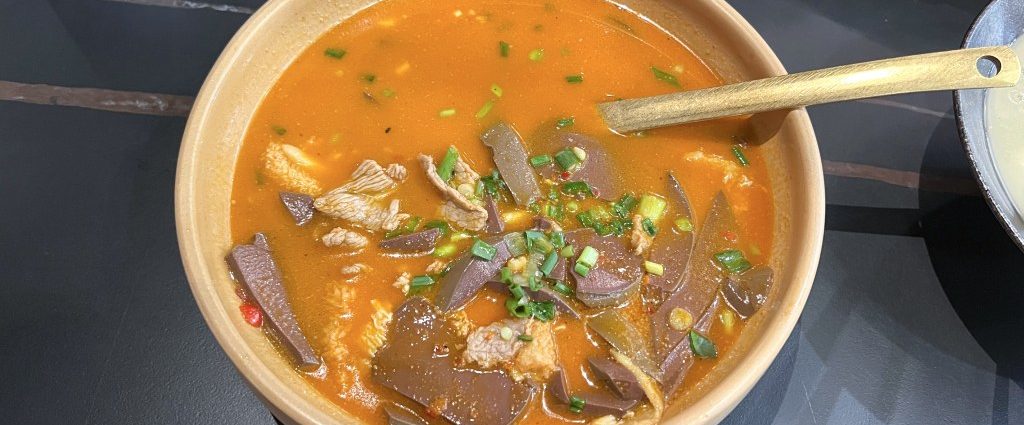
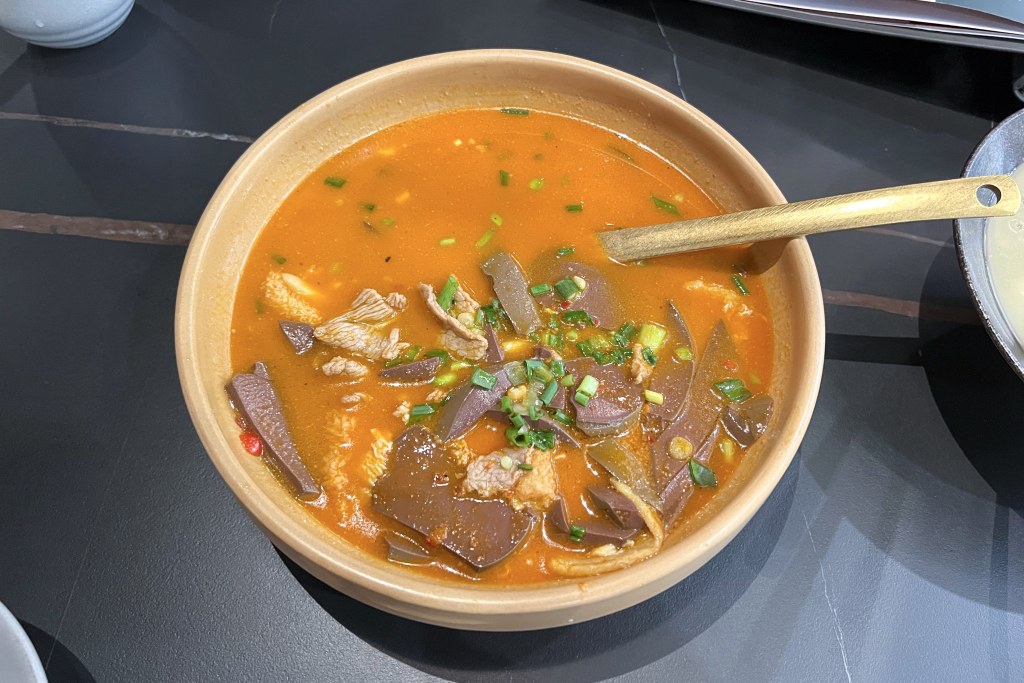
Xinhua Sanhetang (新化三合汤) is the soup people from Xinhua county in central Hunan will argue about the longest. The name means “three-in-one soup”, and the three are beef, ox tripe and ox blood — simmered in a sour, fiery broth perfumed with 山胡椒油, the oil pressed from the fruit of the mountain pepper tree. It is a bowl built for cold, damp mountains and hard work, and it tastes like it.
What separates it from every other Chinese beef soup is one ingredient. Everything else in the pot is familiar; the 山胡椒油 is not.
Sanhetang (三合汤) is a Hunan beef soup from Xinhua county, Loudi, in which thinly sliced beef, pre-cooked ox tripe and cubes of coagulated ox blood are simmered in a sour-spicy broth. Its signature is 山胡椒油 (mountain pepper or litsea oil), a green, citrus-tinged oil added off the heat. It is usually eaten over rice noodles. It is not 毛血旺 — that is a Sichuan dish, numbing rather than sour, and built on chili oil rather than broth.
What “Three-in-One” Actually Means
The three are not interchangeable, and each does a specific job. Beef gives the broth sweetness and body — sliced thin, cooked two minutes and no more. Ox tripe gives chew, and because it simmers first it also gives the broth gelatinous depth. Ox blood gives silky dark cubes that hold their shape and quietly thicken the liquid around them.
Take any one away and the dish stops being sanhetang — worth saying, because two other famous dishes use similar parts. 毛血旺, from Sichuan, also pairs blood and tripe, but it is 麻辣: numbing, chili-oil based, a pot you eat with rice to survive. 永州血鸭, elsewhere in Hunan, uses blood as a sauce that coats duck. Sanhetang is neither: it is a sour-hot broth, and the blood floats in it rather than coating anything.
The Mountain Pepper Oil That Makes It 新化
山胡椒油 — also sold as 木姜子油, or litsea cubeba oil — is pressed from the small green fruit of a tree in the laurel family. It is vivid green and smells like lemon zest crossed with pine resin. Three to five drops perfume an entire pot.
It is also the most common reason a home attempt fails. 山胡椒油 is volatile: boil it and the aroma evaporates with the steam. It goes in after the pot comes off the heat, never before. Without it you have a decent beef and tripe soup; with it, you have sanhetang.
The same oil appears in Guizhou sour fish soup and across western Hunan cooking, which is a useful clue to where this dish sits on the map.
Where It Comes From: The Meishan Mountains
Xinhua county sits in Loudi, in the hill country of central Hunan known as 梅山 — the Meishan region, which also takes in neighbouring Anhua. Historically this was remote, damp mountain country with its own preserved, fermented, heavily seasoned cooking.
Local tradition explains the soup through the work. Men cut timber and ran logs down the rivers — 放排 — spending long days wet and cold in the hills. The bowl they wanted had beef for strength, tripe because nothing was wasted, blood for substance, and enough chili and mountain pepper to warm a body through. True or not, it describes exactly what the soup does.
Today sanhetang is Xinhua’s signature dish and one of the best-known things to come out of Loudi, most often ladled over rice noodles.
Ingredients and Where to Find Them
- Beef — 250g flank or sirloin, sliced paper-thin against the grain
- Pre-cooked ox tripe — 200g; cooked beef tripe saves two hours of simmering
- Mountain pepper oil — litsea cubeba oil (山胡椒油), the signature ingredient
- Coagulated blood — coagulated pork blood if ox blood is unavailable; both work
Also needed: ginger, garlic, dried red chilies, pickled chilies or white vinegar for the sour note, scallions, cilantro, light soy sauce, Shaoxing wine, cornstarch, salt and oil. Rice noodles to serve.
Prep: Getting the Tripe and Blood Right
- If your tripe is raw rather than pre-cooked, simmer it with ginger and a splash of Shaoxing wine for 2–3 hours until a knife slides through, then cool and cut into 5cm strips. Pre-cooked tripe only needs slicing
- Cut 200g coagulated blood into 2cm cubes, then blanch 60 seconds in lightly salted water and drain. This firms the cubes so they survive the simmer without clouding the broth
- Slice 250g beef against the grain as thin as you can, and marinate 10 minutes with 1 tsp light soy, 1 tsp Shaoxing wine, 1 tsp cornstarch and 1 tsp oil
- Slice 4 garlic cloves, julienne a thumb of ginger, snip 6 dried chilies, and measure 1 tbsp pickled chili or 1 tsp white vinegar
Cook: Building the Broth
- Heat 2 tbsp oil in a pot and fry the ginger, garlic and dried chilies 30 seconds until fragrant
- Pour in 1.2 litres of water or light unsalted stock and bring to a rolling boil
- Add the tripe first and simmer 10 minutes — this gives the broth its body
- Slide in the beef slices one at a time so they do not clump; cook just 2 minutes
- Add the blood cubes and the pickled chili or vinegar; simmer 3 minutes more
- Season with 1 tbsp light soy and salt. The broth should be sour, hot and faintly cloudy — not thick
- Off the heat, add 3–5 drops of 山胡椒油 and stir once. Do not return it to the flame
- Ladle over rice noodles or serve with rice, topped with scallions and cilantro
Troubleshooting: Why Your Sanhetang Tastes Flat
- It tastes like ordinary beef soup — the 山胡椒油 was boiled, or you used too little. Add it off the heat; start with 4 drops per litre
- The tripe is rubbery — it was not cooked long enough before going in. Raw tripe needs hours; there is no shortcut in the pot
- The broth went cloudy and the blood broke up — the cubes were not blanched, or the pot was stirred hard. Blanch them, then stir gently once
- The flavour is muddy and heavy — too much chili oil. This is a broth, not a chili-oil dish; the heat should be clean, not slick
- The beef is tough — sliced with the grain, or simmered too long. Slice across the grain and give it two minutes, no more
How to Serve It
In Xinhua the default is over rice noodles, which makes it a full meal; with plain rice it becomes one dish among several. On a Hunan table it sits alongside a stir-fry and a vegetable — my Xiao Chao Rou 小炒肉 and Stir-Fried Water Spinach 清炒空心菜 are the natural partners, with a bowl of Hunan Rice Noodles 湖南米粉 on the side. If you like the blood-and-offal logic here, my Yongzhou Blood Duck 永州血鸭 takes the same ingredient in a completely different direction.
Frequently Asked Questions
What is 山胡椒油 and can I substitute it?
It is litsea cubeba oil, sold as 木姜子油 or mountain pepper oil. There is no true substitute — the aroma is the dish. The nearest approximation is a few drops of another litsea oil plus a sliver of lemon zest, but order the real thing if you can.
Where can I buy ox blood?
Coagulated pork blood (猪血) is far easier to find than ox blood (牛血) outside China, and it works perfectly well — the texture is slightly softer. Look in the refrigerated section of a Chinese or Vietnamese grocery, usually near the tofu, or buy it canned online.
Is this the same as 毛血旺?
No. 毛血旺 is Sichuan: numbing, chili-oil based, loaded with luncheon meat and offal. Sanhetang is Hunan: a sour-hot broth, aromatic rather than numbing, with only three main ingredients. For the Sichuan one, see my Mao Xue Wang 毛血旺.
Is sanhetang very spicy?
It is hot, but not numbing — there is no Sichuan peppercorn in the classic version. The heat comes from dried and pickled chilies, so you control it entirely. The sourness matters just as much as the heat, and the two together are the point.
More Hunan Favorites to Try
Explore the rest of the Hunan table with my Steamed Fish Head with Chopped Chili 剁椒鱼头, the cured-meat classic La Wei He Zheng 腊味合蒸, the summer favourite Spicy Crayfish 口味虾, or the ginger-forward Hunan Ginger Chicken 生姜炒鸡.
Photo: “Xinhua Sanhetang at Huanxiang Restaurant, GR Mall, Beijing” by N509FZ, licensed under CC BY-SA 4.0, via Wikimedia Commons. Adapted by resizing.
As an Amazon Associate, I earn from qualifying purchases. These are affiliate links at no extra cost to you.