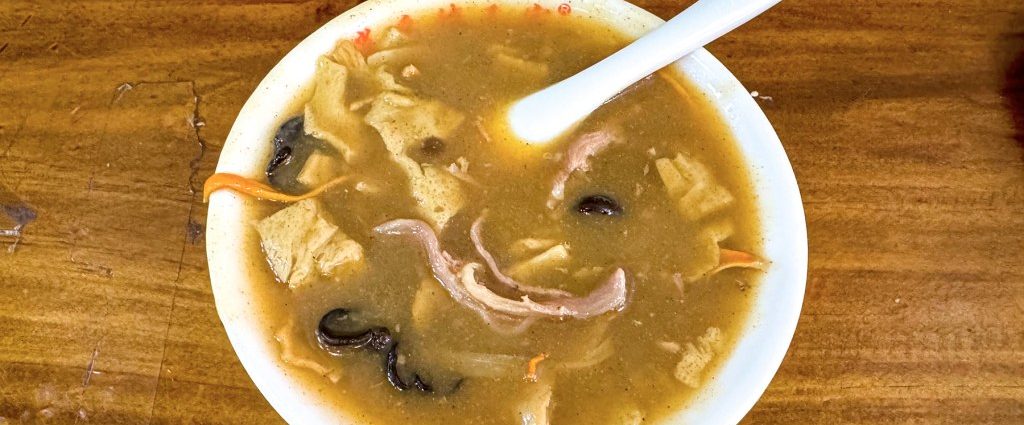
胡辣汤 (hú là tāng) is how Henan starts the day. A thick, dark, peppery soup — closer to a gravy than a broth — ladled out of a huge pot before seven in the morning, eaten with a stick of fried dough and finished with a slug of vinegar. It is one of the great breakfasts of China, and almost nobody outside the province has heard of it.
It is also the only Chinese soup where the heat comes from pepper rather than chili, and where the thickening agent is made from the same dough as one of the ingredients.
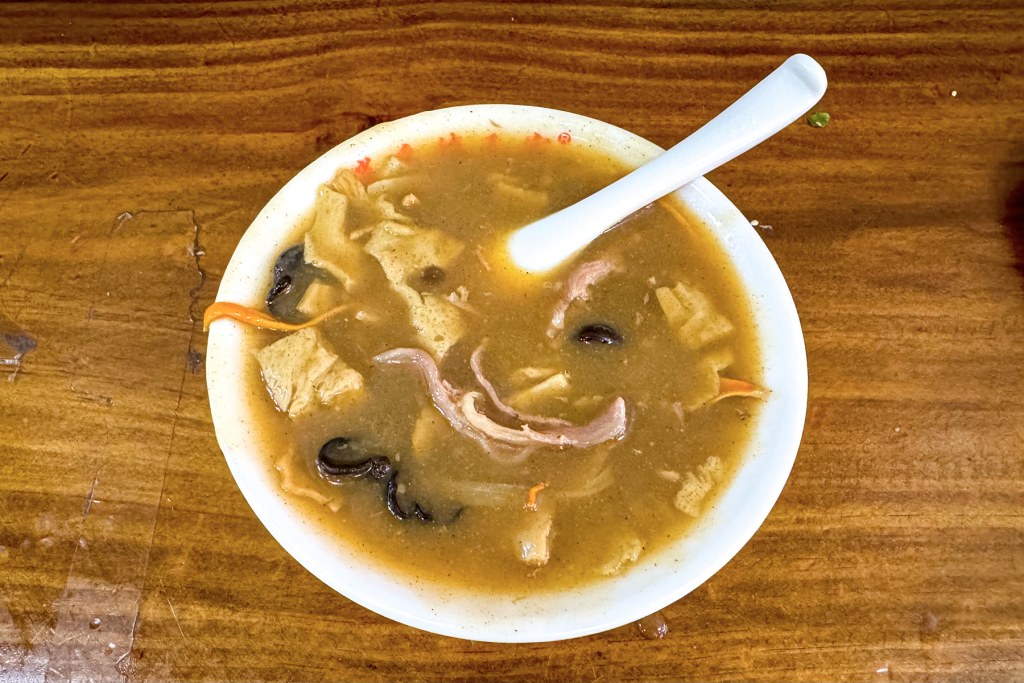
胡辣汤 is a thick, peppery breakfast soup from Henan province, thickened with starch and loaded with beef or lamb, gluten (面筋), sweet potato noodles, wood ear, daylily and peanuts. Its heat comes mainly from white pepper — 胡 in the name refers to 胡椒, pepper — not from chili. It is eaten in the morning, almost always with 油条 (fried dough sticks). It is not the same as 酸辣汤: that is a light, vinegar-forward soup, while hulatang is thick, dark and pepper-driven.
The Heat Comes from Pepper, Not Chili
This is the single thing to understand about hulatang, and the thing that trips up every first attempt. The name is often translated as “spicy soup”, which sends people looking for chilies. But 胡 in 胡辣汤 is short for 胡椒 — pepper, a spice that arrived along the Silk Road, which is why it carries the 胡 (“foreign”) character. 胡辣 means “pepper-hot”.
So the dominant sensation is the warm, sinus-clearing pungency of white pepper, used in quantities that would seem reckless in any other dish. Chili is present, but as a background note. If you taste your hulatang and think “this needs more heat”, the answer is almost always more white pepper, not more chili.
Two Towns, Two Schools
Henan does not have one hulatang. It has two rival traditions, each named after the town that owns it, and people from either side will tell you the other one is not really hulatang at all.
逍遥镇 (Xiaoyao Town), in Xihua County, Zhoukou, is the commercially dominant style — the one you will find in most shops nationwide. It is darker, heavier on pepper and chili, built on beef, and generous with gluten, wood ear, daylily and peanuts. Xiaoyao Town is essentially a hulatang town: the dish is its main industry.
北舞渡 (Beiwudu), in Wuyang County, Luohe, is the other historic school, and is often described as the older of the two. It is lighter in colour and less aggressive, traditionally made with lamb, and it leans on sweet potato noodles for body. Where Xiaoyao Town is dark and blunt, Beiwudu is paler and more layered.
There is also a genuine offshoot in Xi’an: 肉丸胡辣汤, meatball hulatang, which adds beef meatballs, potato and carrot and is eaten with torn 饦饦馍. It is a different dish wearing the same name.
What Goes In
The ingredient list looks long, but it is built around three jobs: something meaty, something chewy, and something that thickens.
- Beef or lamb — thinly sliced, simmered until tender; it also builds the stock
- 面筋 (gluten) — torn pieces of washed wheat gluten, the signature chew
- 粉条 (sweet potato noodles) — glassy, slippery, and they survive a long simmer
- 木耳 and 黄花菜 — wood ear for crunch, daylily for a faint sweetness
- Peanuts — soft, starchy, and traditional in the Xiaoyao Town style
- White pepper — the defining seasoning, and not a garnish
- Starch — the thickener, traditionally the starch water from washing the gluten
Ingredients and Where to Find Them
- White pepper — ground white pepper; buy it whole and grind it if you can, since it loses its punch fast
- Dried daylily — 黄花菜 (golden needles), soaked before use
- Sweet potato noodles — 红薯粉条, the wide glassy kind
Also needed: plain flour (for the gluten), beef or lamb, dried wood ear, raw peanuts, ginger, star anise, light soy sauce, salt, a little chili, black vinegar and sesame oil to finish.
Prep: The Washing Technique
The traditional method produces both the gluten and the thickener from one piece of dough, which is the trick that makes hulatang what it is.
- Mix 250g of plain flour with about 130ml of water and knead into a firm dough. Cover and rest 30 minutes
- Put the dough in a bowl of cold water and knead and squeeze for 5–8 minutes. The water turns milky as the starch washes out
- Lift the dough out. What remains is a small, springy ball of gluten — set it aside. Keep the milky water: that is your thickener, better than any slurry
- Soak the wood ear, daylily and peanuts in warm water for 30 minutes, then drain. Tear the wood ear into small pieces
Shortcut: if you would rather not wash dough, use store-bought gluten (面筋) and thicken with a cornstarch or potato starch slurry instead. It works, but the soup is a little less silky.
Cook: Building the Soup
- Put 1.5 litres of water in a pot with the sliced beef or lamb, a thumb of ginger and one star anise. Simmer gently for 30 minutes to build the stock
- Add the soaked peanuts and simmer 10 minutes, then the wood ear and daylily and simmer 5 minutes more
- Tear the gluten into small pieces and drop them in. Simmer 5 minutes — they will puff slightly
- Season with 2 teaspoons of ground white pepper, 1 tablespoon of light soy sauce, and a pinch of chili. Taste: it should be assertively peppery, not merely warm
- Add the sweet potato noodles and simmer 5 minutes until soft
- Stir the reserved starch water (or your slurry) and pour it in slowly, stirring constantly, off a rolling boil. Keep going until the soup coats the back of a spoon — hulatang should be thick, closer to gravy than broth
- Finish with a splash of black vinegar and a few drops of sesame oil, and serve immediately
Troubleshooting: Why Your Hulatang Is Thin or Flat
- It never thickened — starch was added to a hard boil, or too little was used. Add a slurry off the boil, a little at a time, stirring until it coats a spoon
- Lumpy and gluey — the starch went in too fast or without stirring. Pour in a thin stream and keep the spoon moving
- It tastes flat despite the pepper — white pepper loses its volatile oils quickly. Grind it fresh; pre-ground pepper from an old jar will not do the job
- Too spicy in a sharp, raw way — too much chili and not enough pepper. The heat should feel warm and nasal, not sharp on the tongue
- The ingredients sink and the soup separates — it is under-thickened. Hulatang is meant to hold its solids in suspension, so thicken further and serve hot
How to Eat It
Hulatang is breakfast, and never eaten alone. The classic pairing is youtiao 油条 — torn into pieces and dunked, so the dough soaks up the soup. 水煎包 (pan-fried buns) or 葱油饼 work just as well.
At the table, add black vinegar and sesame oil to taste. The vinegar is not optional for many people — it cuts the starch and lifts the whole bowl.
Frequently Asked Questions
What is hulatang made of?
Beef or lamb, wheat gluten (面筋), sweet potato noodles, wood ear, daylily, peanuts, and a stock thickened with starch. The defining seasoning is white pepper — 胡 in the name refers to 胡椒, pepper, not chili.
Is hulatang spicy?
It is pungent rather than hot. The dominant heat is the warm, nasal pungency of white pepper; chili is a background note. If you find it too strong, cut the pepper — but do not remove it entirely, or you lose the dish.
What is the difference between Xiaoyao Town and Beiwudu hulatang?
Xiaoyao Town (Xihua County, Zhoukou) is the darker, beef-based style that dominates commercially. Beiwudu (Wuyang County, Luohe) is lighter, traditionally lamb-based, and leans on sweet potato noodles. Both claim long histories, and locals on either side consider theirs the original.
Is hulatang the same as hot and sour soup?
No. Hot and sour soup 酸辣汤 is a light, vinegar-forward soup with a clear broth. Hulatang is thick, dark and pepper-driven, and is eaten as a breakfast rather than a course.
More Chinese Soups to Try
If you like soups with real body, try Egg Drop Soup 蛋花汤, the slow-simmered Winter Melon and Pork Rib Soup 冬瓜排骨汤 and Clear Pork Rib Soup 清炖排骨汤, the Shanghai classic Lu Song Soup 罗宋汤, or the banquet centrepiece Fotiaoqiang 佛跳墙.
Photo: Windmemories via Wikimedia Commons, CC BY-SA 4.0. Adapted by resizing.
As an Amazon Associate, I earn from qualifying purchases. These are affiliate links at no extra cost to you.