
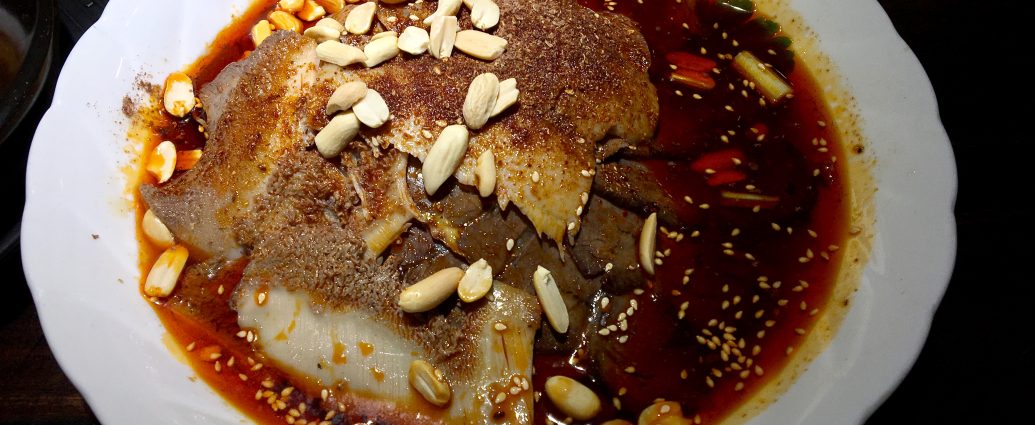
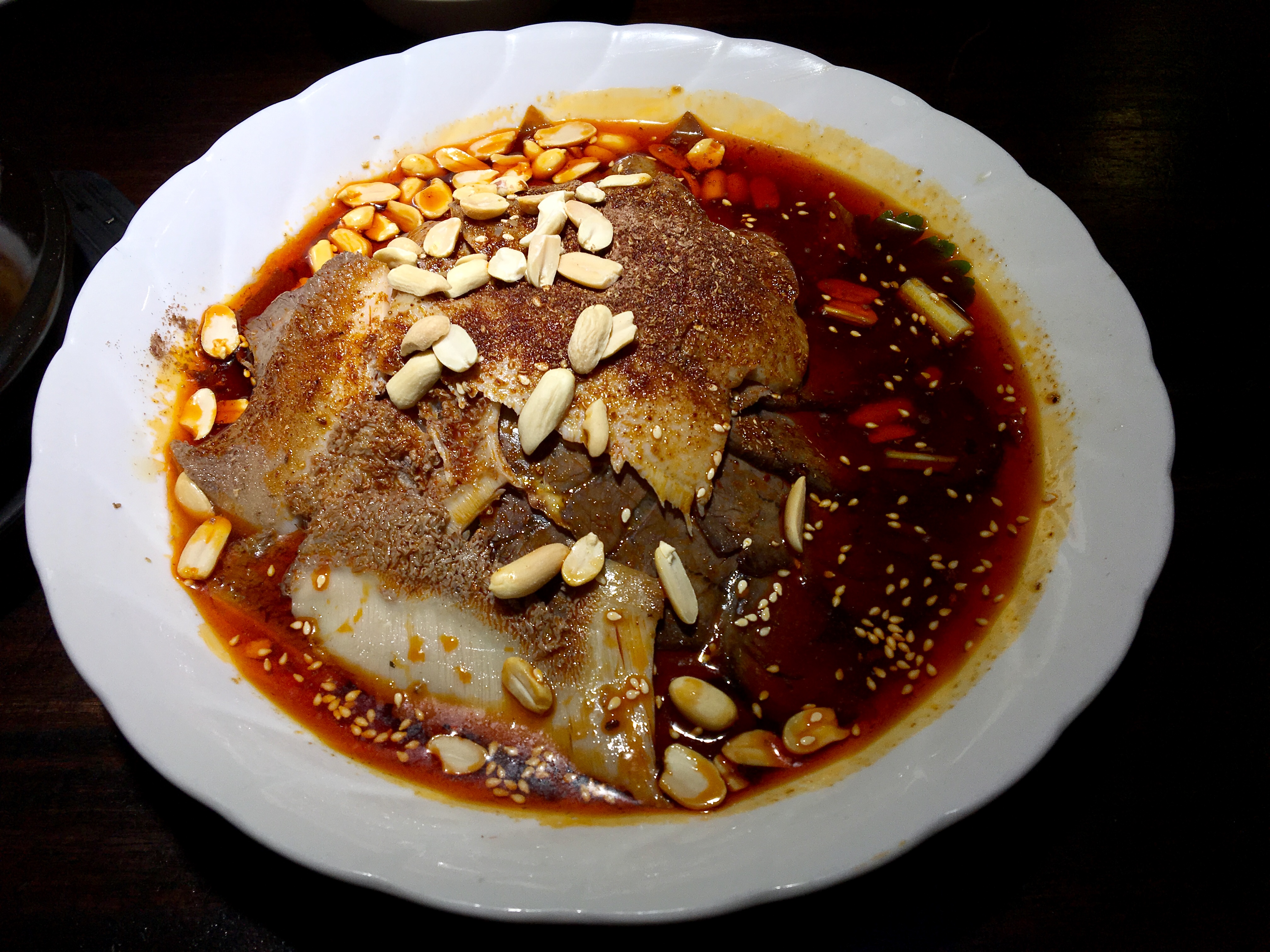
Fu Qi Fei Pian (夫妻肺片), or Couple’s Delight, is one of Sichuan’s most famous cold dishes — paper-thin slices of beef, beef tongue, and tripe tossed in a fiery chili-oil dressing with toasted peanuts and sesame. Despite the name (which translates literally as “couple’s lung slices”), no lungs are involved. The name honors the married couple who invented the dish in 1930s Chengdu. Here is the authentic recipe.
Fu qi fei pian (夫妻肺片), also called Couple’s Delight, is a Sichuan cold dish of thinly sliced beef, beef tongue, and tripe dressed in chili oil, Sichuan peppercorns, garlic, and sesame. It is spicy, numbing, and savory, served cold with crushed peanuts.
The story is one of the most charming in Chinese food history. In 1930s Chengdu, a couple named Guo Chaohua and Zhang Tianzheng sold a cheap street snack made from offcuts — beef scalp, heart, tongue, and tripe that butchers discarded — simmered with spices and dressed in chili oil. The dish was originally called 废片 (fèi piàn), “discarded slices,” a nod to the humble ingredients. Business thrived, the couple’s cart became a shop, and customers began calling it 夫妻肺片 — “the couple’s slices” — honoring the two of them. The characters shifted from 废 (discarded) to 肺 (lung) along the way, which is why the name mentions an organ the dish has never contained.
This recipe comes from a Chengdu master who taught me the essential dressing technique: the chili oil is the star, but the balance of black vinegar, soy, and a pinch of sugar is what turns a good dressing into a great one. The meat is boiled with spices until tender, then sliced paper-thin.
The Dressing Is the Dish
Boiled beef and tripe are neutral — pleasant, but not memorable on their own. Everything that makes 夫妻肺片 distinctive lives in the dressing, and the dressing is a careful four-way balance:
- 辣 (spicy) — chili oil (红油) with plenty of sediment, for color and body as much as heat
- 麻 (numbing) — freshly toasted and ground Sichuan peppercorn, added last so the tingle stays bright
- 酸 (sour) — a restrained amount of Chinkiang vinegar, enough to sharpen without souring
- 咸甜 (salty-sweet) — light soy and a pinch of sugar, which rounds the chili and gives the dressing its glossy cling
Garlic, sesame oil, and toasted sesame paste add depth and body. Crushed roasted peanuts and sesame seeds go on top for crunch, and a scatter of scallion and cilantro finishes it. Sichuan cooks describe the ideal as 麻辣鲜香 — numbing, spicy, fresh, and fragrant all at once.
Boil, Chill, Slice Thin
- Boil with aromatics — beef shank, tongue, and tripe simmered with ginger, scallion, star anise, cinnamon, and Sichuan peppercorn until tender
- Cook each cut to its own time — tripe needs far longer than shank; remove each when done
- Chill completely before slicing — cold meat slices thin and clean; warm meat tears
- Slice as thin as you can — 1–2mm; the traditional standard is translucent
- Dress just before serving — the meat absorbs the dressing quickly, and an hour of marinating is ideal
Ingredients and Where to Find Them
- Beef shank — beef shank, simmered until tender and sliced thin
- Sichuan chili oil — chili oil with sediment (红油)
- Sichuan peppercorns — whole Sichuan peppercorns, toasted and ground fresh
Also needed: beef tongue and/or tripe (optional but traditional), garlic, Chinkiang vinegar, light soy sauce, sugar, sesame oil, sesame paste, roasted peanuts, scallions, and cilantro. Star anise, cinnamon, and bay leaves go into the poaching liquid.
How to Make It
- Simmer 600g (1.3 lb) beef shank in water with ginger, scallion, 2 star anise, 1 cinnamon stick, and 1 teaspoon Sichuan peppercorns for 90 minutes until tender; add cleaned tripe to a separate pot and cook 2 hours
- Reserve 4 tablespoons of the poaching liquid; cool the meats completely, ideally overnight in the refrigerator
- Slice the beef and tripe as thinly as possible and arrange on a plate
- Make the dressing: 3 tablespoons chili oil, 2 tablespoons light soy, 1 tablespoon Chinkiang vinegar, 1 teaspoon sugar, 1 teaspoon sesame oil, 1 tablespoon sesame paste, 3 minced garlic cloves, and the reserved poaching liquid
- Toast and grind 1 tablespoon Sichuan peppercorns; stir half into the dressing
- Pour the dressing over the sliced meats and toss gently to coat
- Top with crushed peanuts, sesame seeds, scallions, cilantro, and the remaining ground peppercorn; rest 20 minutes and serve cool
Variations
- Beef only — skip the tripe and tongue; shank alone makes an excellent, simpler version
- With tendon — simmered beef tendon adds a gelatinous texture that many consider essential
- Extra numbing — finish with 1 teaspoon of 藤椒油 (green peppercorn oil)
- With cucumber — a bed of smacked cucumber lightens the dish and soaks up the dressing
Frequently Asked Questions
Why is it called “couple’s lung slices” if there is no lung?
The dish was created by a married couple, Guo Chaohua and Zhang Tianzheng, in 1930s Chengdu, and was originally called 废片 — “discarded slices,” after the cheap offcuts used. Customers renamed it 夫妻肺片 in their honor, and the character shifted to 肺 (lung) over time. It is a name of affection, not a description of the ingredients.
What meats are traditionally used?
Beef shank, beef tongue, beef heart, and tripe are traditional — the offcuts that were cheap and plentiful. Modern restaurant versions usually use beef shank and tripe. You can make an excellent version with shank alone.
How spicy is it?
Quite spicy and distinctly numbing, though the chili oil is aromatic rather than purely hot. You can reduce the chili oil and peppercorn, but the dressing is the point of the dish, so do not strip it back too far.
How long does it keep?
2-3 days refrigerated — the dressing-soaked meat improves overnight. Store the dressing separately if serving over multiple days.
More Sichuan Cold Dishes
Build a Sichuan cold-dish platter with my Garlic White Pork 蒜泥白肉, the classic Mouthwatering Chicken 口水鸡, or the street-style Bo Bo Chicken 钵钵鸡.
As an Amazon Associate, I earn from qualifying purchases. These are affiliate links at no extra cost to you.
1 Comment