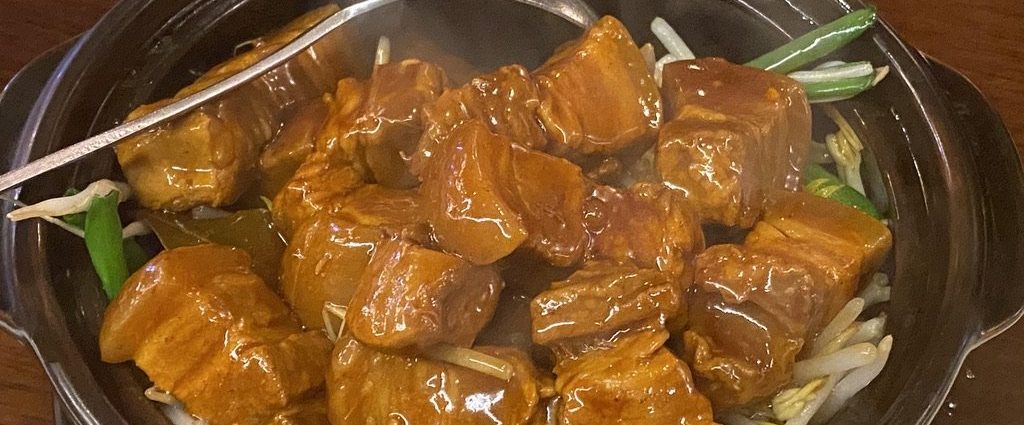
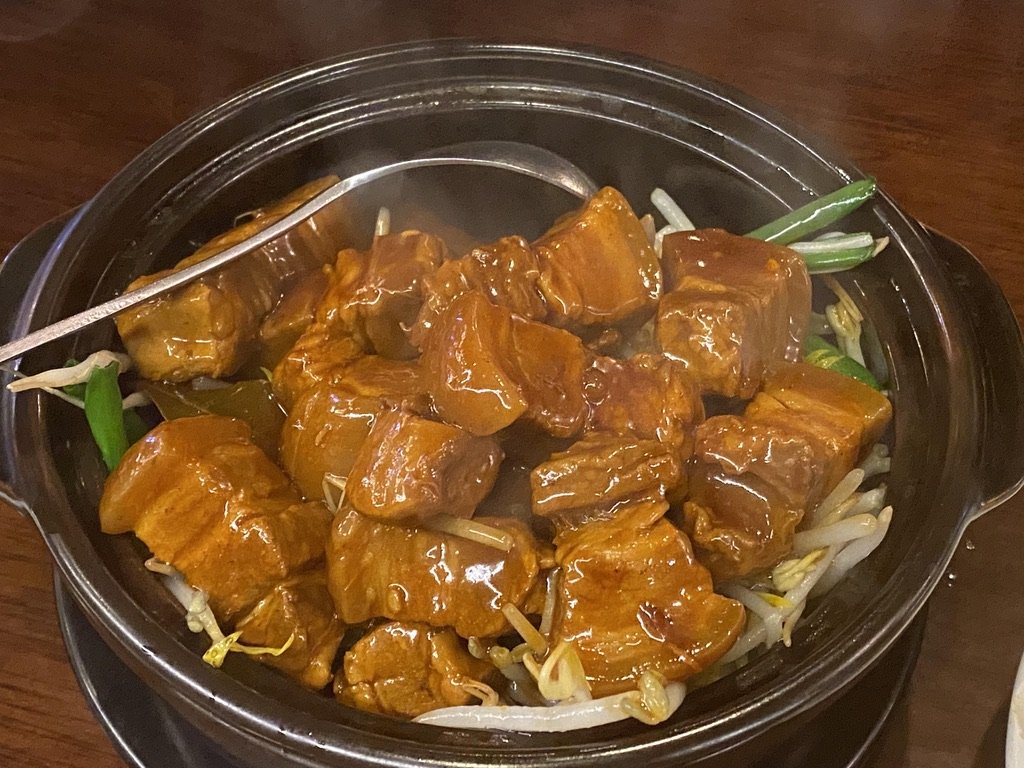
Hong Shao Rou (红烧肉) is the ultimate Chinese comfort food — tender, melt-in-your-mouth pork belly braised in a rich, sweet-savory sauce of soy sauce, rock sugar, and aromatic spices. Each bite is a perfect balance of rich pork fat, caramelized sweetness, and deep umami.
红烧肉 is one of the most personal dishes in Chinese cooking — every region, and every family, makes it differently. The Shanghai version is dark, glossy, and sweet, with a thick glaze; the Hunan version, 毛氏红烧肉, is famously associated with Mao Zedong and skips the soy sauce in favor of caramelized sugar for color; the Zhejiang 东坡肉 is a close cousin, named for the Song dynasty poet Su Dongpo and simmered in wine. What they share is the technique: caramelize sugar, brown the pork, then braise low and slow until the fat turns to silk and the sauce thickens to a lacquer. It is a dish about patience, not ingredients.
This recipe comes from my travels in Hunan, where I watched a grandmother in a tiny village kitchen transform simple ingredients into something magical. The secret? Low and slow cooking, and the patience to let the pork belly caramelize properly before braising.
Why the Sugar Comes First
红烧 begins with 炒糖色 (chǎo táng sè) — frying rock sugar in oil until it melts, darkens to an amber or mahogany color, and begins to smell of caramel. The pork is then turned in that caramel, which coats every piece and gives the dish its deep red-brown color and its characteristic bittersweet depth. Skip this step and the dish tastes flat; burn the sugar and it turns bitter. The window is narrow — a few seconds between amber and acrid — which is why the sugar must be watched constantly and the pork must be ready to go in before you start.
The Braise: Time and Temperature
- Blanch the pork first — 3 minutes in boiling water removes impurities and firms the meat for browning
- Brown the pieces well before adding liquid; the Maillard reaction adds flavor that braising alone cannot
- Use hot water, never cold — cold water shocks the meat and makes it tough
- Bare simmer only — a rolling boil breaks down the fat into the sauce and leaves it greasy
- 90 minutes minimum, 2 hours better; the collagen needs time to melt into gelatin
- Reduce uncovered at the end until the sauce coats the back of a spoon and glazes each piece
Ingredients and Where to Find Them
- Skin-on pork belly — pork belly, cut into 3cm cubes with clear layers
- Rock sugar — rock sugar (冰糖) melts more evenly than granulated and gives a cleaner glaze
- Shaoxing wine — Shaoxing wine for the braising liquid
Also needed: light and dark soy sauce, ginger, scallions, star anise, bay leaves, and a cinnamon stick. Some cooks add dried tangerine peel or a splash of vinegar to cut the richness.
How to Make It
- Cut 1kg (2.2 lb) skin-on pork belly into 3cm cubes and blanch 3 minutes in boiling water; drain and pat dry
- Heat 2 tablespoons oil in a heavy pot, add 50g (1/4 cup) rock sugar, and cook over medium-low heat until it melts and turns amber — watch closely
- Add the pork and turn to coat in the caramel; brown on all sides for 5 minutes
- Add 3 ginger slices, 3 scallions, 2 star anise, 1 cinnamon stick, and 2 bay leaves; stir 30 seconds
- Pour in 2 tablespoons Shaoxing wine, 2 tablespoons light soy, 1 tablespoon dark soy, and hot water to just cover
- Bring to a boil, then reduce to the barest simmer, cover, and braise 90 minutes to 2 hours
- Uncover, raise the heat, and reduce 10–15 minutes until the sauce is thick and glossy and coats each piece; serve with steamed rice
Variations
- Hunan 毛氏红烧肉 — omit the dark soy and rely entirely on caramelized sugar for color; add dried chilies for heat
- With bamboo shoots — a Shanghai variation that adds texture and lightens the richness
- With eggs — hard-boiled eggs simmered in the sauce for the last 20 minutes; a classic addition
- With potatoes or taro — added in the last 30 minutes; they soak up the sauce beautifully
Frequently Asked Questions
How do I keep the pork from being greasy?
Render the fat properly and skim it off. Blanching removes surface fat, browning drives out more, and during the braise the fat rises to the surface where you can spoon it away. The final uncovered reduction is what concentrates the sauce rather than leaving the dish swimming in oil.
Why did my sugar burn?
The heat was too high or you looked away. Caramelizing rock sugar takes only 2–3 minutes and goes from amber to bitter very quickly. Use medium-low heat, keep the pieces moving, and have the pork ready to add the moment the sugar reaches a deep amber color.
Is Hong Shao Rou served dry or with sauce?
Traditional Shanghai-style serves it with a thick, sticky glaze coating each piece — not swimming in liquid. Reduce the sauce until it generously coats the back of a spoon.
Can I use a slow cooker?
Yes, for the braise. Do the caramelizing and browning in a pan first — that step cannot be skipped — then transfer everything to the slow cooker and cook on low for 4–5 hours. Finish by reducing the sauce in a pan on the stove, since a slow cooker will not thicken it.
More Braised & Comfort Classics
Love slow-braised Chinese food? Try my Honey Char Siu 蜜汁叉烧, the tofu classic Home-Style Braised Tofu 家常豆腐, or the everyday Xiao Chao Rou 小炒肉.
As an Amazon Associate, I earn from qualifying purchases. These are affiliate links at no extra cost to you.