
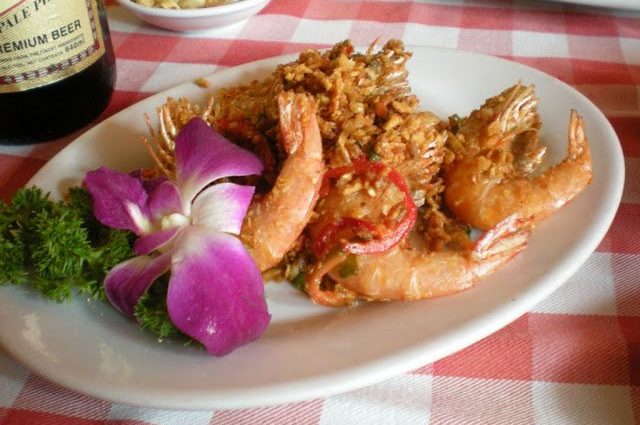
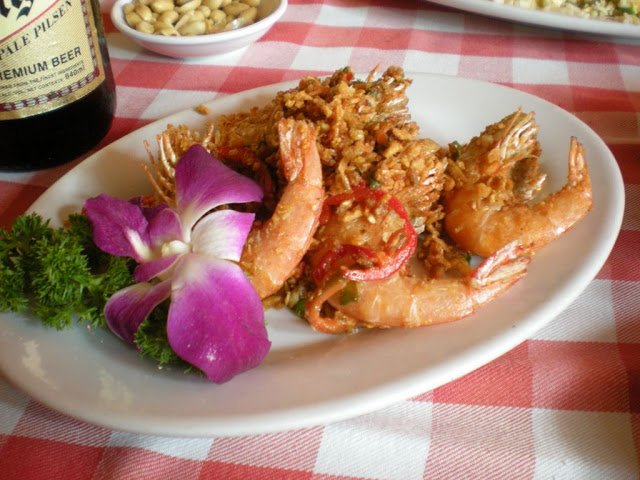
Salt and Pepper Prawns (椒盐虾) is a Cantonese restaurant classic — plump prawns tossed in cornstarch and deep-fried until the shells are shatteringly crisp, then stir-fried with a fragrant mix of garlic, chilies, and the namesake salt and pepper seasoning. The shells become so crispy they are meant to be eaten whole.
椒盐 (jiāo yán) means “pepper salt,” and it is one of the cornerstones of Cantonese seafood cooking — a simple dry seasoning that lets the natural sweetness of fresh shellfish lead. In Hong Kong’s 大排档 (dai pai dong, open-air food stalls), salt and pepper prawns arrive at the table still crackling, tossed with fried garlic, sliced chilies, and scallions. The technique is Chinese in its restraint: no batter, no sauce, just starch, oil, and a fragrant dusting at the end.
This recipe comes from a seafood restaurant in Hong Kong where the chef taught me that the key is to coat the prawns lightly in potato starch (not flour) and fry them twice — once at medium heat to cook, once at high heat to crisp the shells to a glassy crunch.
大排档: The Open-Air Kitchen
椒盐虾 is inseparable from 大排档 — Hong Kong’s open-air food stalls, which set up tables on the pavement and cook over ferocious gas burners with a wok that has seen thousands of dishes. The format emerged in the mid-twentieth century and became a fixture of Hong Kong eating: plastic stools, cold beer, and a menu of seafood, stir-fries, and claypot dishes priced for a family. The cooking is fast and unfussy, and it rewards the kind of high-heat technique that is impractical in a home kitchen but achievable with a hot wok and a willingness to use oil. Salt and pepper prawns are among the most ordered dishes in that setting, because they arrive hot, crisp, and dramatic — a pile of glistening prawns with fried garlic scattered over them.
Potato Starch and the Double Fry
- Potato starch, not flour or cornstarch — it fries into a thinner, glassier crust and does not absorb oil as readily
- Coat lightly and shake off the excess — a heavy coating steams into a soft, doughy shell; a thin one crisps
- Dry the prawns thoroughly first — surface moisture is the enemy of crispness and causes violent spattering
- First fry at 160°C (320°F) — cooks the prawns through and sets the coating
- Second fry at 190°C (375°F) — drives off remaining moisture and blisters the shell to a crunch
- Fry in small batches — crowding drops the oil temperature and leaves the prawns greasy
- Drain on a rack, not paper — paper traps steam and softens the crust from below
The 椒盐 Seasoning
椒盐 is a dry seasoning blend, and it is deceptively simple: salt, ground white pepper, and often a pinch of five-spice or ground Sichuan peppercorn. Cantonese versions sometimes add a little sugar to round it out. In this dish the blend is tossed with the fried prawns along with fried garlic, sliced fresh chilies, and scallions — the heat of the wok blooms the aromatics, and the seasoning coats the shells rather than dissolving into a sauce. Because the seasoning is applied at the very end and off the highest heat, it stays bright and fragrant instead of scorching.
Ingredients and Where to Find Them
- Prawns — shell-on prawns, head on if you can get them
- Potato starch — potato starch for the crust
- White pepper — ground white pepper for the 椒盐 blend
Also needed: garlic, fresh red and green chilies, scallions, five-spice powder, salt, sugar, Shaoxing wine, and oil for frying. Lime or lemon wedges for serving.
How to Cook It
- Devein 600g (1.3 lb) shell-on prawns, keeping the shells intact; pat completely dry and dust lightly with potato starch
- Mix the 椒盐: 2 teaspoons salt, 1 teaspoon white pepper, 1/4 teaspoon five-spice, and 1/2 teaspoon sugar
- Heat oil to 160°C (320°F) and fry the prawns in batches for 90 seconds until just cooked; drain on a rack
- Raise the oil to 190°C (375°F) and fry again for 45 seconds until the shells are crisp; drain
- Pour off the oil, leaving 1 tablespoon, and stir-fry 5 minced garlic cloves and the sliced chilies for 30 seconds
- Return the prawns, sprinkle over the 椒盐, and toss over high heat for 20 seconds
- Add the scallions, toss once, and serve immediately with lime wedges
Variations
- With squid (椒盐鲜鱿) — scored squid tubes, fried the same way; a dai pai dong staple
- With tofu (椒盐豆腐) — firm tofu cubes, coated and fried, tossed in the same seasoning
- With soft-shell crab — the whole crab is edible, and the seasoning suits it perfectly
- With 蒜香 (extra garlic) — increase the fried garlic and add it in two stages for a deeper flavor
Frequently Asked Questions
Why are my prawn shells still tough?
The second fry was missing or not hot enough. The high-temperature second fry is what blisters the shell into something edible; at 160°C the shell cooks but stays leathery. Dry the prawns thoroughly and fry again at 190°C for about 45 seconds.
Can I use cornstarch instead of potato starch?
You can, but potato starch gives a thinner, glassier, less oily crust. Cornstarch tends to produce a slightly thicker coating that softens faster once out of the oil.
Do I have to eat the shells?
Not at all, but the dish is designed so that you can. Double-frying makes the shells thin and crisp, and they carry the salt and pepper seasoning. If you prefer, peel them — the meat inside will still be sweet and juicy.
What is 椒盐?
椒盐 (jiāo yán) is a simple Chinese seasoning of salt and ground white or Sichuan pepper, often with a little five-spice. Some Cantonese kitchens add a pinch of sugar to round it out. It is used across seafood, tofu, and fried meat dishes.
More Cantonese Seafood & Classics
Love Cantonese seafood? Try my Steamed Scallops with Garlic Vermicelli 蒜蓉粉丝蒸扇贝, the iconic Typhoon Shelter Crab 避风塘炒蟹, or the classic Steamed Fish 清蒸鱼.
As an Amazon Associate, I earn from qualifying purchases. These are affiliate links at no extra cost to you.


4 Comments