
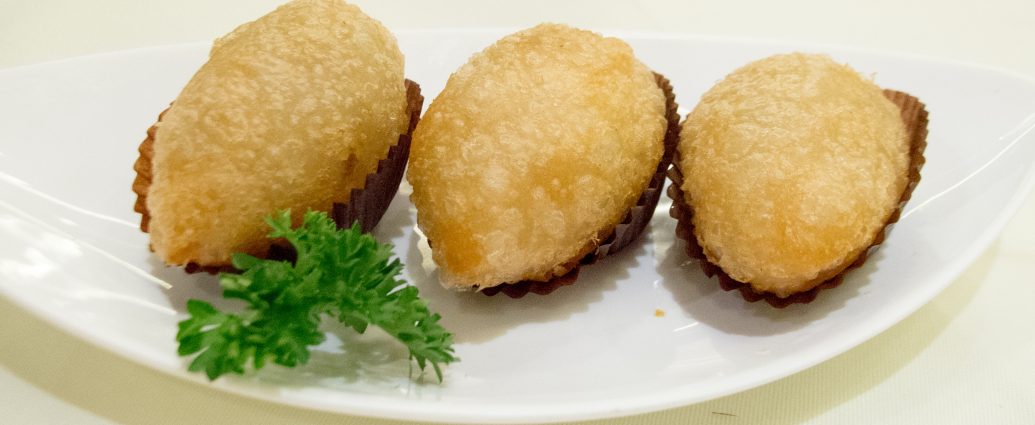
Ham Sui Gok (咸水角) is the underrated star of the dim sum trolley — a golden, teardrop-shaped dumpling that shatters when you bite into it, revealing a sticky, chewy glutinous rice shell and a savory filling of pork, shrimp, and dried mushrooms. Its name means “salty water dumpling,” a playful nod to its crispy, blistered crust that bubbles like it has been fried in sea water.
Unlike har gow or siu mai, which showcase delicate steamed wrappers, Ham Sui Gok is all about texture contrast: a crisp, blistered exterior, a soft and chewy glutinous rice layer, and a juicy, savory center. The trick lies in the dough — a hot-water glutinous rice pastry that fries into a crackling shell while staying tender inside. Served piping hot from the fryer, it is the dim sum that never makes it to the leftovers box.
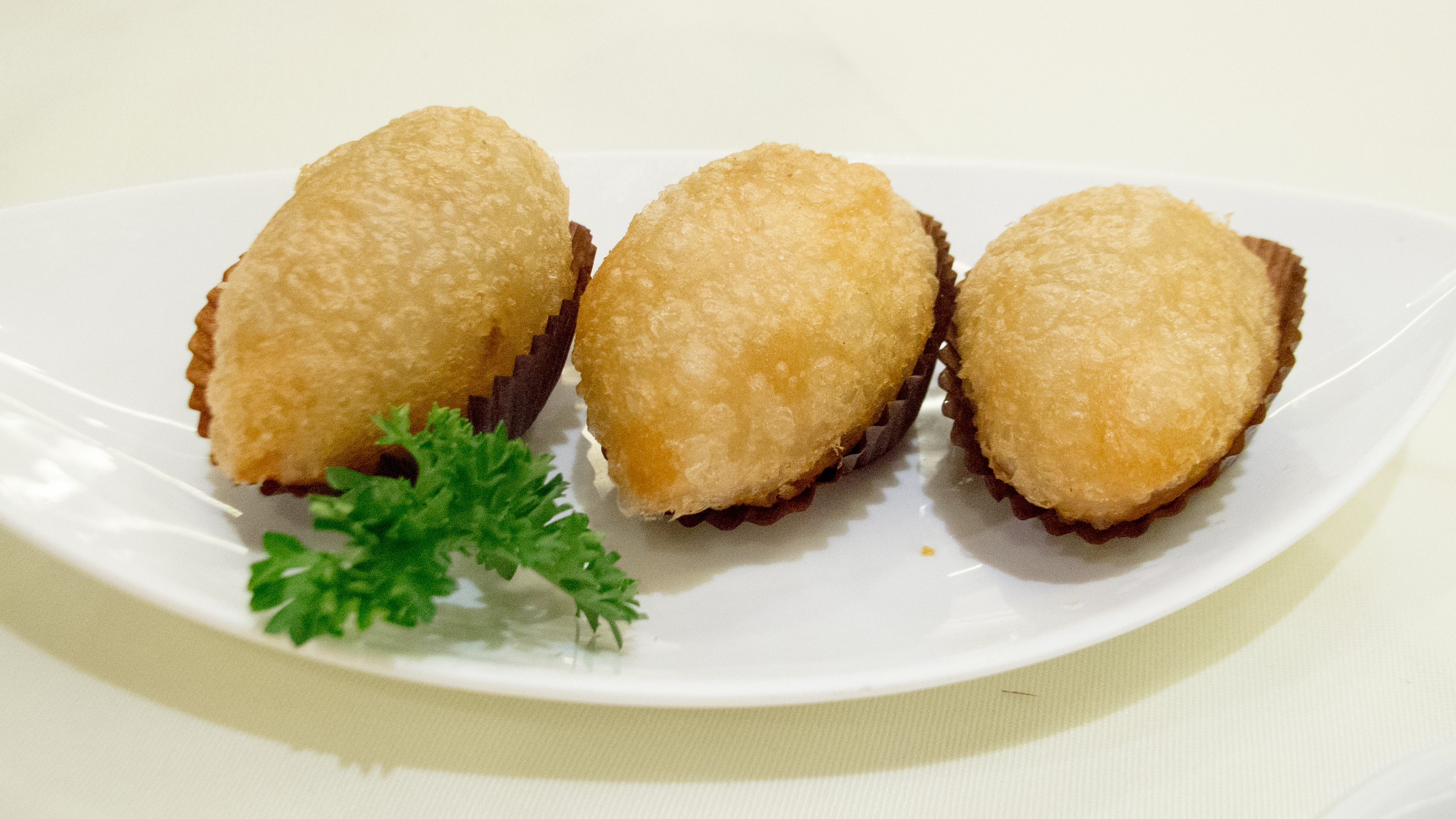
Photo: SML via Wikimedia Commons, CC BY 2.0
The Fried Side of the Dim Sum Cart
Dim sum divides into two broad families: steamed (蒸) and fried (炸). Steamed dim sum dominates the conversation — har gow, siu mai, and char siu bao get all the attention — but the fried category is where texture becomes the point. 咸水角 belongs there, alongside spring rolls, 芋角 (taro puffs), and 咸水角’s close relative 煎堆 (sesame balls). What unites them is a wrapper designed to transform under hot oil: glutenous rice flour, which fries into a shell that is crisp on the outside and stretchy within. In a Cantonese tea house, a basket of fried items usually arrives alongside the steamed ones to give the table contrast — something crunchy between the soft dumplings.
Why Glutinous Rice Flour, Not Wheat
- Glutinous rice flour contains no gluten — its elasticity comes from starch, not protein, which is why it stretches and chews rather than tearing
- It must be scalded with boiling water — hot water gelatinizes the starch so the dough becomes pliable and holds its shape
- It fries into blisters — the moisture in the dough turns to steam under the hot oil, puffing the surface into the signature bubbled crust
- It is fragile when raw — the dough tears easily, so it must be worked gently and sealed carefully
- It stiffens as it cools — which is why 咸水角 are served immediately and never reheated in a microwave
Ingredients and Where to Find Them
- Glutinous rice flour — glutinous rice flour; not regular rice flour, which behaves completely differently
- Dried shrimp — dried shrimp for the filling’s savory depth
- Chinese chives — Chinese chives, or scallions as a substitute
Also needed: ground pork, dried shiitake, bamboo shoots, light soy sauce, oyster sauce, Shaoxing wine, sesame oil, sugar, white pepper, cornstarch, and oil for deep-frying.
How to Make Them
- Filling: stir-fry 150g (5 oz) ground pork with 2 tablespoons soaked dried shrimp, 4 diced shiitake, and 60g diced bamboo shoots; season with 1 tablespoon light soy, 1 tablespoon oyster sauce, 1 teaspoon sugar, and Shaoxing wine; thicken with cornstarch, then fold in chopped chives and cool completely
- Dough: pour 200ml boiling water over 250g glutinous rice flour with 1 teaspoon sugar and 1/2 teaspoon salt; stir, then knead in 2 tablespoons oil until smooth; rest 20 minutes
- Divide into 16 pieces and flatten each into a round with a slight hollow in the center
- Place a teaspoon of filling in each, fold over, and seal into a crescent; pinch the seam firmly and shape into a plump teardrop
- Heat oil to 160°C (320°F) and fry in batches for 4–5 minutes, turning, until golden and blistered
- Raise the heat briefly to 180°C (355°F) for 30 seconds to crisp the surface; drain on a rack
- Serve immediately — these are at their best within minutes of frying
Variations
- With taro (芋角) — mashed taro added to the dough gives a fluffier, more delicate shell; the classic 蜂巢芋角 with a honeycomb crust
- With char siu — diced barbecue pork in place of ground pork
- Vegetarian — mushrooms, bamboo shoots, and cabbage with extra oyster sauce substitute
- With a sweeter filling — a version filled with sweet coconut or peanut for a dessert dim sum
Frequently Asked Questions
Why did my ham sui gok burst during frying?
Air trapped inside, or a weak seal. Press the seam firmly and squeeze out any air before frying. Frying at too high a temperature also causes the shell to puff too fast and split — start at 160°C (320°F) and only raise the heat at the very end.
Can I use regular rice flour instead of glutinous rice flour?
No — they behave completely differently. Glutinous rice flour is what gives the chewy, elastic shell and the blistered crust. Regular rice flour will produce a hard, brittle dumpling.
Can I make them ahead?
Freeze uncooked, sealed dumplings on a tray, then transfer to a bag. Fry from frozen at 170°C (340°F) for 6–7 minutes. Reheat cooked ones in an air fryer or hot oven, never the microwave.
Why is the crust not blistered?
The oil was too cool, or the dough was too dry. The blisters form when moisture inside the dough turns to steam and pushes the surface outward under hot oil. Keep the oil at 160–170°C and make sure the dough is soft and well-hydrated.
More Dim Sum Favorites
Craving more dim sum? Try my Har Gow 虾饺, the classic Shu Mai 烧卖, or crispy Spring Rolls 春卷.
As an Amazon Associate, I earn from qualifying purchases. These are affiliate links at no extra cost to you.
1 Comment