
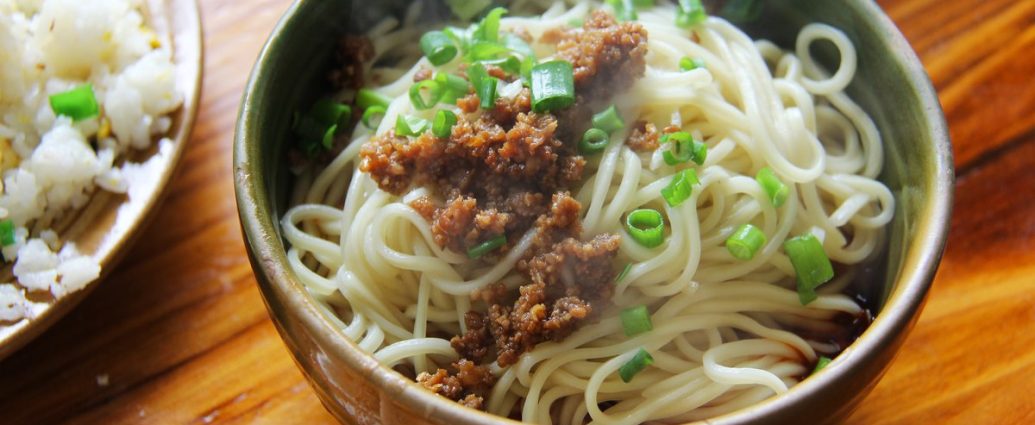
Dan Dan Noodles (担担面) is Sichuan street food at its finest — a bowl of chewy noodles crowned with savory minced pork, crushed peanuts, and a torrent of fragrant chili oil, all held together by a rich, nutty sesame sauce. The name comes from the bamboo pole (dan dan) that street vendors used to carry their wares, swinging pots of noodles and sauce as they walked through Chengdu alleyways.
担担面 began as a genuinely itinerant food. In nineteenth-century Chengdu, a vendor would sling a bamboo shoulder pole across his back — a stove and pot of noodles hanging from one end, a pot of sauce and bowls from the other — and walk the city’s lanes, stopping wherever customers called. The name 担担 literally means “carried on a pole.” The original was a dry dish, not a soup: a small bowl, a spoonful of sauce at the bottom, noodles on top, and a scattering of minced pork. Over the decades it moved into restaurants and diversified, and today you will find both the traditional dry version and soupier variants, but the sauce remains the soul of the dish.
This recipe comes from a night market stall in Chengdu where the vendor had been making dan dan noodles for 40 years. His secret: a dressing of Sichuan chili oil, Chinese sesame paste, and a splash of the noodle cooking water that binds everything into a silky, clingy sauce.
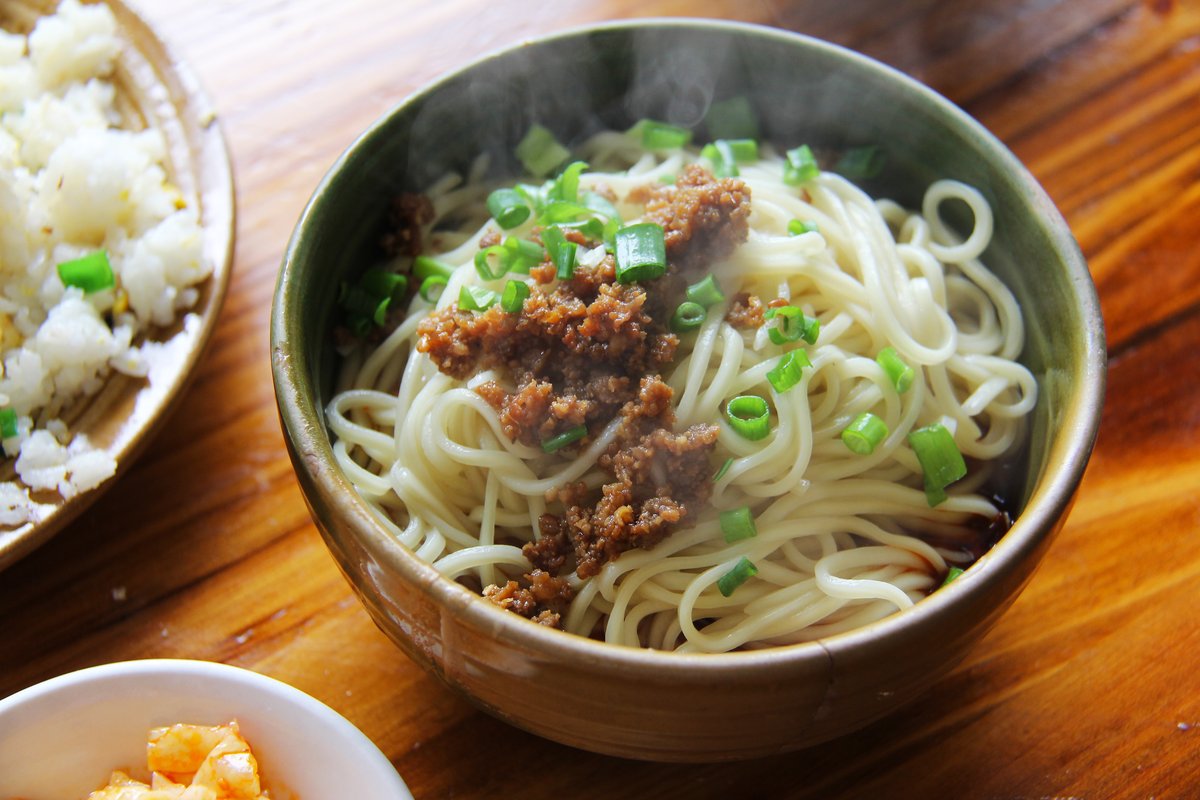
The Dressing Goes in the Bowl First
The assembly order is not arbitrary. In the traditional method, the sauce is built in the bottom of an empty bowl — chili oil, sesame paste, soy, vinegar, garlic water, and ground Sichuan peppercorn — and the freshly boiled noodles are lifted straight from the pot onto it. The residual heat of the noodles warms the sauce, and a spoonful of starchy noodle-cooking water is added to loosen it into something that clings. Tossing happens at the table, from the bottom up, so each strand picks up sauce on the way out. The result is a bowl that is intensely flavored and almost dry, not soupy — which is the authentic 干拌 (dry-tossed) format.
What Makes It 担担
- Chili oil with sediment (红油) — the aromatic, red component; the flakes and paste give body as well as heat
- Chinese sesame paste (芝麻酱) — not tahini; toasted sesame gives the nutty, slightly bitter backbone
- Ground Sichuan peppercorn — added at the end for the numbing tingle, ground fresh so it stays bright
- Minced pork fried until crisp (肉臊) — the traditional topping, cooked down with soy and a little doubanjiang until dry and crumbly
- Crushed roasted peanuts and scallions — for crunch and freshness against the rich sauce
- A splash of noodle water — the trick that turns a thick paste into a clinging, silky dressing
Ingredients and Where to Find Them
- Sichuan chili oil — chili oil with sediment
- Chinese sesame paste — Chinese sesame paste
- Sichuan peppercorns — whole Sichuan peppercorns, toasted and ground fresh
Also needed: fresh wheat noodles, ground pork, doubanjiang, garlic, ginger, scallions, light soy sauce, Chinkiang vinegar, sugar, roasted peanuts, and preserved vegetables (芽菜) if you can find them — they are traditional in Chengdu.
How to Make It
- Fry 200g (7 oz) ground pork over high heat with 1 tablespoon doubanjiang, garlic, and ginger until dry and crisp, about 5 minutes; set aside
- Build the sauce in each bowl: 2 tablespoons chili oil, 1 tablespoon sesame paste loosened with 1 tablespoon warm water, 1 tablespoon light soy, 1 teaspoon Chinkiang vinegar, 1 teaspoon garlic water, 1/2 teaspoon sugar, and 1/4 teaspoon ground Sichuan peppercorn
- Toast and crush 1 tablespoon Sichuan peppercorns and 3 tablespoons roasted peanuts
- Cook 300g (10.5 oz) fresh noodles in boiling water until just tender, about 2 minutes
- Add 3 tablespoons of the starchy cooking water to each bowl and stir to combine the dressing
- Lift the noodles directly into the bowls and top with the pork, peanuts, and scallions
- Toss from the bottom at the table and eat immediately
Variations
- With soup (汤担担面) — add 200ml hot stock to the bowl for a soupier version, common in restaurants outside Sichuan
- With preserved vegetables — 芽菜 adds a fermented, savory crunch; traditional in Chengdu
- With sesame-forward dressing — increase the sesame paste for a nuttier, milder bowl
- Milder version — halve the chili oil and skip the peppercorn; the dish remains savory and aromatic
Frequently Asked Questions
Why is my dan dan noodle sauce too thick?
The sesame paste was not loosened. Whisk it with warm water before it goes into the bowl, and add a splash of the starchy noodle-cooking water when the noodles go in — that liquid is what turns the paste into a clinging sauce.
Is dan dan noodles a soup or a dry dish?
Traditionally it is dry — 干拌, tossed in a sauce rather than served in broth. Many restaurants outside Sichuan serve a soupier version, which is delicious but not the original format. Try the dry version first.
What is the difference between dan dan noodles and Chongqing small noodles?
Both are Sichuan-style dressed noodles, but dan dan noodles are defined by sesame paste and a minced pork topping, while Chongqing small noodles are built on chili oil with braised peas and pork, and contain almost no sesame.
How spicy is this dish?
Authentic dan dan noodles are moderately to very spicy. The heat builds with each bite. Control the spice level by adjusting the amount of chili oil and Sichuan peppercorn. Start with 1 tbsp chili oil for a mild version and increase from there.
More Sichuan Street Food
Love Sichuan flavors? Try my Suan La Fen 酸辣粉, the chili-oil Hong You Chao Shou 红油抄手, or the dressed Chongqing Small Noodles 重庆小面.
As an Amazon Associate, I earn from qualifying purchases. These are affiliate links at no extra cost to you.
3 Comments