
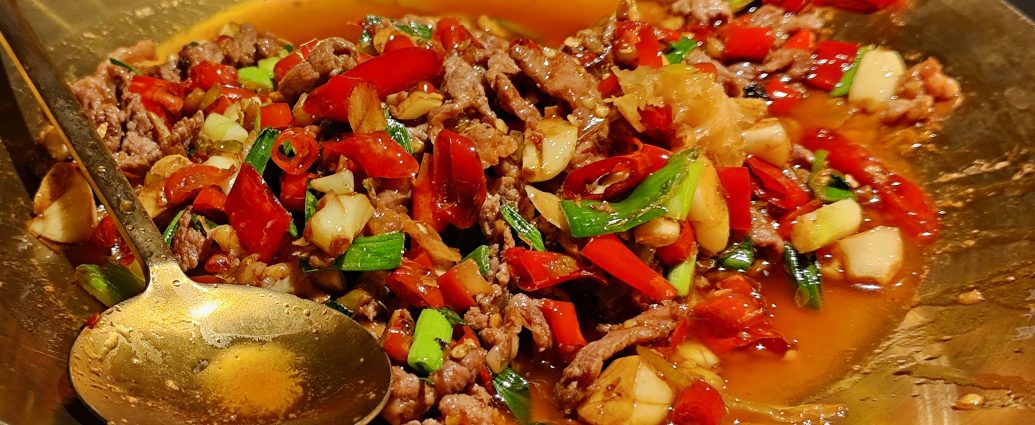
Xiao Chao Huang Niu Rou (小炒黄牛肉) is the dish that put “Hunan small stir-fry” on China’s food map — velveted slices of yellow beef flash-fried at roaring heat with fresh red chilies, pickled chilies, garlic, and celery, all coated in a glossy, salty-spicy sauce that begs for rice. Order it at any Changsha restaurant and you will see why Hunan people call it 米饭杀手, the “rice killer.”
The dish comes from the “Xiao Chao” (小炒) tradition of Hunan home cooking: a small wok, a very hot flame, and quick, confident tosses that seal in juices. What sets this version apart is the beef — 黄牛肉 (yellow beef) from native Chinese cattle breeds is leaner and beefier than grain-fed imports. The name literally means “small-stir-fried yellow beef,” and this recipe recreates the signature wok hei and chili heat at home.
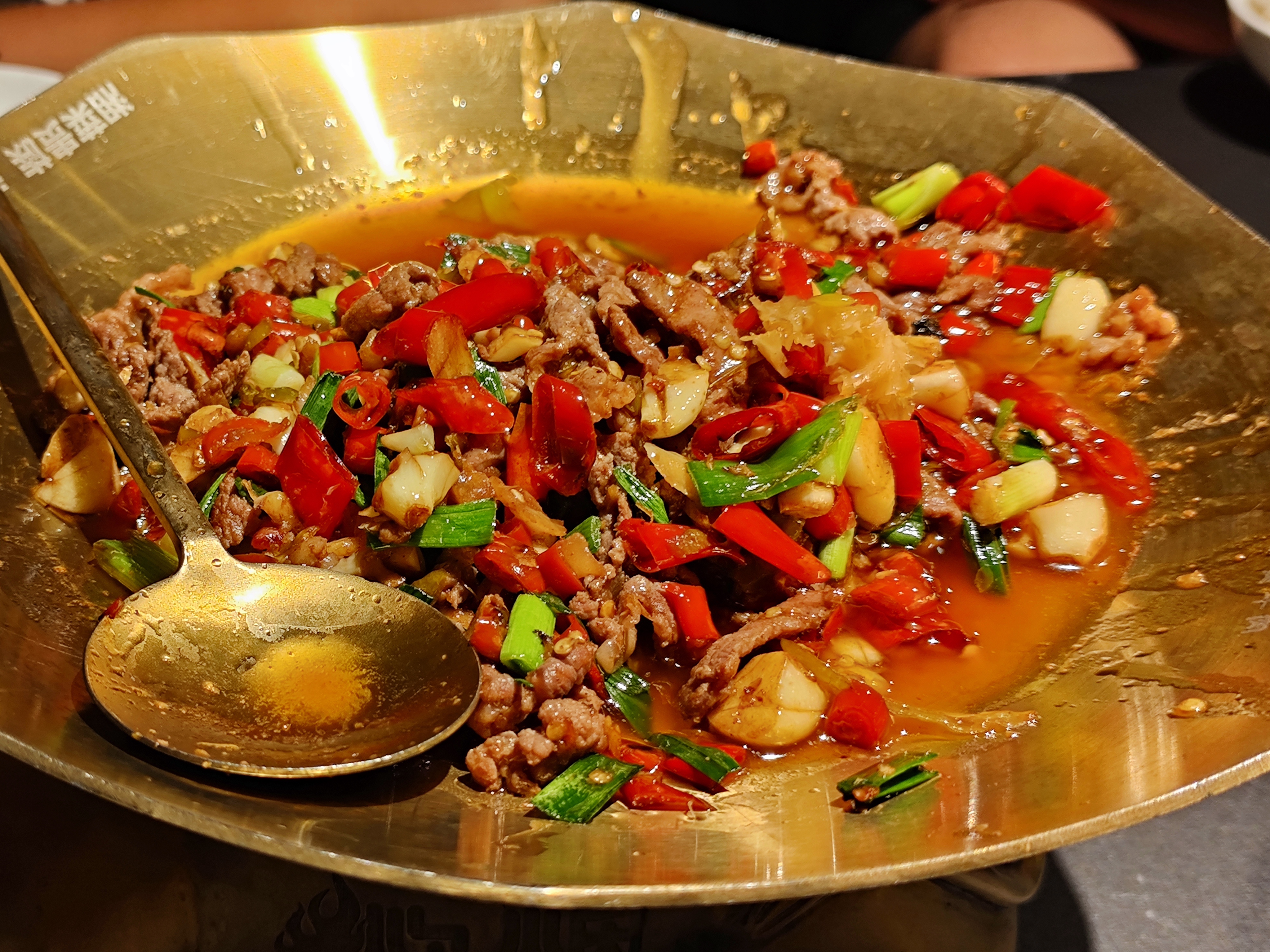
Photo via Wikimedia Commons, CC BY-SA 4.0
What 小炒 Really Means
小炒 (xiǎo chǎo) translates as “small stir-fry,” and the word 小 is doing real work. It refers not to portion size but to the scale of the operation: a home wok, a single portion, a fierce flame, and a cooking time measured in seconds. Hunan cooks contrast 小炒 with 大锅菜 — the big-pot cooking of banquet kitchens and canteens — and they prize the former for its immediacy. In a proper 小炒, the ingredients are cut small, the wok is smoking hot, and the entire cook takes two to three minutes. Nothing is braised, nothing waits. That is why 小炒 dishes are almost impossible to replicate well in a slow or crowded pan: the technique depends on speed, and speed depends on heat.
Yellow Beef and Why It Matters
- 黄牛 (yellow cattle) — native Chinese breeds, smaller and slower-growing than imported beef cattle, with leaner meat and a more pronounced beef flavor
- Leaner means less margin for error — without fat to insulate it, the beef toughens quickly, which is exactly why velveting matters here
- Slice thin against the grain — 2–3mm slices, cut across the muscle fibers so they stay tender
- Velvet with baking soda and cornstarch — a pinch of baking soda raises the surface pH and keeps the fibers from tightening; the cornstarch holds moisture
- Do not marinate too long — 15–20 minutes is plenty; longer and the baking soda leaves a soapy edge
- Substitutes — beef flank or skirt works well; avoid lean stewing cuts
Building the Heat
The chilies come in two forms, and both are necessary. Fresh red chilies provide brightness and a clean, sharp burn, while pickled chilies (泡椒) add a fermented, tangy heat that is the signature of Hunan cooking. Garlic goes in with them, and celery — Chinese celery if you can find it — joins at the end for a crisp, aromatic counterpoint. The sauce is deliberately simple: light soy, a little dark soy for color, Shaoxing wine, and a pinch of sugar. It should be salty and glossy, not sweet.
Ingredients and Where to Find Them
- Beef — beef flank or skirt, sliced thin against the grain
- Pickled chilies — pickled chilies (泡椒)
- Chinese celery — Chinese celery, or regular celery sliced thin
Also needed: fresh red chilies, garlic, ginger, light and dark soy sauce, Shaoxing wine, baking soda, cornstarch, egg white, sugar, and a high-smoke-point oil.
How to Cook It
- Slice 300g (10.5 oz) beef into 2–3mm slices against the grain; marinate 15 minutes with 1/4 teaspoon baking soda, 1 tablespoon light soy, 1 tablespoon Shaoxing wine, 1 egg white, and 2 teaspoons cornstarch
- Cut 4 fresh red chilies into rings, 3 pickled chilies into pieces, and 3 celery stalks into batons
- Heat a wok until smoking with 3 tablespoons oil and sear the beef for 60–90 seconds until just browned; remove
- Add the chilies, pickled chilies, garlic, and ginger; stir-fry 30 seconds until fragrant
- Return the beef with 1 tablespoon light soy, 1/2 teaspoon dark soy, and 1/2 teaspoon sugar
- Toss over maximum heat for 30 seconds, then add the celery and toss 20 seconds more — it should stay crisp
- Serve immediately with steamed rice
Variations
- With 剁椒 — Hunan chopped chili instead of fresh chilies for a fermented, saltier heat
- With beef tendon or tripe — other 小炒 classics using the same technique
- With pork — 小炒肉 uses the same method with pork belly or shoulder; see my Xiao Chao Rou 小炒肉
- With more heat — add dried chilies with the fresh ones or a spoonful of chili oil at the end
Frequently Asked Questions
Why is my beef tough?
It was sliced with the grain, marinated without cornstarch, or overcooked. Cut across the muscle fibers, velvet with cornstarch and egg white, and sear for no more than 90 seconds. Lean yellow beef has little fat to protect it, so speed is everything.
What is yellow beef and can I substitute it?
黄牛肉 comes from native Chinese cattle breeds and is leaner and more intensely beefy than imported beef. Beef flank or skirt are the best widely available substitutes. Avoid lean stewing cuts, which will not tenderize in a two-minute stir-fry.
Why does the recipe use baking soda?
A small pinch raises the surface pH of the meat, which stops the muscle fibers from tightening during cooking and gives the characteristic silky texture of restaurant stir-fries. Use only a quarter teaspoon — too much leaves a soapy taste and a spongy texture.
Can I make it less spicy?
Yes — reduce the fresh and pickled chilies and add a green bell pepper for bulk. The dish will be milder but still aromatic. Keep some chili for balance, since the salt and heat are designed to work together.
More Hunan Classics to Try
Love Hunan cooking? Try my Xiao Chao Rou 小炒肉 (Stir-Fried Pork with Chili), the famous Steamed Fish Head with Chopped Chili 剁椒鱼头, or the homestyle Fen Zheng Rou 粉蒸肉 (Steamed Pork with Rice Flour).
As an Amazon Associate, I earn from qualifying purchases. These are affiliate links at no extra cost to you.
1 Comment