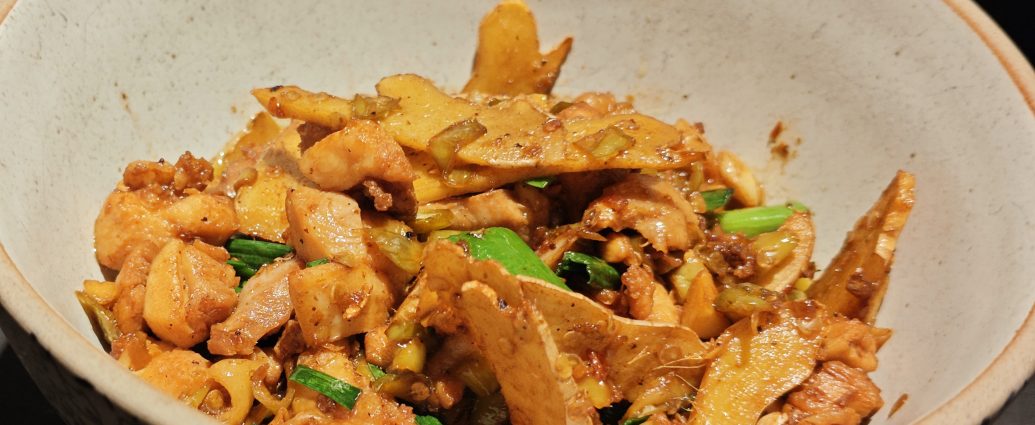
Hunan ginger chicken (生姜炒鸡) is the dish Hunan home cooks make when someone needs warming up — chicken pieces braised and stir-fried with an unapologetic amount of fresh ginger, green chilies, and a splash of rice wine. The ginger is not a background note here; it is the point, delivering a clean, bracing heat that cuts through the richness of the chicken and leaves you feeling restored.
In Hunan kitchens, ginger (生姜) is treated as a vegetable, not a seasoning — sliced into fat coins and cooked down until tender and sweet. This version, common in Changsha and Xiangtan homes, combines that ginger-forward style with the region’s love of fresh green chilies, producing a glossy, savory dish that is lighter than 小炒 but every bit as bold. Serve it with plain rice and a green vegetable, and you have a classic Hunan family dinner.
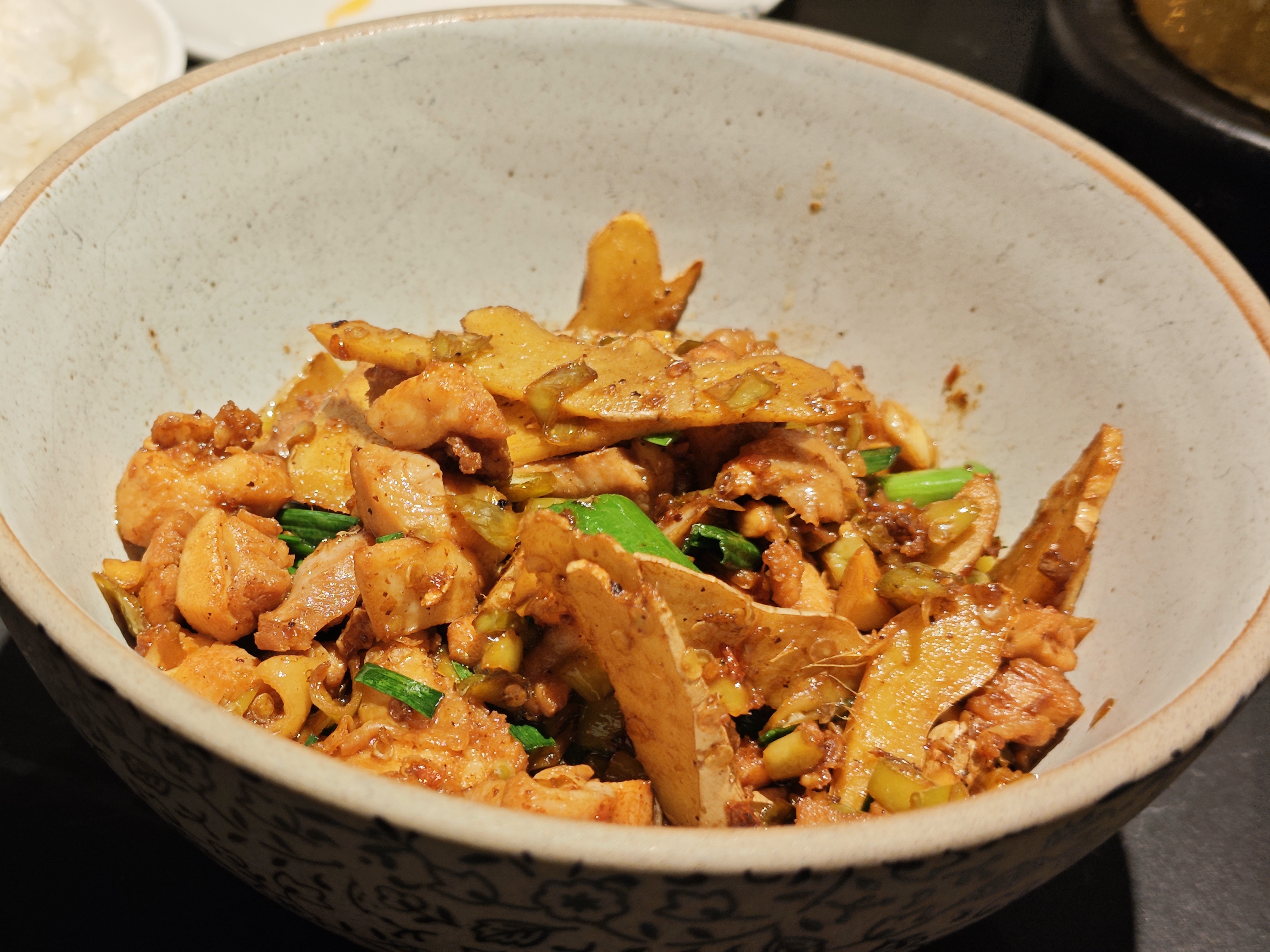
Photo via Wikimedia Commons, CC BY-SA 4.0
Ginger as a Vegetable, Not a Seasoning
This is the idea that makes the dish unfamiliar to cooks outside Hunan. In most Chinese cooking, ginger is an aromatic — a few slivers to remove funk from meat, discarded or left unnoticed. Here, a large knob of ginger is sliced into thick coins and cooked until it softens, sweetens, and loses its raw bite. What remains is tender, faintly sweet, and pleasantly warm — closer to a braised vegetable than a spice. The technique requires enough cooking time and enough liquid for the ginger to mellow, which is why the dish is braised briefly rather than flash-fried. Traditional Chinese cooking regards ginger as a warming ingredient, which is why this dish is associated with cold weather and with recovery; that is a culinary tradition rather than a medical claim.
Building the Dish
- Use bone-in chicken pieces — thighs and drumsticks stay juicy through the braise and give the sauce more flavor
- Be generous with the ginger — 80–100g for a whole chicken; anything less and the dish loses its identity
- Slice the ginger into coins, not slivers — thick slices hold their shape and become tender rather than dissolving
- Fry the ginger first — in hot oil until the edges color slightly; this releases its aroma and starts the softening
- Add rice wine, not just water — Shaoxing wine or 米酒 gives the sauce its fragrance and helps the ginger sweeten
- Finish with fresh green chilies — added late so they keep their bright color and fragrance
Ingredients and Where to Find Them
- Chicken — bone-in chicken thighs, cut into pieces
- Fresh ginger — fresh ginger, a large knob
- Shaoxing wine — Shaoxing wine for the braise
Also needed: fresh green chilies, garlic, scallions, light and dark soy sauce, sugar, and a high-smoke-point oil. Some cooks add a little doubanjiang or pickled chili for extra heat.
How to Cook It
- Cut 800g (1.75 lb) bone-in chicken into pieces; slice 100g ginger into thick coins and 6 green chilies into sections
- Heat 3 tablespoons oil and fry the ginger coins for 3 minutes until fragrant and lightly colored; remove and reserve
- Add the chicken in a single layer and fry over high heat for 5 minutes until the skin is golden
- Add 4 minced garlic cloves and the scallion whites; stir 30 seconds
- Pour in 3 tablespoons Shaoxing wine, 2 tablespoons light soy, 1 teaspoon dark soy, and 1 teaspoon sugar with 150ml water
- Return the ginger, cover, and braise 12 minutes until the chicken is cooked through and the ginger is tender
- Uncover, raise the heat, add the green chilies, and toss 2 minutes until the sauce is glossy; serve with rice
Variations
- With 米酒 (rice wine) — using a sweeter rice wine instead of Shaoxing gives a rounder, more aromatic sauce
- With sesame oil — a traditional version browns the ginger in sesame oil for a deeper, nuttier flavor
- With dried chilies — added with the garlic for a smokier heat
- With duck — the same treatment applied to duck pieces makes 生姜炒鸭, richer and more robust
Frequently Asked Questions
Why is the ginger not spicy in this dish?
Because it is cooked. Long braising softens the ginger’s fibers and mellows its pungency, leaving a sweet, tender slice with gentle warmth. Slicing it thick and giving it time is what transforms it from a seasoning into a vegetable.
How much ginger should I use?
Be generous — about 80–100g for a whole chicken, roughly a 10cm knob. The dish is defined by the ginger, and using too little makes it an ordinary chicken stir-fry. Traditional Hunan home versions use even more.
Can I use chicken breast?
You can, but bone-in thigh is much better. The bones flavor the sauce and the darker meat stays juicy through the braise, while breast tends to dry out. If using breast, reduce the braising time to 8 minutes.
Is this dish very spicy?
It is warmly spicy rather than numbing — the heat comes from fresh green chilies and ginger. For a milder version, remove the chili seeds and membranes, or use green bell peppers and add a pinch of chili flakes for aroma.
More Hunan Favorites
Explore more Hunan flavor: my Dong’an Chicken 东安子鸡, the fiery Xiao Chao Huang Niu Rou 小炒黄牛肉, or the everyday classic Xiao Chao Rou 小炒肉.
As an Amazon Associate, I earn from qualifying purchases. These are affiliate links at no extra cost to you.