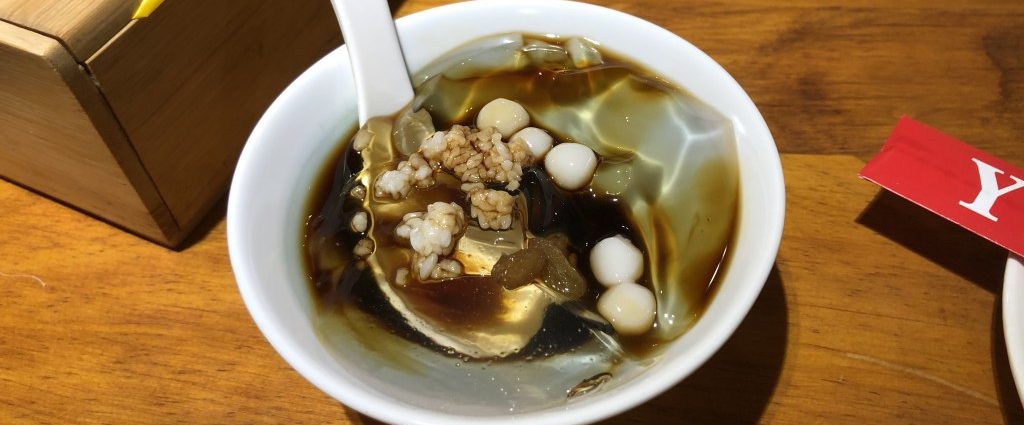
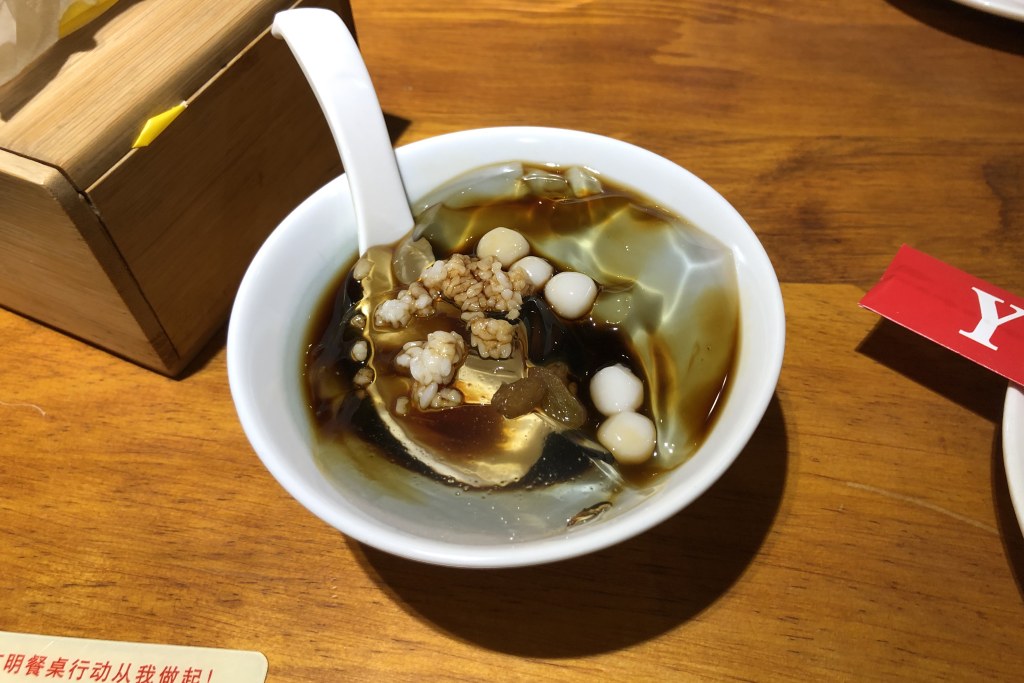
冰粉 (bīng fěn, “ice jelly”) is the dessert that gets Chengdu through summer. A bowl of barely-set, translucent jelly drowning in dark brown sugar syrup and buried under crushed peanuts, fermented rice, chewy rice cakes and dried hawthorn. It is cold, faintly sweet, and the only thing anyone wants when the humidity hits 35°C.
It is also one of the few classic Sichuan preparations with no chili in it at all — and the only one most people have never heard of. Here is how to make it at home, both the easy way and the traditional way.
Bingfen (冰粉) is a Sichuan cold dessert: a soft, translucent jelly made either by hand-rubbing 冰粉籽 (the seeds of Nicandra physalodes) in water and setting it with lime water, or by dissolving 冰粉粉 (a commercial powder) in hot water. It is served chilled in brown sugar syrup with toppings such as crushed peanuts, 醪糟 (fermented rice), mini glutinous rice balls and dried hawthorn. It is vegan, contains no chili, and is usually eaten in summer.
Two Ways to Make It, and Why They Differ
There are two completely different routes to the same bowl, and Sichuan locals have strong opinions about which is correct.
手搓冰粉 (hand-rubbed) is the traditional method. Dried 冰粉籽 are tied into a cloth bag and rubbed in a bowl of water for eight to ten minutes. The seeds release a mucilaginous pectin that thickens the water, and lime water is stirred in to set it. The result is delicate, almost weightless, full of tiny trapped bubbles. It wobbles rather than holds.
冰粉粉 (powder) is the modern shortcut: a commercial blend — usually konjac glucomannan with carrageenan — dissolved in boiling water and chilled. It sets firmer, cuts cleanly, and takes five minutes of work instead of half an hour. It is what most home cooks outside Sichuan use, and there is no shame in it.
If you can get the seeds, make it by hand at least once — the texture is genuinely different. If not, the powder gets you 90% of the way there.
The Chemistry: Seeds, Pectin and Lime Water
The hand-rubbed method looks like magic and is straightforward chemistry. The seeds of Nicandra physalodes carry a mucilage rich in pectin. When you rub them, that pectin dissolves into the water.
Pectin alone will not gel at this concentration. What sets it is 石灰水, a clear solution of calcium hydroxide. The calcium ions cross-link the pectin chains into a loose network that traps the water. Use too little and you get syrup; use too much and the jelly turns rubbery and tastes faintly bitter.
This is why the lime water has to be made properly: dissolve food-grade calcium hydroxide in water, let it settle completely, and use only the clear liquid on top. The sediment is grit, and it will ruin the texture.
Chengdu’s Summer Cold Trio
Bingfen is not alone. In Sichuan it belongs to a family of cold summer sweets sold from the same stalls: 凉虾 (liáng xiā, “cold shrimp” — tiny rice-flour droplets), 凉糕 (liáng gāo, a firmer rice jelly), and bingfen itself.
Of the three, bingfen travelled furthest, and it did so from 乐山 (Leshan). Leshan bingfen is the benchmark — the city is famous for it, and the stalls there are why the dessert spread across the province and then the country. What spread with it was the topping culture: 糍粑冰粉, with chewy glutinous rice cakes, became the standard modern order, and the bowls have only got more elaborate since.
Bingfen is also an old idea dressed up as a trend. The hand-rubbed method is not a modern health-food invention; it is how the dessert was always made, and the powder version is the newcomer.
Ingredients and Where to Find Them
- Bingfen powder — 40g; bingfen powder (冰粉粉) is the easy route and sets in about 4 hours
- Ice jelly seeds — 50g of 冰粉籽 if you want to make it by hand, plus food-grade calcium hydroxide
- Brown sugar — Chinese dark brown sugar (红糖); the syrup is not negotiable and pale sugar will not taste right
Also needed: 醪糟 (fermented glutinous rice), crushed roasted peanuts, dried hawthorn flakes or raisins, mini glutinous rice balls or cubed 糍粑, and optionally rose jam or fresh fruit. Ice, obviously.
Prep: Making the Jelly
- Powder method: bring 2 litres of water to a boil, add 40g of 冰粉粉, and stir for 2 minutes until completely dissolved. Simmer 1 minute, then take it off the heat
- Skim any foam off the surface — this is what leaves cloudy streaks in the finished jelly
- Pour into a wide, shallow container and leave to cool to room temperature, then refrigerate at least 4 hours, ideally overnight, until fully set
- Hand-rubbed method: tie 50g of 冰粉籽 into a clean muslin bag. Submerge it in 2 litres of cooled boiled water and rub and squeeze for 8–10 minutes, until the water turns slippery and no more gel comes out of the bag
- Dissolve 5g of food-grade calcium hydroxide in 250ml of water and let it stand 30 minutes. Slowly pour the clear top layer into the seed water while stirring gently in one direction, then stop stirring and let it set for 1–2 hours
The Brown Sugar Syrup
This is the part that makes or breaks the bowl. Combine 150g of Chinese dark brown sugar with 100ml of water in a small pan and simmer for 5–8 minutes until it coats a spoon lightly — thick enough to cling to the jelly, thin enough to pour. Let it cool. It should taste of molasses and caramel, not just sweetness.
Some stalls add a little 冰糖 for a cleaner finish or a spoonful of 玫瑰酱 for perfume. Both are good. Neither is required.
Toppings: Building Your Bowl
Ladle the set jelly into bowls — spoon it out roughly, so the pieces are irregular — then pour over the syrup and add toppings. The classic combination is:
- 醪糟 (fermented glutinous rice) — a spoonful; adds a gentle sweetness and a faint alcoholic tang
- Crushed roasted peanuts — texture, and the most important topping after the syrup
- 糍粑 or mini glutinous rice balls — chewy contrast against the jelly
- Dried hawthorn or raisins — the sour note that stops it becoming cloying
- Fresh fruit — mango, watermelon or strawberry in summer
Troubleshooting: Why Your Bingfen Didn’t Set
- Still liquid after chilling — the powder went into water that was not boiling, or there was not enough of it. It must go into a rolling boil, and the ratio matters
- Rubbery and tough — too much powder, or too much lime water in the hand-rubbed version. Cut back by a quarter and try again
- Bitter aftertaste — excess lime water. Only the clear top layer goes in, and only slowly
- Cloudy with streaks — foam was not skimmed before setting, or the container was moved while it cooled
- Watery and broken, with jelly fragments floating — the jelly was stirred or spooned too aggressively, or it was set at room temperature instead of in the fridge
Frequently Asked Questions
What is bingfen made of?
Traditionally, it is water set with the pectin from 冰粉籽 — the seeds of Nicandra physalodes — using lime water as the gelling agent. The modern version uses 冰粉粉, a commercial powder based on konjac and carrageenan.
What does bingfen taste like?
The jelly itself is almost flavourless — faintly clean and cool. The taste comes from the brown sugar syrup and the toppings, so the finished bowl is caramel-sweet, nutty and slightly sour, never spicy.
Can I make it without the seeds or the powder?
Not really — those two are the whole point. Gelatin or agar will set a jelly, but the texture will be wrong: gelatin is too elastic and agar too brittle. If you cannot find either, make 凉糕 instead.
Is bingfen vegan?
Yes. It is water, plant pectin or konjac, sugar and fruit or nut toppings. Just check that your 醪糟 has no added dairy, which it rarely does.
More Sichuan Favorites to Try
Once you have the cold side of the table covered, build the rest: Dan Dan Noodles 担担面, Mapo Tofu 麻婆豆腐, the cold-plate trio of Fu Qi Fei Pian 夫妻肺片, Mouthwatering Chicken 口水鸡 and Bo Bo Chicken 钵钵鸡, or the street-food classics Mala Tang 麻辣烫 and Mala Xiang Guo 麻辣香锅.
For another Chinese sweet, see my Tanghulu 糖葫芦.
Photo: N509FZ via Wikimedia Commons, CC BY-SA 4.0. Adapted by resizing.
As an Amazon Associate, I earn from qualifying purchases. These are affiliate links at no extra cost to you.