
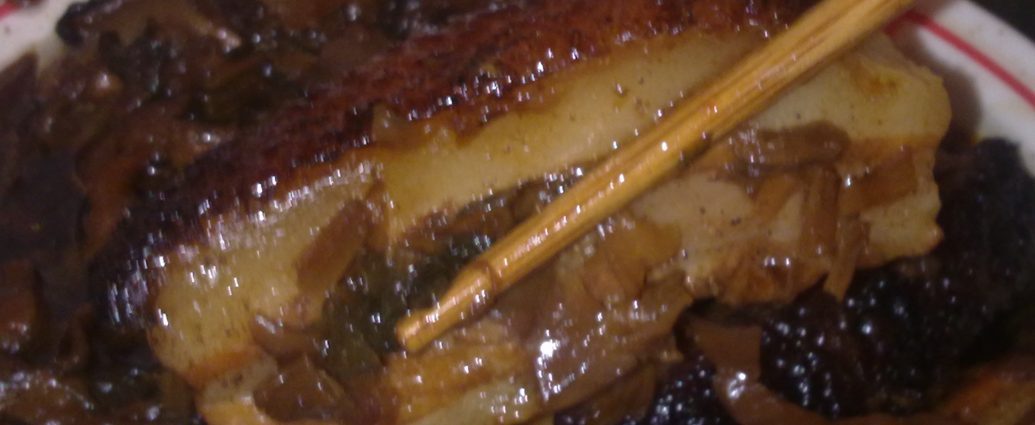
Mei Cai Kou Rou (梅菜扣肉) is one of Cantonese cuisine’s most beloved comfort dishes — tender, melt-in-your-mouth pork belly layered with preserved mustard greens (mei cai), braised in a sweet-savory soy sauce until the flavors meld into pure umami. It is the centerpiece of festive Cantonese meals and a dish that gets better the next day. Here is the classic method.
Mei cai kou rou (梅菜扣肉) is a Cantonese dish of thick slices of braised pork belly layered with preserved mustard greens (mei cai), steamed until the pork is meltingly tender. It is sweet, savory, and rich, and is a traditional festive dish.
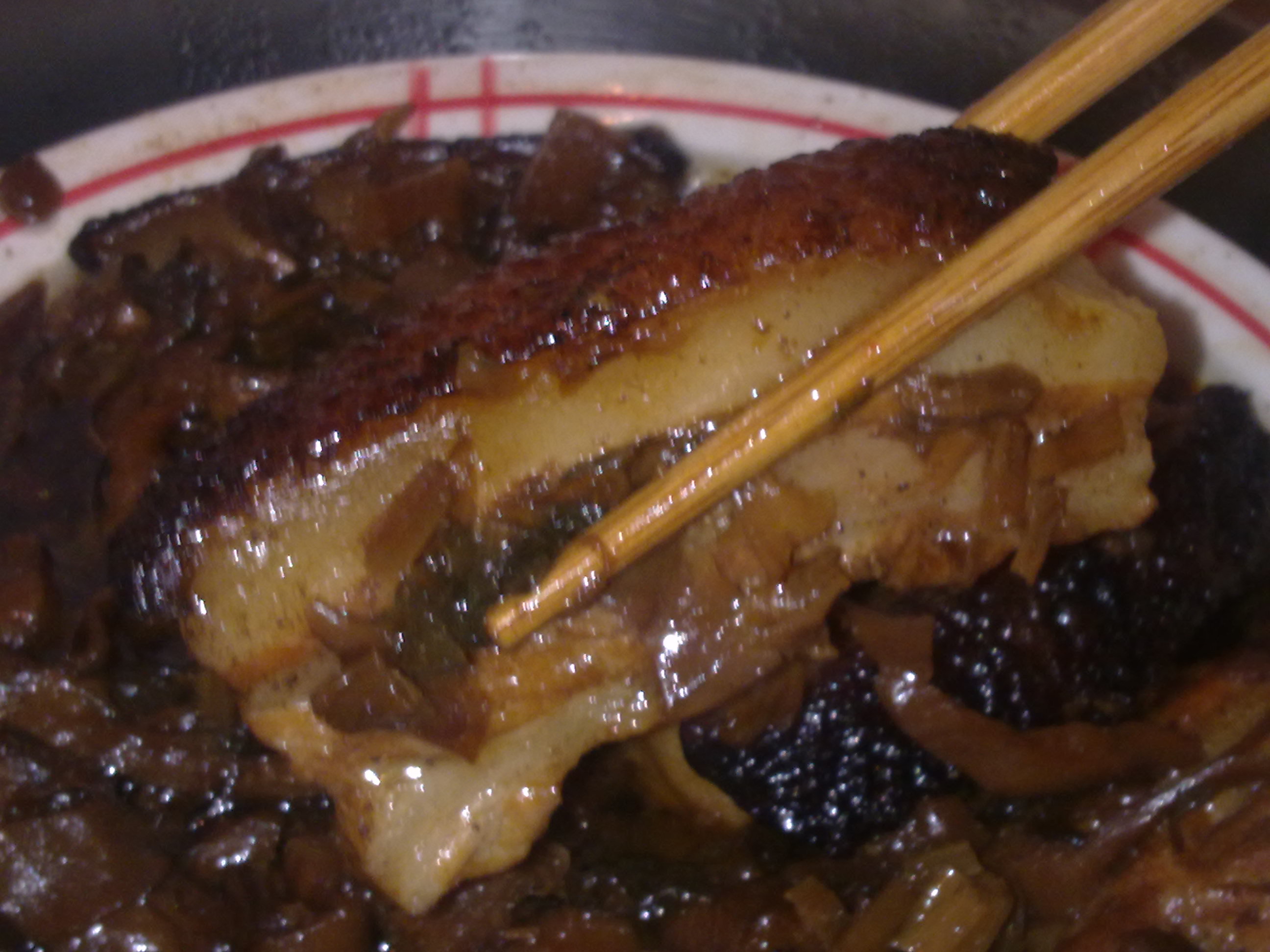
梅菜扣肉 is a Hakka dish by origin. The Hakka — the “guest people” who migrated south over centuries from northern China — settled in Guangdong, Fujian, and Jiangxi, and their cooking is defined by preservation: salted, dried, and fermented ingredients that kept through long journeys and humid climates. 梅菜 is one such ingredient, a preserved mustard green from the Meizhou region, salted and sun-dried until it turns dark, soft, and intensely savory. The 扣 in the name means “to invert” — the dish is steamed in a bowl with the pork on the bottom and the greens on top, then flipped onto a plate to serve, so the beautifully layered pork sits on a bed of greens. It is one of the great banquet dishes of the Cantonese and Hakka table.
This recipe comes from a Hakka grandmother in Guangdong who taught me the essential three-step process: boil and deep-fry the pork belly to puff the skin, slice and layer it with the preserved greens, then steam slowly for 2 hours until the meat falls apart at the touch of a chopstick.
Three Steps, Each Essential
- Boil and deep-fry the pork. The belly is simmered whole until firm, then the skin is pricked, rubbed with dark soy, and deep-fried until it puffs and blisters. This is what gives 扣肉 its signature bubbled, gelatinous skin — the step most home cooks skip and the one that matters most.
- Slice and layer. The cooled belly is cut into thick slices and arranged skin-side down in a bowl, with the soaked, stir-fried mei cai packed on top. The greens go on top because they will be inverted later.
- Steam for two hours. Long, gentle steaming is what renders the fat into silk and lets the greens absorb the pork’s juices. There is no shortcut — pressure cooking helps, but the texture is never quite the same.
Handling the Mei Cai
- Rinse and soak — 20–30 minutes in warm water removes excess salt and grit
- Squeeze dry and chop — into 1cm pieces so they layer evenly
- Stir-fry before layering — with garlic, ginger, and a little sugar; this wakes up the flavor and removes the raw, salty edge
- Sweeten slightly — a teaspoon of sugar balances the salt and echoes the pork’s richness
- Do not oversalt the pork — the greens will season the whole dish as they steam
Ingredients and Where to Find Them
- Preserved mustard greens (梅菜) — mei cai, sold dried and salted
- Skin-on pork belly — pork belly, one even slab with clear layers
- Dark soy sauce — dark soy sauce for the deep mahogany color on the skin
Also needed: light soy sauce, Shaoxing wine, rock sugar, garlic, ginger, star anise, and oil for deep-frying. Some versions add fermented bean curd or a little five-spice.
How to Make It
- Simmer 800g (1.75 lb) skin-on pork belly in water with ginger and Shaoxing wine for 30 minutes; drain and pat dry
- Prick the skin all over, rub with dark soy, and deep-fry skin-side down in 180°C (355°F) oil for 3–4 minutes until puffed and blistered; cool, then slice into 1cm pieces
- Soak 100g mei cai in warm water for 30 minutes; rinse, squeeze dry, and chop
- Stir-fry the mei cai with garlic, ginger, 1 teaspoon sugar, 1 tablespoon light soy, and 1 tablespoon Shaoxing wine for 3 minutes
- Arrange the pork slices skin-side down in a bowl, brush with a mix of 1 tablespoon light soy, 1 teaspoon dark soy, and 1 teaspoon rock sugar
- Pack the mei cai on top, add 2 star anise, and steam over simmering water for 2 hours
- Pour off the juices into a pan, invert the bowl onto a plate, thicken the juices slightly, and pour back over the pork; serve with rice
Variations
- With taro (芋头扣肉) — sliced taro alternated with the pork; a Cantonese banquet favorite
- With preserved vegetables (冬菜扣肉) — a Sichuan version using different preserved greens
- Pressure cooker version — 45 minutes at high pressure instead of 2 hours of steaming; faster, slightly less silky
- With quail eggs — a few simmered quail eggs tucked among the greens absorb the sauce beautifully
Frequently Asked Questions
Do I have to deep-fry the pork?
It is what gives 扣肉 its signature puffed, gelatinous skin, and it cannot be replicated by other means. If you skip it, the dish still tastes good but the texture will be closer to ordinary braised pork belly. Pat the skin completely dry before frying to minimize spattering.
How do I keep the pork from being greasy?
Long steaming renders the fat out of the belly and into the greens, which is exactly what you want. After steaming, pour off the accumulated juices and skim the fat before thickening and pouring back. The dish should taste rich, not oily.
Can I make it ahead?
Yes, and it is better that way. Make it a day ahead and reheat by steaming for 15 minutes — the flavors deepen and the texture improves overnight. It also freezes well for up to 2 months.
How long does it keep?
3-4 days refrigerated — it improves overnight. It also freezes well for 2 months. Reheat by steaming for 15 minutes to restore the texture.
More Cantonese Classics
Love Cantonese cooking? Try my Siu Yuk 脆皮烧肉, the lacquered Honey Char Siu 蜜汁叉烧, or the braised Hong Shao Rou 红烧肉.
As an Amazon Associate, I earn from qualifying purchases. These are affiliate links at no extra cost to you.
1 Comment