
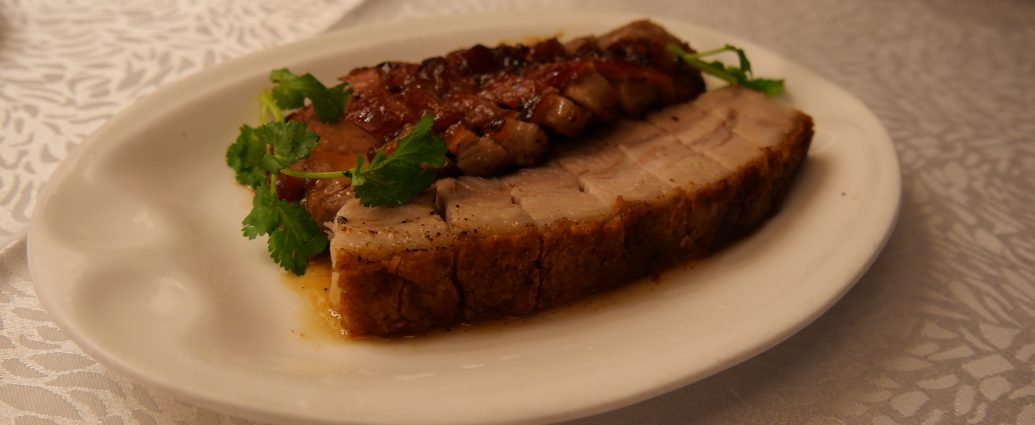
Siu Yuk (脆皮烧肉) is the crown jewel of Cantonese siu mei — a slab of pork belly roasted until the skin erupts into crackling, golden blisters while the meat beneath stays juicy and impossibly tender. Served simply with a dab of mustard or hoisin, it is the dish Hong Kong barbecue shops hang in their windows to lure customers in, and the one home cooks dream of replicating.
The magic of Siu Yuk is all in the technique: a salt crust or vinegar-air-dried skin, then a fierce blast of heat that shatters the surface into crackling. The name means “crispy roasted meat,” and while professional kitchens use hanging rotisserie ovens, a home oven produces stunning results with the right prep — this recipe walks you through every step.
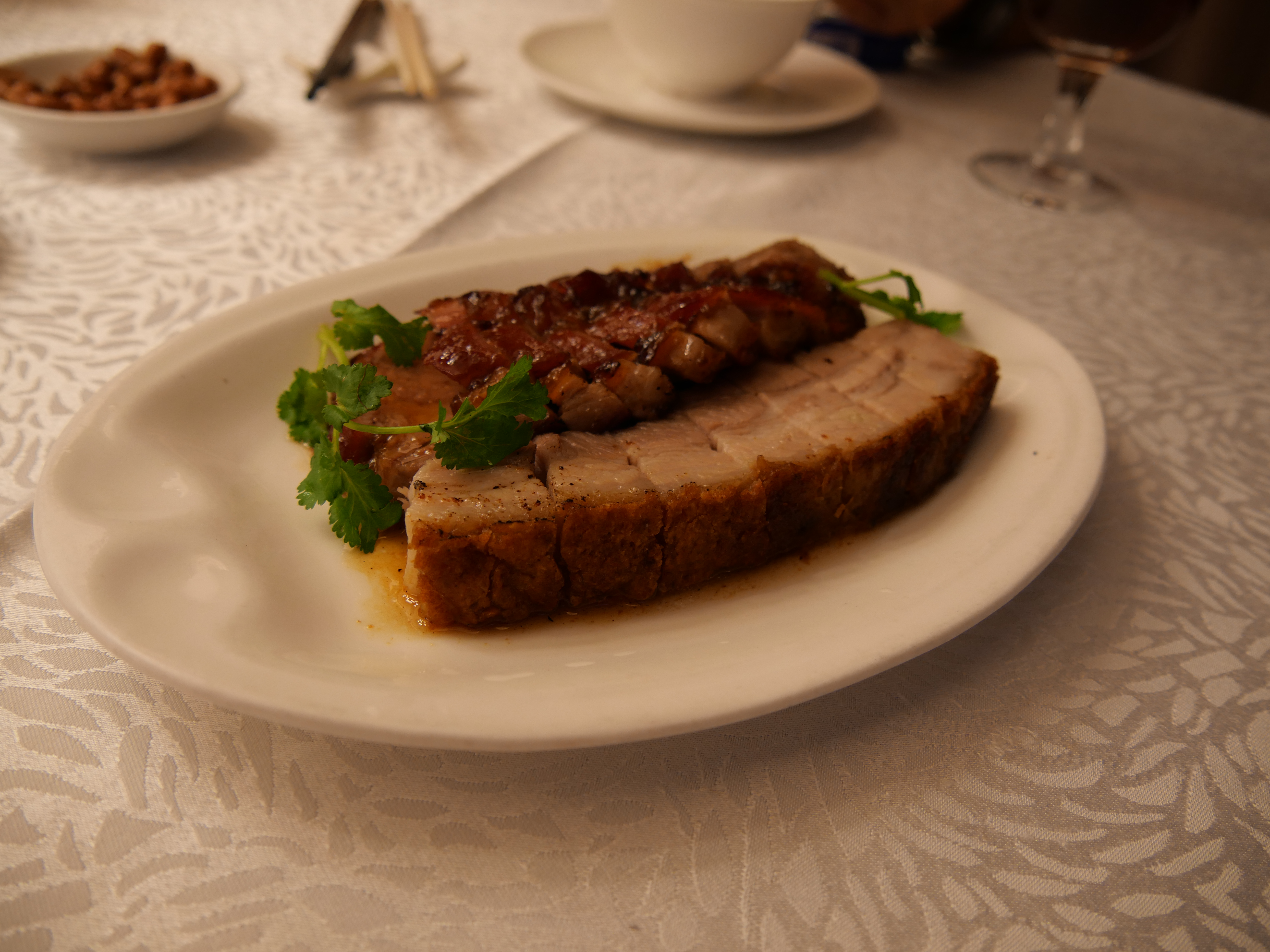
Photo: Peachyeung316 via Wikimedia Commons, CC BY-SA 4.0
Siu Mei: The Cantonese Roast Shop
脆皮烧肉 belongs to 烧味 (siu mei), the Cantonese tradition of roasted meats — a family that includes roast duck 烧鸭, char siu 叉烧, and 烧鹅. In Hong Kong and Guangdong, 烧腊 shops hang these meats in their windows, glazed and glistening, and customers buy them by weight to take home for dinner. The window display is a form of advertising that has existed for generations: a shop with good 烧肉 shows it off. Within the family, 烧肉 is the hardest to get right, because the skin is unforgiving — it either puffs into crackling or it turns into a hard, leathery sheet, and there is no middle ground. That is why it commands the highest price per pound of any 烧腊 item.
Why the Skin Puffs
- Dry skin is the entire secret — water on the surface turns to steam and prevents blistering; the skin must be dehydrated before roasting
- Prick the skin densely — hundreds of small holes let steam escape and create the blisters; a needle or a spiked roller works
- Rub with vinegar and coarse salt — the acid tightens the skin proteins and the salt draws out moisture
- Air-dry overnight, uncovered, in the refrigerator — this is the step home cooks skip and the reason their crackling fails
- Low roast first, high blast last — the meat cooks gently at 160°C (320°F), then the skin is blasted at 230–250°C (450–480°F) until it puffs
- Salt crust on the skin during the low roast — a thick layer of coarse salt keeps the skin dry and is scraped off before the blast
Choosing the Belly
Ask your butcher for a piece of skin-on pork belly with an even distribution of fat and lean — a slab about 4–5cm thick, with the skin intact and unscored. Uneven layers cook unevenly, and a thin piece will dry out before the skin puffs. Some butchers will offer to score the meat side; keep the skin side untouched. If the skin has been previously frozen or has a leathery texture, it will be much harder to puff.
Ingredients and Where to Find Them
- Skin-on pork belly — pork belly, one even slab
- Coarse salt — coarse salt for the crust
- Five-spice powder — five-spice powder for the meat
Also needed: rice vinegar or white vinegar, Shaoxing wine, garlic, sugar, white pepper, and a little salt. Mustard or hoisin for serving.
How to Make It
- Score the meat side of a 1.5kg (3.3 lb) pork belly in a crosshatch, cutting down to but not through the skin
- Rub the meat with 2 teaspoons five-spice, 1 tablespoon Shaoxing wine, 1 teaspoon sugar, 1 teaspoon salt, and minced garlic
- Wipe the skin dry, prick it densely all over with a needle or spiked roller, then rub with 1 tablespoon vinegar
- Spread a thick layer of coarse salt over the skin and refrigerate uncovered overnight
- Scrape off the salt and pat the skin dry; place the belly skin-side up on a rack over a foil-lined tray
- Roast at 160°C (320°F) for 60 minutes, then raise the heat to 240°C (465°F) and roast 20–30 minutes until the skin puffs and blisters
- Rest 15 minutes, then chop into pieces with a cleaver, keeping the crackling on each piece; serve with mustard
Variations
- With a vinegar wash only — no salt crust; simpler, but the skin must still air-dry overnight
- With a baking-soda rub — a pinch of baking soda in the salt accelerates blistering; use sparingly or it tastes soapy
- With 卤水 braise first — some kitchens braise the belly in master stock before roasting for extra depth
- As a claypot topping — sliced 烧肉 added to claypot rice 煲仔饭 for the last 10 minutes
Frequently Asked Questions
Why is my crackling hard instead of puffy?
The skin was not dry enough. It needs an overnight uncovered rest in the refrigerator, a dense pricking to let steam escape, and a vinegar rub to tighten the surface. Any residual moisture will produce a hard, chewy skin rather than crackling.
Can I skip the overnight drying?
You can shorten it to 4 hours in front of a fan, but the results will be less reliable. The overnight refrigerator method is the single biggest factor in getting consistent crackling, and it costs nothing but time.
What temperature should the pork reach?
About 70–75°C (160–170°F) at the center after the low roast. The final high-heat blast is for the skin, not the meat, so do not worry about the internal temperature rising further — the belly is fatty enough to stay moist.
How do I reheat it?
Reheat in a hot oven at 200°C (390°F) for 5–8 minutes, never the microwave. Place the pieces skin-side up on a rack so the crackling stays crisp.
More Cantonese Classics to Try
Explore more Cantonese favorites: my Roast Duck 烧鸭, the sweet Honey Char Siu 蜜汁叉烧, or the comforting Claypot Rice 煲仔饭.
As an Amazon Associate, I earn from qualifying purchases. These are affiliate links at no extra cost to you.

1 Comment