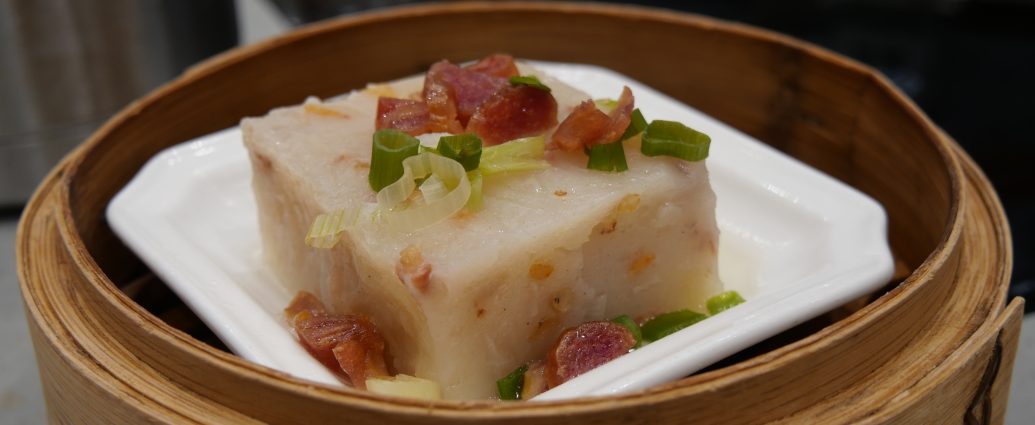
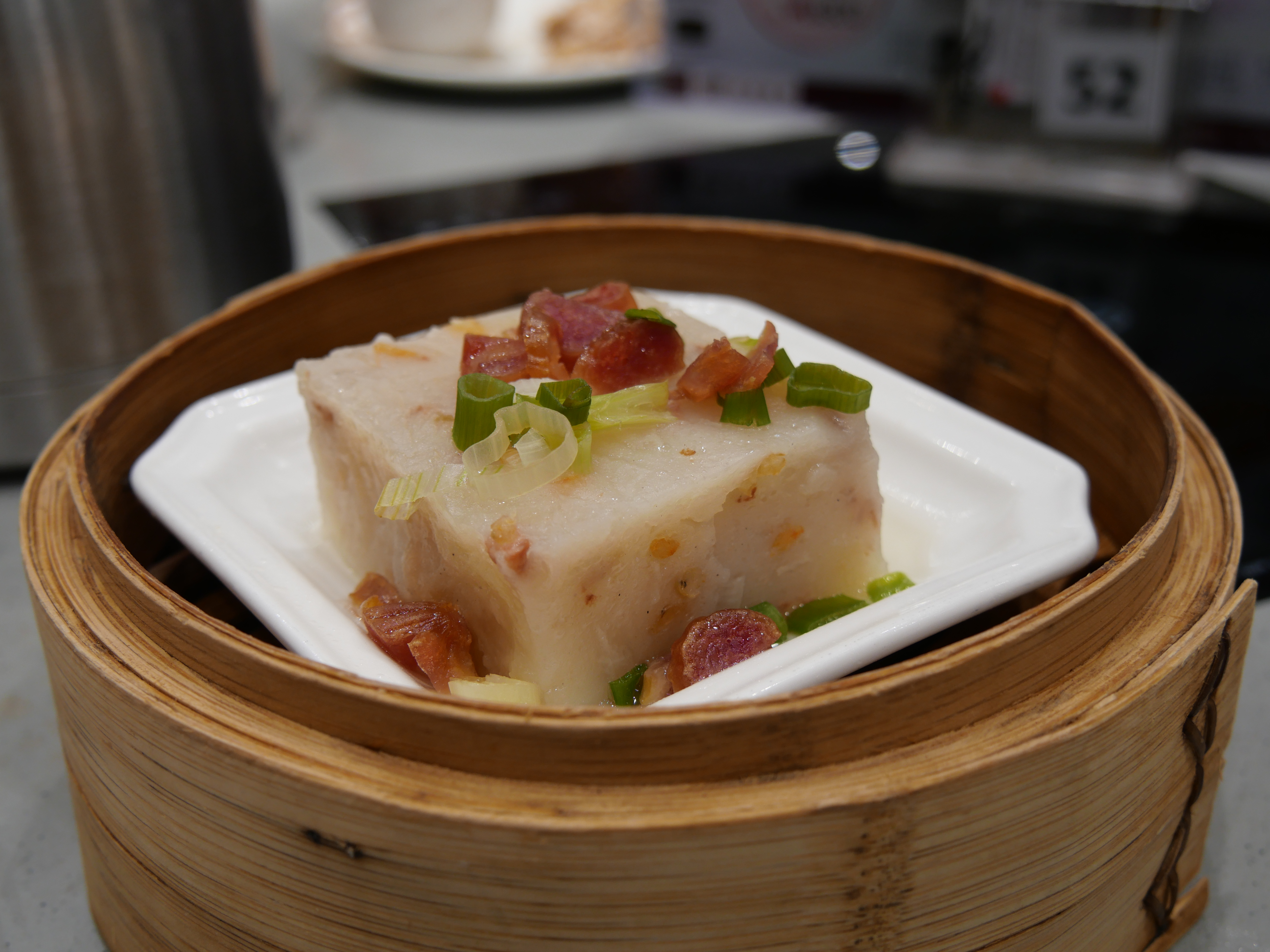
Turnip Cake (萝卜糕), known as Lo Bak Go in Cantonese, is a dim sum favorite — a savory steamed cake made from daikon radish, rice flour, dried shrimp, and Chinese sausage, then pan-fried until golden and crispy on both sides. Soft and tender inside, crispy outside, it is the perfect bite with dipping sauce. Here is the classic recipe.
Turnip cake (萝卜糕) is a Cantonese dim sum dish made by steaming a batter of daikon radish, rice flour, dried shrimp, and Chinese sausage into a firm cake, then slicing and pan-frying until crispy. It is served golden-brown with dipping sauce.
The English name is misleading — there is no turnip in 萝卜糕. The 萝卜 in question is daikon, the long white radish, and 糕 means “cake.” In Cantonese it is 蘿蔔糕 (lo bak go), and it holds a special place in the culture: it is the essential Lunar New Year cake, made in huge batches in the days before the holiday and given as gifts between families. The tradition has a linguistic logic — 糕 sounds like 高 (“high”), so eating it at New Year is a wish for rising fortune. But it is eaten year-round as dim sum, pan-fried to order so the outside crisps while the inside stays soft and studded with savory bits.
This recipe comes from a dim sum chef in Hong Kong who taught me the essential trick: squeeze the shredded daikon DRY before mixing with the batter. Too much moisture makes the cake mushy and it falls apart when fried.
Why Moisture Control Decides Everything
Daikon is over 90% water, and rice flour batter is unforgiving. If the shredded radish goes into the batter wet, the cake never sets firmly — it steams into a soft, gluey block that collapses the moment you try to slice it. The traditional solution is to salt the shredded daikon, let it stand, then squeeze it out by hand or in a clean towel until it releases no more liquid. Crucially, that radish water is not wasted: Cantonese cooks reserve it and use it to mix the rice flour, so the flavor stays in the cake while the excess moisture is gone. It is a small piece of kitchen wisdom that makes the difference between a sliceable cake and a puddle.
Steam, Cool, Then Fry
- Steam. The batter is poured into an oiled tin and steamed for 45–60 minutes until completely firm. The cake must be cooked through — an underdone center will not hold.
- Cool completely. This is non-negotiable. A warm cake is fragile; a fully cooled (ideally chilled overnight) cake slices cleanly into neat rectangles.
- Fry to order. Slices go into a hot pan with a little oil until golden and crisp on both sides. This is the step that transforms a plain steamed cake into dim sum.
Ingredients and Where to Find Them
- Daikon radish — daikon radish, grated or shredded
- Rice flour — plain rice flour (not glutinous) for the batter; a little wheat starch adds springiness
- Chinese sausage (lap cheong) — lap cheong, diced small
Also needed: dried shrimp, dried shiitake, scallions, salt, sugar, white pepper, and sesame oil. XO sauce or chili oil are the classic dipping accompaniments.
How to Make It
- Grate 900g (2 lb) daikon, toss with 1 teaspoon salt, rest 20 minutes, then squeeze dry — reserve the liquid
- Soak 30g dried shrimp and 4 dried shiitake; dice the mushrooms and finely chop the shrimp
- Stir-fry the lap cheong, dried shrimp, and shiitake with 2 scallions for 3 minutes; add the daikon and cook 5 minutes until soft
- Mix 300g (2.5 cups) rice flour with 2 tablespoons wheat starch and enough reserved daikon liquid plus water to make 500ml of thin batter
- Combine the batter with the cooked daikon mixture; season with 1 teaspoon salt, 1 teaspoon sugar, and white pepper
- Pour into an oiled tin and steam over high heat for 50–60 minutes until firm; cool completely, ideally overnight
- Slice into 1.5cm rectangles and pan-fry in a little oil over medium heat until golden and crisp on both sides; serve with chili oil or XO sauce
Variations
- With XO sauce — stir a tablespoon of XO sauce into the batter for a luxurious, briny upgrade
- With taro — swap half the daikon for mashed taro for a richer, starchier cake
- Vegetarian — omit the sausage and shrimp and use extra shiitake and a splash of soy for savoriness
- Steamed, not fried — serve slices straight from the steamer, soft and delicate, with soy sauce
Frequently Asked Questions
Why did my turnip cake fall apart?
Too much moisture, or not enough rice flour. Squeeze the grated daikon thoroughly before mixing, and keep the flour-to-liquid ratio close to the recipe — the batter should be thick, like a heavy pancake batter, not pourable like cream. Chilling the cake overnight before slicing also makes a large difference.
Can I make it ahead?
Yes, and it is actually better that way. Steam the cake up to two days ahead and refrigerate it; chilling firms the texture and makes slicing clean. Fry the slices just before serving so they arrive crisp.
What is 萝卜糕 called in English?
It is most often called turnip cake or radish cake, and in Cantonese lo bak go. Despite the name, the main ingredient is daikon (white radish), not turnip. The confusion comes from the Cantonese word 蘿蔔 being loosely translated as “turnip.”
Is turnip cake gluten-free?
Yes, as written — rice flour and daikon are naturally gluten-free. Just check that your Chinese sausage and dried shrimp have no wheat additives.
More Dim Sum Classics
Build a dim sum spread with my Har Gow 虾饺, the pork and shrimp Shu Mai 烧卖, or the lotus-leaf parcel Lo Mai Gai 糯米鸡.
As an Amazon Associate, I earn from qualifying purchases. These are affiliate links at no extra cost to you.