
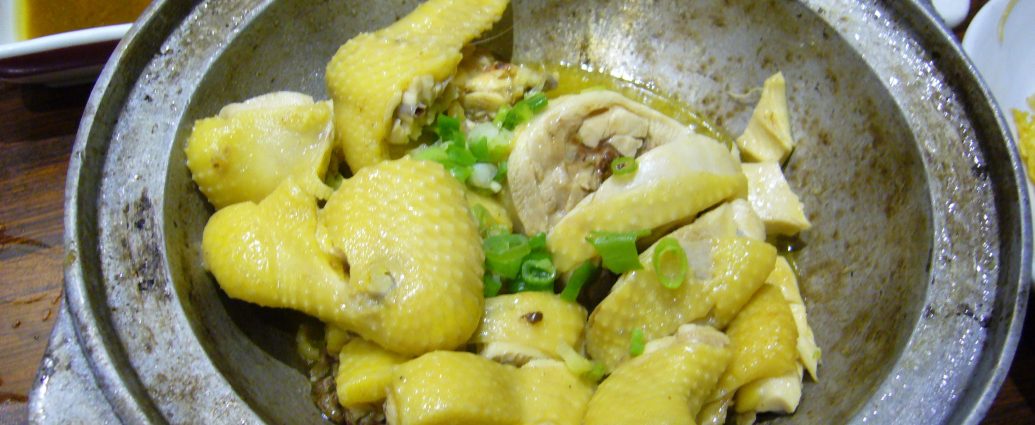
Salt Baked Chicken (盐焗鸡) is a Hakka classic that produces astonishingly tender, savory chicken with almost no effort: a whole bird is rubbed with salt and spices, wrapped in paper, and buried in a pile of hot coarse salt until gently cooked by the salt’s stored heat. The result is succulent meat that pulls cleanly from the bone, with a clean, mineral savor you will not get from any other cooking method.
The dish originated with the Hakka people of eastern Guangdong, who developed salt-baking as a way to preserve and cook chicken for long journeys. Today it is served across Cantonese restaurants as a cool, sliced appetizer or a hot centerpiece. This home version keeps the tradition — a salt crust in a covered pot — but uses a manageable amount of salt and a standard oven.
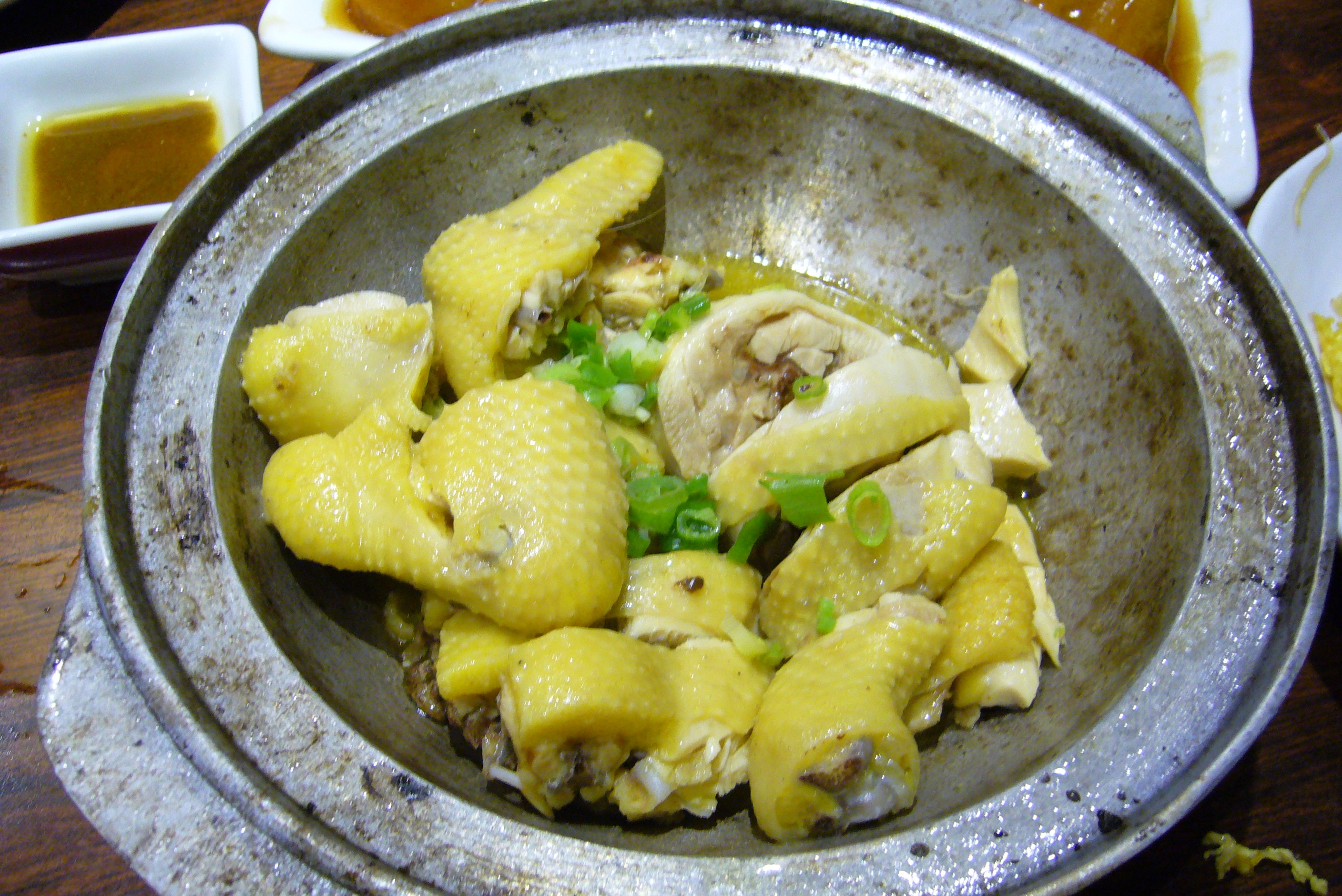
Photo via Wikimedia Commons, CC BY 2.5
How Salt Baking Works
The technique is a form of dry-heat cooking that behaves like steaming. Coarse salt is heated until very hot, then the wrapped chicken is buried in it. The salt conducts heat slowly and evenly to every surface, and because the chicken is sealed inside paper, its own moisture is trapped and turns to steam. The bird effectively steams inside a salt oven — which is why the meat comes out so juicy and why the salt does not make it salty. Only a thin layer of seasoning on the skin penetrates; the salt itself is a heat medium, not a seasoning. This is the insight that makes the dish approachable: you are not curing the chicken, you are cooking it.
The Hakka Preservation Tradition
- Salt was a preservative — for a people who migrated repeatedly over centuries, salted and dried foods were practical survival
- Wrapping in paper — traditionally 纱纸 (a thin, porous paper); parchment paper is the modern equivalent
- Coarse salt, not fine — coarse crystals hold heat evenly and do not pack into a solid mass
- Aromatics inside — ginger, scallion, and a splash of Shaoxing wine go into the cavity to perfume the meat from within
- Rest before serving — ten minutes lets the juices redistribute; slicing hot loses them
Serving It Two Ways
盐焗鸡 is unusual in that it is equally good hot and cold, and Cantonese restaurants serve it both ways. Served hot, it is carved into pieces and eaten as a main course with rice, accompanied by ginger-scallion oil — the same dipping sauce that goes with 白切鸡. Served cold, it is chilled, sliced thinly, and presented as a starter, with the skin firm and gelatinous and the meat dense and savory. The cold version is arguably the more traditional Cantonese restaurant format, and it is a good reason to make two chickens at once: eat one hot, and keep the second in the refrigerator for the next day. Cold 盐焗鸡 keeps for three to four days and slices beautifully.
Ingredients and Where to Find Them
- Whole chicken — a small whole chicken, about 1.2–1.5kg
- Coarse salt — coarse sea salt; about 1.5kg, reusable a few times
- Shaoxing wine — Shaoxing wine for the cavity
Also needed: ginger, scallions, and a little five-spice or sand ginger (沙姜) powder. Parchment paper and a heavy Dutch oven or deep baking dish with a lid are the only equipment required.
How to Make It
- Rub a 1.3kg (3 lb) chicken inside and out with 1 tablespoon Shaoxing wine and 1 teaspoon salt; stuff the cavity with 4 ginger slices and 3 scallions
- Wrap the chicken tightly in two layers of parchment paper, twisting the ends to seal
- Spread 1.5kg coarse salt in a Dutch oven, nestle the wrapped chicken in the middle, and cover completely with the remaining salt
- Bake at 200°C (400°F) for 60–70 minutes, until the internal temperature at the thigh reaches 75°C (165°F)
- Remove from the oven and let it rest in the salt for 10 minutes
- Dig out the parcel, unwrap carefully, and brush off any salt clinging to the skin
- Chop into pieces with a cleaver or carve, and serve hot with ginger-scallion oil, or chill and slice for a cold appetizer
Variations
- With sand ginger (沙姜) — rubbing 沙姜粉 on the skin gives the sharper, more aromatic Hakka version
- With bone-in thighs — salt-bake thighs for 30–35 minutes; more forgiving and perfect for weeknights
- With a soy glaze — brush the skin with dark soy before wrapping for a deeper color
- With tea leaves — a few tea leaves in the salt add a faint smoky note, similar to 樟茶鸭
Frequently Asked Questions
Doesn’t the chicken become extremely salty?
No — the salt is a cooking medium, not a seasoning. Because the chicken is wrapped in paper, only the light rub on the skin seasons the meat. The salt conducts heat and traps steam; it never touches the flesh directly.
Can I reuse the salt?
Yes, several times. Let it cool completely, break up any clumps, and store it in an airtight container. Discard it once it darkens or picks up a strong odor from the chicken.
Can I make this with chicken pieces instead of a whole bird?
Absolutely — salt-bake bone-in thighs for 30–35 minutes. They are even more forgiving than a whole bird and perfect for weeknight dinners.
What is 沙姜 and should I use it?
Sand ginger is a rhizome with a sharper, more camphor-like aroma than common ginger, and it is the traditional Hakka seasoning for this dish. It is sold as a powder and is worth seeking out; if unavailable, a mix of ground ginger and a pinch of white pepper is a reasonable substitute.
More Cantonese Classics
Explore more Cantonese favorites: my White Cut Chicken 白切鸡, the delicate Steamed Fish 清蒸鱼, or the smoky Roast Duck 烧鸭.
As an Amazon Associate, I earn from qualifying purchases. These are affiliate links at no extra cost to you.
1 Comment