
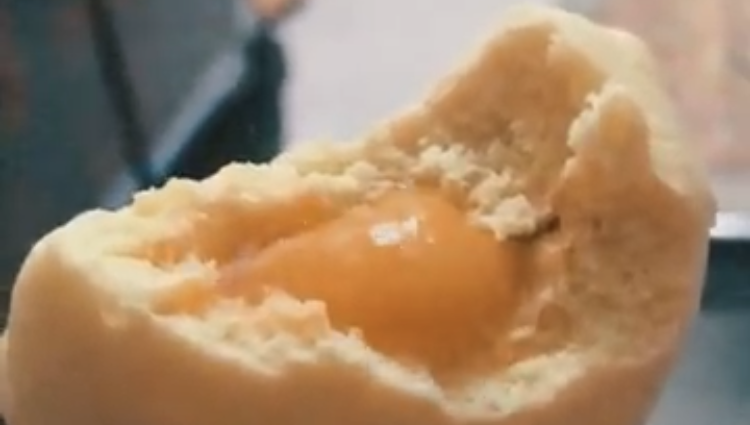
Salted Egg Yolk Custard Buns (流沙包), known as Liu Sha Bao, are the molten-lava stars of the dim sum cart — soft, fluffy white buns hiding a warm, savory-sweet golden custard that flows out the moment you tear them open. The filling is made from salted egg yolks, butter, and custard powder, creating that irresistible “molten lava” effect. Here is the restaurant method.
Salted egg yolk custard buns (流沙包) are steamed dim sum buns filled with a molten, savory-sweet custard made from salted egg yolks, butter, sugar, and milk powder. When steamed, the filling liquefies, so biting into the fluffy bun releases a warm golden “lava” of custard.
The name 流沙 says it all: 流 (“to flow”) and 沙 (“sand”), describing a filling that pours out with the fine, grainy texture of sand — the texture that salted egg yolk takes on when it is mashed with butter and sugar. 流沙包 is a modern dim sum invention, a Hong Kong and Guangdong innovation from recent decades rather than an ancient dish, and it has become one of the most photographed items on any dim sum table. Its appeal is theatrical: the bun arrives looking plain, you tear it open, and the golden filling spills out. But it is also genuinely delicious, because salted egg yolk is one of the great flavors of Cantonese cooking — rich, savory, faintly salty, and unlike anything else.
This recipe comes from a dim sum chef in Hong Kong who taught me the essential trick for the molten filling: the custard must be FROZEN solid before wrapping, so it stays contained during steaming and melts perfectly inside the bun. Skip the freeze and you end up with a soggy mess.
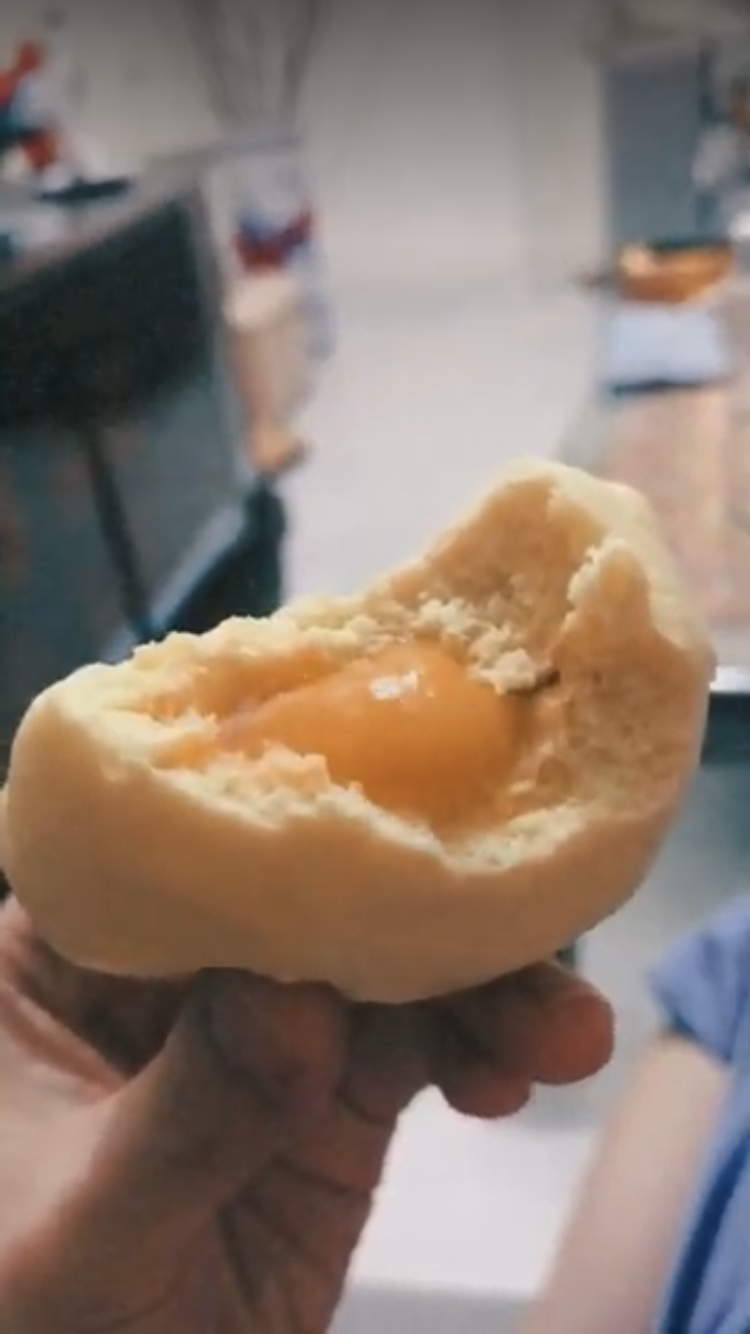
Freeze the Filling — This Is the Whole Trick
A molten filling is a contradiction: it must be solid enough to wrap and liquid enough to flow when eaten. The solution is temperature, not chemistry. The custard is mixed, then frozen solid into small portions. Each frozen disc is placed in the center of the dough and wrapped while still hard, so it does not smear into the dough or leak through the seams. In the steamer, the bun cooks in about eight minutes while the frozen center thaws and warms — arriving at the table as a liquid. The timing is delicate: too little steaming and the center is still cold; too much and the filling is absorbed into the dough. Eight minutes from frozen is the reliable window.
The Filling’s Balance
- Salted egg yolks — steamed or baked, then mashed; they supply the salty, savory depth and the “sand” texture
- Butter — the fat that carries the flavor and becomes liquid when hot; this is what “flows”
- Sugar and milk powder — sweetness and creaminess; milk powder adds body without extra liquid
- Custard powder or cornstarch — a small amount stabilizes the mixture so it does not separate
- A pinch of salt — balances the sugar; the filling should be savory-sweet, not a dessert
Ingredients and Where to Find Them
- Salted egg yolks — salted duck egg yolks, vacuum-packed or from whole salted eggs
- Custard powder — custard powder for body and color
- Low-protein flour — low-protein bao flour for the softest crumb
Also needed: butter, sugar, milk powder, cornstarch, yeast, baking powder, lard or shortening, and milk. That is the full list — the filling is only five ingredients.
How to Make Them
- Steam 6 salted egg yolks for 10 minutes, then mash while warm with 80g (1/3 cup) softened butter, 60g (1/4 cup) sugar, 30g milk powder, and 1 tablespoon custard powder
- Divide into 12 portions, roll into balls, and freeze solid — at least 2 hours
- Mix 400g (3.3 cups) flour, 1 tablespoon yeast, 1 tablespoon baking powder, 50g sugar, and 1/2 teaspoon salt; add 220ml warm milk and 30g lard; knead 10 minutes until smooth
- Rise 1 hour, punch down, and divide into 12 pieces
- Flatten each piece, place a frozen filling ball in the center, and pleat and seal tightly and quickly
- Rest 20 minutes, then steam over high heat for 8 minutes with a towel-wrapped lid
- Rest 2 minutes before opening the lid; serve immediately and warn your guests — the filling is very hot
Variations
- With a crispy top — brush with egg wash and briefly broil after steaming for a baked-then-steamed hybrid
- With black sesame — a spoonful of black sesame paste swirled into the filling adds a nutty note
- With salted egg custard and mochi — a layer of mochi around the filling gives an extra chewy contrast
- Baked version — bake at 190°C (375°F) for 18 minutes for a golden, slightly crusty bun
Frequently Asked Questions
Why did my filling leak out during steaming?
The filling was not frozen solid, or the seal was loose. Freeze the portions completely — at least two hours — and wrap them quickly while still hard. Seal the pleats firmly and place the bun seam-side down in the steamer.
Why is my filling not molten?
It was over-steamed, or the bun was left sitting. The window is about eight minutes from frozen; beyond that the liquid is absorbed into the dough. Serve them the moment they come out of the steamer.
Are these the same as custard buns (nai huang bao)?
No — nai huang bao uses a thicker, cooked egg custard filling that does not flow. Liu sha bao’s molten salted-egg filling is the “lava” version, which is richer and savory-sweet.
Can I freeze the assembled buns?
Yes — freeze assembled buns on a tray, then bag them. Steam from frozen for 10–11 minutes. Do not thaw them first, or the filling will soften and leak.
More Dim Sum Classics
Build a dim sum table with my Custard Buns 奶黄包, the classic Char Siu Bao 叉烧包, or the airy Malay Cake 马拉糕.
As an Amazon Associate, I earn from qualifying purchases. These are affiliate links at no extra cost to you.
2 Comments