
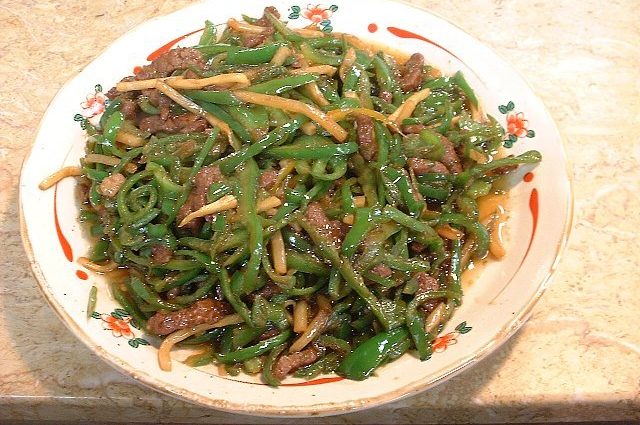
Shredded Pork with Green Pepper (青椒肉丝) is a cornerstone of Chinese home cooking — tender strips of pork loin stir-fried with fresh green peppers in a savory, slightly sweet sauce. It is simple, fast, and endlessly satisfying, a dish that every Chinese home cook knows by heart and can produce in minutes.
青椒肉丝 belongs to the great family of Chinese 丝 (sī, “shredded”) stir-fries, alongside 鱼香肉丝 and 京酱肉丝. The shredding is not decorative — it is functional. Thin, uniform strips cook through in seconds, which means the meat stays tender while the vegetables keep their bite, and everything finishes at the same moment. It is the dish that taught generations of Chinese children to hold a knife, and it remains the standard by which a home cook’s knife skills are judged.
This recipe comes from a Shanghai home cook who taught me that the secret to perfect shredded pork is the velveting technique — a cornstarch and egg white marinade that keeps the pork silky and tender even under high heat. Velveting is the difference between restaurant-quality and tough, dry pork.
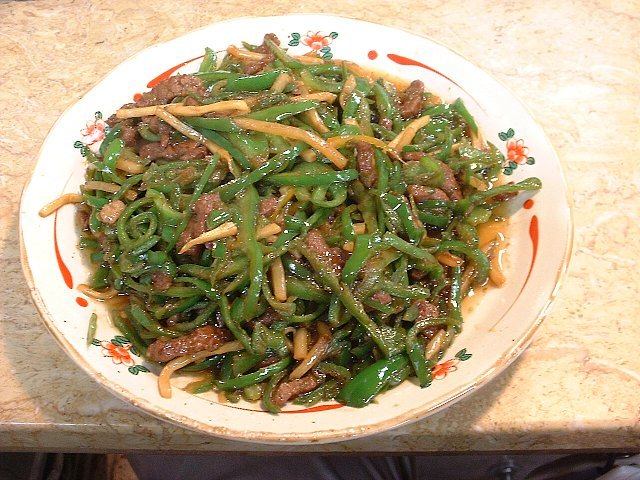
The Knife Work Comes First
Everything about this dish depends on how the pork is cut. Slice the loin into 3mm planks, stack the planks, and cut them into 3mm matchsticks — all of them the same size. Uniform shreds cook uniformly, and non-uniform shreds guarantee that some pieces are dry while others are underdone. Cut across the grain rather than along it; the muscle fibers shorten, and the pork bites tender instead of stringy. If the meat is soft and hard to slice, put it in the freezer for 20 minutes first — firm pork cuts far more cleanly than warm pork.
Why Velveting Changes Everything
Velveting is the technique that separates restaurant stir-fries from home attempts. The pork is tossed with cornstarch, a little egg white, wine, and oil, then rested briefly before cooking. That coating forms a protective sheath around each shred, trapping moisture inside while the outside seals. Under a screaming-hot wok, uncoated pork sheds its juices and turns dry within a minute. Velveted pork comes out glossy, tender, and juicy — and it stays that way even if you are a few seconds late pulling it from the pan.
Ingredients and Where to Find Them
- Pork loin or tenderloin — pork loin, sliced into thin matchsticks
- Light soy sauce — light soy sauce seasons the pork and the sauce without darkening the peppers
- Shaoxing wine — Shaoxing wine for the marinade and the finish
Also needed: green bell peppers or thin-skinned Chinese green peppers, garlic, ginger, cornstarch, egg white, sugar, and a high-smoke-point oil. Oyster sauce and a few drops of sesame oil are optional but common additions.
How to Cook It
- Slice 300g (10.5 oz) pork loin into 3mm matchsticks and marinate 15 minutes with 1 tablespoon light soy, 1 tablespoon Shaoxing wine, 1 egg white, 2 teaspoons cornstarch, and 1 teaspoon oil
- Cut 3 green peppers in half, remove the seeds, and slice into strips the same thickness as the pork
- Mix the sauce: 1 tablespoon light soy, 1 teaspoon oyster sauce, 1 teaspoon sugar, 1 teaspoon cornstarch, and 3 tablespoons water
- Heat a wok over the highest heat until it smokes, add 2 tablespoons oil, and spread the pork in a single layer
- Let it sear 30 seconds undisturbed, then toss for 60 seconds until just cooked; remove
- Add the garlic and ginger, stir 15 seconds, then add the peppers and stir-fry 90 seconds so they blister but stay crisp
- Return the pork, pour the sauce down the side of the wok, and toss over high heat 30 seconds until glossy; serve with rice
Variations
- With black bean sauce — add 1 tablespoon mashed fermented black beans with the garlic for a Cantonese twist
- With shredded carrot and wood ear — a colorful version; add them with the peppers
- Spicier version — use long hot peppers instead of bell peppers, or add a teaspoon of doubanjiang
- Chicken or beef version — the identical technique works with chicken thigh or flank steak; see my Oyster Sauce Beef 蚝油牛肉
Frequently Asked Questions
How do I keep the pork from turning tough?
Three things: cut across the grain into uniform matchsticks, velvet the pork with cornstarch and egg white, and cook it fast over very high heat in a single layer. Overcrowding the wok is the most common cause of tough pork — the meat steams in its own juices instead of searing.
What peppers should I use?
Thin-skinned Chinese green peppers (杭椒 or 尖椒) are traditional and give the dish a gentle heat. Green bell peppers are the mild, widely available substitute. A mix of both gives you heat plus sweetness.
Can I make this ahead?
You can slice and marinate the pork up to a day ahead, and mix the sauce in advance. The stir-fry itself should be cooked and eaten immediately — reheated versions lose the peppers’ crunch and the pork’s silky texture.
What other vegetables can I add?
Thinly sliced carrots, wood ear mushrooms, or bamboo shoots are excellent additions. Add them with the peppers and adjust the cooking time so everything finishes together. Bean sprouts should go in at the very end so they stay crisp.
More Classic Chinese Stir-Fries
Love homestyle stir-fries? Try my Xiao Chao Rou 小炒肉, the northern classic Moo Shu Pork 木须肉, or the Cantonese Oyster Sauce Beef 蚝油牛肉.
As an Amazon Associate, I earn from qualifying purchases. These are affiliate links at no extra cost to you.
2 Comments