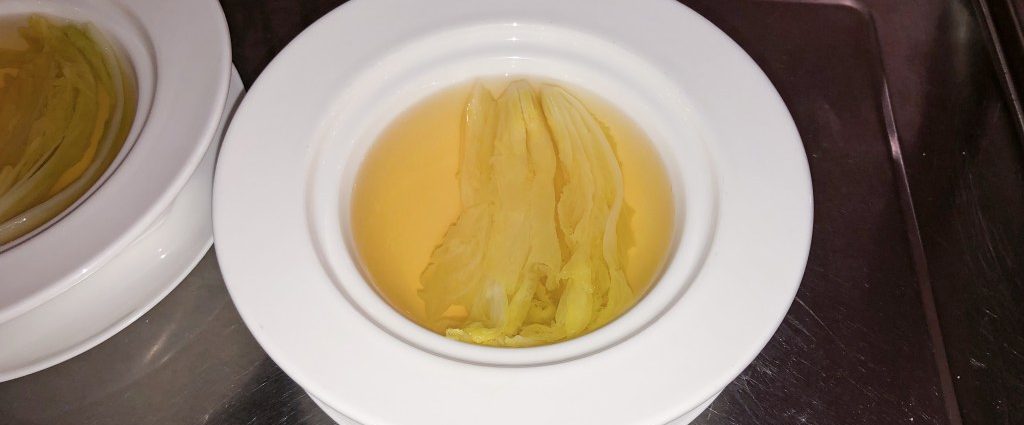
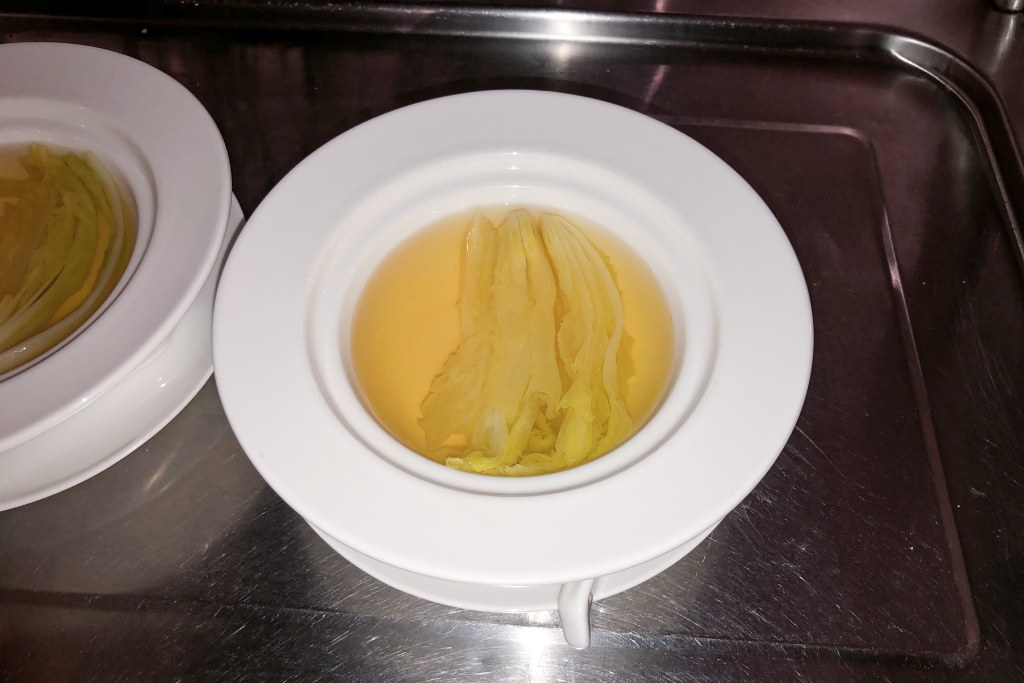
开水白菜 translates as “boiled cabbage”, which is either the most modest name in Chinese cooking or the most arrogant. A single heart of napa cabbage, sitting in what looks like plain water, served as the centrepiece of a banquet. The cabbage is ordinary. The “water” is not.
It is 川菜 at its most counter-intuitive: a Sichuan dish with no chili, no pepper and no oil, whose entire point is to prove that the cuisine’s high end has nothing to do with heat. It is also the clearest demonstration in Chinese cooking of what a properly clarified stock can be.
开水白菜 is a classic Sichuan dish of tender napa cabbage hearts served in a crystal-clear consommé. The “开水” (boiled water) is a misdirection — it is a rich stock of old hen, pork ribs and Jinhua ham, simmered for hours and then clarified with minced meat until it is transparent, then strained. It contains no chili at all. The dish is commonly credited to the Sichuan chef 黄敬临 and was later popularised at state banquets by 罗国荣.
The Name Is the Joke
Calling it “boiled cabbage” is a piece of understatement that only makes sense once you know what is in the bowl. The cabbage is blanched and then warmed in the soup; it is genuinely plain. The liquid, though, is 高级清汤 — the highest grade of clear stock in Chinese cooking — and producing it takes a day or more of work and a great deal of meat.
The joke lands because the dish looks like nothing. A bowl of clear soup with a cabbage heart in it arrives and the reaction is usually confusion. Then you taste it.
Why the Soup Looks Like Water
Two techniques do all the work.
吊汤 (building the stock) is the first. An old hen, pork ribs and Jinhua ham go into cold water and are brought up to a temperature that barely trembles — never a boil. A hard boil emulsifies fat into the liquid and you will never get it clear afterwards. Several hours later the stock is rich, and then it is strained and every trace of fat is skimmed off.
扫汤 (scouring the stock) is the second, and it is the trick that makes 开水白菜 possible. Minced chicken breast — and often minced lean pork — is mixed with cold water into a loose slurry and stirred into the cooled stock. As the stock heats, the meat proteins coagulate and rise, forming a raft that traps the fine particles and fat still suspended in the liquid. The stock beneath the raft turns transparent. You strain it, and repeat if you want it perfect.
What you are left with is a consommé: intensely savoury, completely clear, and light on the tongue in a way a thick stock never is. The same technique clarifies French consommé, which is why the two feel like cousins.
The Chefs Behind It
The dish is commonly credited to 黄敬临, a late-Qing and Republican-era Sichuan figure who was both a county magistrate and a serious cook — an unusual combination that made him a legend in the cuisine. He is associated with several dishes that took Sichuan cooking beyond chili; this is the most famous.
It reached its widest audience through 罗国荣, a Sichuan chef who cooked in Beijing and brought it to state banquets for foreign guests. That is how a cabbage heart became a diplomatic statement: the answer to anyone who assumed Sichuan food meant heat.
The principle behind it is 一菜一格,百菜百味 — every dish its own style, a hundred dishes a hundred flavours. This is the argument in its purest form. For the other side of the coin, my Shui Zhu Niu Rou 水煮牛肉 is what most of the world thinks Sichuan food is.
Ingredients and Where to Find Them
- Old hen — 1, about 1.5kg; an older bird gives far more flavour than a young one
- Pork ribs — 500g, for body
- Jinhua ham — 100g of Jinhua ham (金华火腿); it is what gives the stock its depth without clouding it
- Napa cabbage — 1 large, of which you will use only the heart
- Chicken breast — 250g minced, for clarifying the stock (this is the 扫汤 step)
- Lean pork — 100g minced, for the same purpose
Also needed: ginger, scallion, Shaoxing wine and salt. Dried scallops (干贝) are a traditional addition to the stock if you want more sweetness. Nothing else — there is nowhere to hide in this dish.
Prep: Building the Stock
- Blanch the hen and the ribs in boiling water for 3 minutes, then rinse off the scum. This is what keeps the final stock clean
- Put them in a pot with 3 litres of cold water, the Jinhua ham, a thumb of ginger, two scallions and a splash of Shaoxing wine
- Bring to a bare simmer and hold for 3–4 hours. The surface should tremble, not boil. Skim every 20 minutes
- Strain through a fine sieve or muslin, discard the solids, and chill the stock so the fat sets on top. Lift the solid fat off completely
Cook: Clarifying the Soup
- Mix the minced chicken breast and minced pork with 200ml of cold water until it forms a loose slurry
- Put the cooled, de-fatted stock in a clean pot and stir the meat slurry in thoroughly
- Heat very gently, stirring slowly, until the meat begins to set and rise. Once the raft forms, stop stirring entirely
- Let it simmer undisturbed for 20 minutes — the raft will collect the impurities and the liquid below will turn clear
- Ladle the clear stock out through the raft, or strain gently through muslin. Repeat the whole process once more for a truly transparent result
- Season with salt only. Taste it: it should be savoury, faintly sweet from the ham, and completely clean
- Separate the napa cabbage into leaves and cut out the firm hearts. Blanch in lightly salted water for 90 seconds, then refresh in iced water and drain
- Warm the cabbage hearts in the clear soup for 3–5 minutes, then serve one heart per bowl with the hot soup poured over
Troubleshooting: Why Your Stock Won’t Clear
- It is cloudy and will not clear — the stock boiled at some point. It has to tremble, not roll; once fat is emulsified, no amount of clarifying will fully rescue it
- The raft broke up into the soup — it was stirred after forming, or the heat was too high. Leave it alone and let it rise
- It tastes greasy despite looking clear — fat was not fully skimmed. Chill the stock and lift the solid cap of fat off the top
- The cabbage is mushy and grey — it was overcooked. Ninety seconds of blanching plus three minutes in the soup is all it needs
- The soup tastes thin and watery — the stock was not reduced enough before clarifying, or too much water was used at the start. Reduce gently before seasoning, never after
How to Serve It
Serve it in a plain white bowl, one cabbage heart per person, with the clear soup poured over at the table. That is the whole presentation — the dish’s austerity is the point, and garnish would only get in the way.
It works as the opening course of a formal Chinese meal, in the slot where a Western dinner would serve consommé. On a Sichuan table it sits alongside my Zhang Cha Duck 樟茶鸭 — another dish from the same technique-first tradition — and the cold plates Fu Qi Fei Pian 夫妻肺片 and Mapo Tofu 麻婆豆腐.
Frequently Asked Questions
Is 开水白菜 really just boiled cabbage?
No — the name is deliberate understatement. The cabbage is plain; it is served in a clarified consommé of old hen, pork ribs and Jinhua ham, simmered for hours and clarified with minced meat until transparent. The work is in the soup, not the vegetable.
Why is it so expensive in restaurants?
Because the soup costs more to make than the cabbage by an enormous margin. Several kilograms of meat and a full day of simmering and clarifying go into a few bowls of clear stock, and almost all of the meat is discarded.
Is Sichuan food always spicy?
No, and this dish is the standard proof. Sichuan cooking has a whole tradition of 清汤 — clear, unspiced soups — and dishes built on technique rather than chili. The saying 一菜一格,百菜百味 (“every dish its own style”) is the principle; 开水白菜 is the demonstration.
Can I make a quicker version?
You can shorten the simmer to 90 minutes, and clarify once instead of twice. You will get a decent clear soup rather than a perfect one — the technique matters more than the clock, so keep the heat low and skim properly.
More Sichuan Favorites to Try
Explore the other end of the cuisine with Kung Pao Chicken 宫保鸡丁, Twice-Cooked Pork 回锅肉, the banquet classic Fotiaoqiang 佛跳墙, or finish with Bingfen 冰粉.
Photo: N509FZ via Wikimedia Commons, CC BY-SA 4.0. Adapted by resizing.
As an Amazon Associate, I earn from qualifying purchases. These are affiliate links at no extra cost to you.