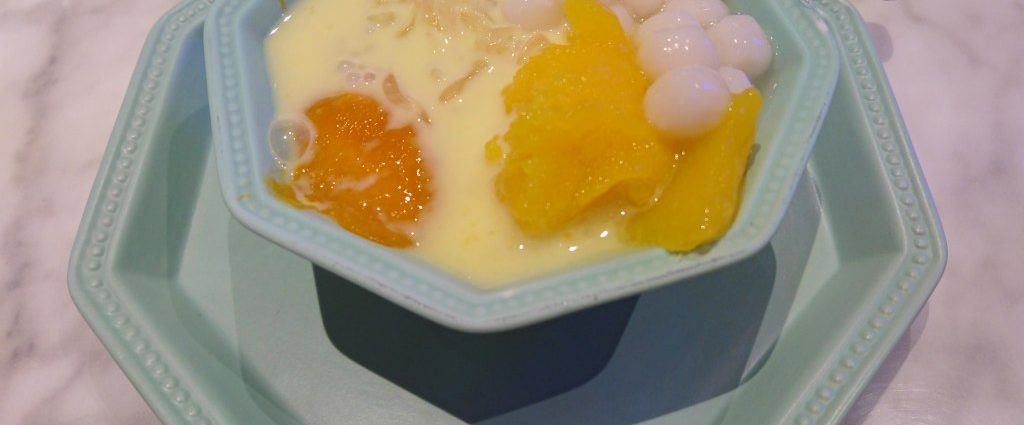
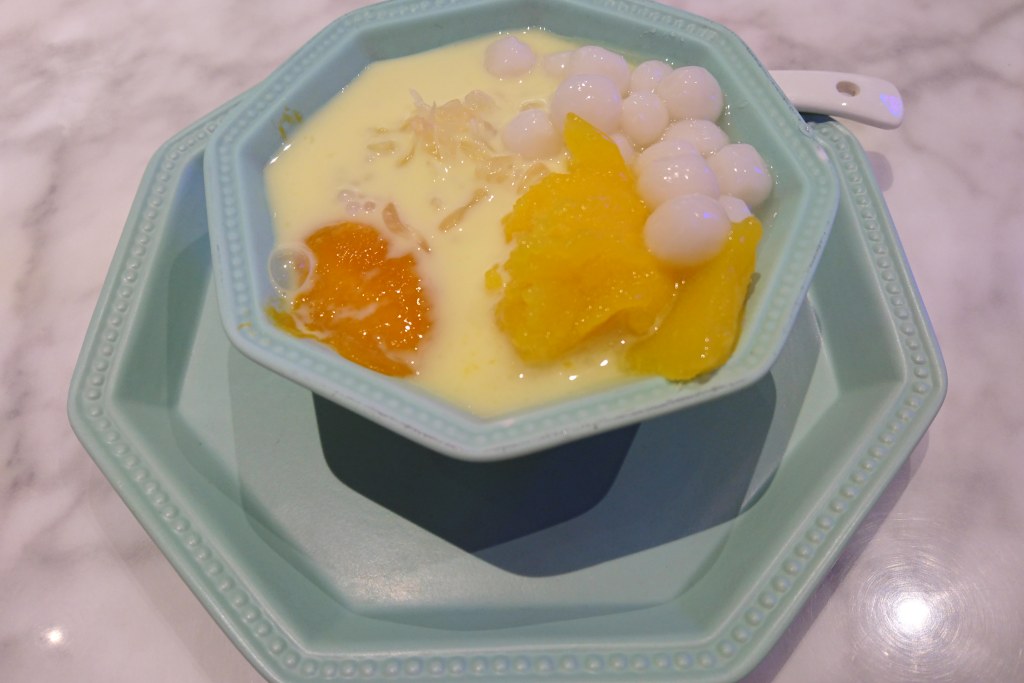
杨枝甘露 (mango pomelo sago) is Hong Kong’s most imitated dessert. A thick, chilled bowl of mango and coconut, studded with translucent sago pearls, mango cubes and the tart little sacs of pomelo that stop the whole thing from turning into a smoothie. It is sweet without being heavy, and it is served cold in a city that understands cold desserts better than almost anywhere.
It is also a genuinely modern dish — not an ancient recipe — and it has a birthdate, a birthplace and an inventor.
杨枝甘露 is a chilled Hong Kong dessert made from a base of blended mango, coconut milk and evaporated milk, folded with cooked sago pearls, diced mango and hand-separated pomelo sacs. It was created in 1984 at the Lei Garden restaurant in Hong Kong. It is not the same as plain mango sago (芒果西米露) — the pomelo is what makes it 杨枝甘露, and it is not vegan unless you swap the evaporated milk for coconut cream.
Invented in 1984, in Hong Kong
Most Chinese dishes have no author. This one does. 杨枝甘露 is commonly credited to 利苑 (Lei Garden), the Hong Kong restaurant group, which introduced it in 1984. From a single kitchen it spread across the territory, then across the border, then into every bubble tea shop on earth as a drink.
That origin matters for a practical reason: because the dish is recent and well documented, the “classic” version is not a matter of regional folklore but of a specific recipe — a mango-and-coconut base, sago, and pomelo. Once you know that, the variations make sense as variations rather than as competing traditions.
The Name Is a Buddhist Image
杨枝甘露 is one of the few Chinese dishes whose name is a metaphor rather than a description. 杨枝 means “willow branch” and 甘露 means “sweet dew”. In Buddhist iconography, 观音 (Guanyin) holds a willow branch and sprinkles sweet dew to relieve suffering and bring refreshment.
The dessert was named for that feeling — something cooling and restorative — rather than for anything in the bowl. It is the same instinct that names a drink “nectar” in English, and it tells you what the dish is for: hot weather, and the end of a heavy meal.
Mango Sago vs Mango Pomelo Sago
These get confused constantly, and the difference is a single ingredient. 芒果西米露 — mango sago — is the simpler, older idea: mango, milk, sago. 杨枝甘露 adds pomelo.
That addition is not decoration. Mango is sweet and soft; coconut milk is rich; sago is chewy but neutral. Without something sharp, the bowl is cloying. The pomelo sacs burst with a clean, faintly bitter tartness that cuts straight through the richness, and their slight crunch gives the dessert a third texture alongside the smooth base and the chewy pearls.
Which is why, if you leave the pomelo out, you have not made a lighter version of 杨枝甘露. You have made a different dessert.
Why Pomelo and Not Grapefruit
Pomelo (柚子) is the largest citrus fruit and the ancestor of the grapefruit. Its sacs are bigger, firmer and easier to separate by hand, and its flavour is milder — sweet with a gentle bitterness rather than the sharp, almost medicinal bite of grapefruit.
Traditional Cantonese versions use 沙田柚, a pale-fleshed pomelo prized for its sweetness. In practice, many restaurants now use grapefruit (西柚) because its pink colour is more striking in photographs and its tartness is more pronounced. Both work. If you use grapefruit, taste as you go — you may want slightly more sugar in the base.
Ingredients and Where to Find Them
- Mangoes — 3 large ripe ones, about 800g; the sweeter the fruit, the less sugar you need
- Sago — 80g of small sago pearls (西米), not the large boba size
- Coconut milk — 200ml of full-fat coconut milk, not a light version
- Pomelo or grapefruit — 1 pomelo or 1 grapefruit; canned pomelo sacs are a reliable fallback out of season
Also needed: 100ml of evaporated milk, 2–3 tablespoons of sugar to taste, and optionally a splash of cream for richness. Nothing else — this is a five-ingredient dessert.
Prep: Cooking the Sago
Sago is where most attempts fail, and the failure is always the same: overcooking.
- Bring about 1.5 litres of water to a rolling boil. Add the 80g of sago and stir so the pearls do not stick
- Boil for 10–12 minutes, stirring occasionally, until the pearls are almost fully translucent with just a tiny white dot left in the centre
- Turn off the heat, cover the pan, and let it stand 5 minutes. The residual heat finishes the pearls without turning them to paste
- Drain and rinse under cold running water until the pearls are cool, then drain thoroughly. This stops the cooking and washes off surface starch — skip it and your dessert turns gluey
Cook: Building the Base
- Peel the mangoes. Set aside about a third, cut into 1cm cubes, for folding in later
- Blend the remaining mango with 200ml coconut milk, 100ml evaporated milk and 2 tablespoons of sugar until completely smooth
- Taste the base. It should be slightly sweeter than you want the finished dessert, because the sago and pomelo will dilute it
- Peel the pomelo, separate the segments, and pull the sacs apart with your fingers, removing every trace of the white pith, the membrane and any seeds
- Fold the drained sago into the mango base, then gently stir in the mango cubes and the pomelo sacs
- Chill for at least 2 hours. Serve in bowls or glasses, topping each with a few extra mango cubes and pomelo sacs
Troubleshooting: Why Your Sago Went Mushy
- Sago turned to paste — it was boiled past the white-dot stage, or never rinsed. Pull it early and shock it in cold water
- The whole thing is gluey — the sago was not drained properly before folding in. Drain it until it stops dripping
- Too sweet and flat — mangoes vary enormously in sugar, and supermarket ones are often under-ripe. Start with less sugar and add pomelo rather than more sugar
- Unpleasantly bitter — pith got into the pomelo sacs. Every scrap of white membrane has to go; it is the only bitter thing in the recipe
- Watery and separated after chilling — the base was not cold before the sago went in, or the coconut milk was a low-fat brand. Chill the base first and use full-fat
How to Serve It
杨枝甘露 belongs to the Cantonese 糖水 tradition — sweet soups and chilled desserts eaten at the end of a meal or as an afternoon pick-me-up, and it works as both. Serve it well chilled in small bowls or tall glasses.
On a Cantonese table it comes after the roast meats: my Roast Duck 烧鸭 and Char Siu 蜜汁叉烧 are exactly the kind of rich dishes this cuts through. For other Cantonese sweets, see my Double Skin Milk 双皮奶 and Hong Kong Egg Tart 蛋挞 — or, if you want the Sichuan equivalent of a cold summer dessert, my Bingfen 冰粉.
Frequently Asked Questions
What is the difference between mango sago and mango pomelo sago?
The pomelo. Mango sago (芒果西米露) is mango, milk and sago pearls. Mango pomelo sago (杨枝甘露) adds hand-separated pomelo sacs, which bring tartness, a little bitterness and a third texture. Without them you have a different, sweeter dessert.
Can I use grapefruit instead of pomelo?
Yes, and many restaurants do — grapefruit is tarter and pinker. Use it if you prefer a sharper dessert, but taste the base first, since grapefruit may need a little more sugar to balance.
Who invented mango pomelo sago?
It is commonly credited to 利苑 (Lei Garden), the Hong Kong restaurant group, which introduced the dessert in 1984. Unlike most Chinese dishes, it has a known origin rather than a folk history.
Is mango pomelo sago vegan?
Not as traditionally made — evaporated milk is a dairy product. To make it vegan, replace the evaporated milk with an equal amount of coconut cream and check that your sugar is not bone-char filtered.
More Cantonese Favorites to Try
Build the rest of the table with White Cut Chicken 白切鸡, Steamed Fish 清蒸鱼, Wonton Noodles 云吞面, or the Hong Kong classic Typhoon Shelter Crab 避风塘炒蟹.
Photo: Ceeseven via Wikimedia Commons, CC BY-SA 4.0. Adapted by cropping and resizing.
As an Amazon Associate, I earn from qualifying purchases. These are affiliate links at no extra cost to you.